

Prescot Road, Persimmon, c Google Earth

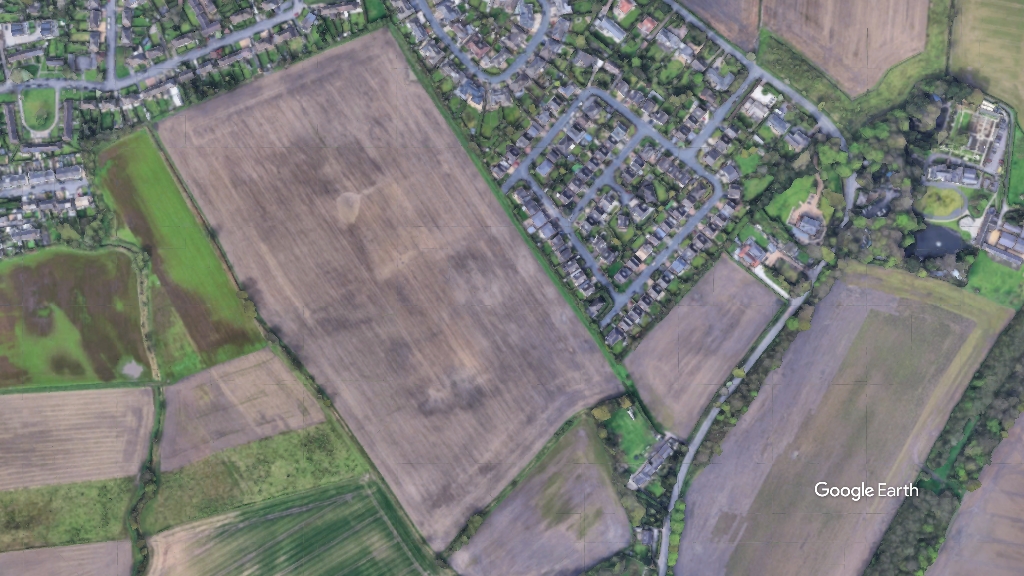
The site is considered by the housebuilder to meet the criteria for Green Belt. Credit: Google Earth

Persimmon lodges 300-home West Lancs proposal

Thirty-four acres of Green Belt off Prescot Road in Aughton are the subject of plans for a residential development featuring 150 affordable properties.

Persimmon Homes and landowner WCK Farming have submitted outline plans for the 300-home development with West Lancashire Council, claiming that the site – which is south of Whalley Drive and west of Sefton Gardens – meets the criteria for Grey Belt.

Around 11 acres of the 34-acre site would be retained as green space, according to the plans.

Persimmon will think it has a good chance of securing approval for the project. West Lancs cannot currently demonstrate a statutory five-year housing land supply following the government’s upping of its annual housing target to 562, which means a refusal of the plans could be tricky to defend at appeal.

In 2025, Wain Homes secured approval for 137 homes on a nearby site just a few years after plans for a residential development on the same plot were rejected by the council and the Planning Inspectorate.

The change in outcome demonstrates how national planning policy and West Lancashire Council’s supply position have shifted over recent years.

PWA Planning is advising Persimmon and GTD and Urban Green are leading on design. To learn more, search for reference number 2026/0544/OUT on West Lancashire Council’s planning portal.
Your Comments

Read our comments policy

This isn’t grey belt unless you believe in fairies it’s grade 1 agricultural land. Should be laughed at and thrown out. Is there an agricultural impact assessment, thought not.

By Anonymous

It is extraordinary that this could be described as “Grey Belt ” It is not ! It is Green Belt BMV Land .Single access for 300 houses is proposed through one existing road contrary to Road Planning criteria .The cumulative effect of this and other proposed and likely applications in Aughton are not sustainable by any metric . WLBC must get their act together and oppose or seek to defer pending Local Government Reorganisation and the completion of a New valid Local Plan for the new district to be know as “South Lancashire “

By Ian F

I’ve no idea if this is grey belt land or not. What I do know is that its agricultural value is completely irrelevant as to whether or not it is. Unsure of my statement? Go and read the document which tells you the five purposes of Green Belt and provides a definition for grey belt.

The impact of development on the agricultural land is something that would still need to be addressed, but it’s nothing to do with grey belt.

By Not again

This is why I don’t really get the “we need to stay in Lancashire to protect the Green Belt” argument. These applications are happening now because of national housing targets, not because of Merseyside.

I honestly think at some point it’ll click that this whole “South Lancashire” idea is just a facade. If it won’t stop development anyway, what’s the point? Why not join the Liverpool City Region instead, where we already have the strongest day-to-day links, and actually benefit from city region investment rather than being lumped into a made-up authority that doesn’t really reflect how people live?

By Anon

the government really need to be more specific as to what qualifies as grey belt. It should not be left to developers to determine just because they fancy a bit of green belt land

By Jon P

Spot the fake Lancastrian in the comments

By Scouse with a mask

Although they claim it’s grey belt due to growing turf or nothing, it’s actually the soil that counts and it’s grade 1. Therefore the council or Inspector would be correct in refusing permission. The developer has been badly advised and look elsewhere.

By Anon

Anon 1:59 August 4th. Yep, they’re still sorting through the mess caused by the 1974 rearrangement. I just wish there was a joined up way of thinking across the whole region, instead of leaving some as hostages to imaginary council lines.

By Anonymous

1.59 anon, only in your head. Trust me nobody would willingly join Merseyside if they could avoid and it looks like we can.

By Anonymous

Jon P and anonymous. What is grey belt is defined for you. And despite me pointing out that the agricultural value of the land is irrelevant to whether it’s grey belt, we have someone still banging on about its agricultural value. I’ll repeat that, not knowing the site, I can’t say whether I think it is or isn’t grey belt. What I do know is that if I was the planning authority and I refused it on the basis that it wasn’t grey belt because of its agricultural value, I’d be costing my authority a lot of money in costs.

By Not again, again

Yet again more housing on farm land. No extra infrastructure like schools, doctors and dentists. It seems that developers are just hanging around like vultures looking at anywhere to build houses. No thought for pressure on roads or facilities

By Ruth dean

@ not again again, check the rules te grade 1 agricultural land , it trumps any building on it by speculation as in this case. Your Officers badly advised you.

By Anonymous

Government stats note that 30% of houses in West Lancashire are empty so why are there planning applications here, Prescot Road and Blackmoss Lane for 100s more on grade 1 land? The council need to contact the government to enforce a moratorium until this can be professionally analysed and a sustainable plan produced. Never mind 5 year supply this was the product of a development consultant employed by the last government.

By Jim

Yet again there’s someone claiming 30% vacancy of stock with absolutely no reference to where the figure has come from. Last time I asked someone to support this claim they never replied, which was unsurprising because I’d found the figure and it wasn’t even close to double-figures, never mind 30%. But let’s see if anyone can provide the link to the government stats referred to…

By Numberwang

Speechless!!!

By Anonymous

@ numberweg – yes I thought that and found the source out of interest. It’s a national government stat on the Lancashire website – they say it’s higher. The problem is inspectors are told to ignore it which beggars belief – if you have excess supply of anything you don’t add to it, basic economics. https://www.lancashire.gov.uk/lancashire-insight/population-and-households/households-and-housing/vacant-dwellings/

By Frank

Frank, that doesn’t say over 30% of dwellings are vacant. It says *of vacant dwellings* x% are *long term* vacant. That is nothing like the same thing. I’ll be generous and say this is misreading of the facts rather than a deliberate attempt to mislead.
Some level of vacancy is necessary to ensure the housing market actually works (as far as it does anyway). Around 2.5-3%. The issue is generally not vacancy per se, but the number that are long-term vacant. Even then, they are often caught up things councils can do nothing about – probate, for example. It’s rarely of a scale that justifies refusing housing applications though. I can’t see that this is the case here, either. That is not to say it should be approved – that’s not my call or my point. I’m just saying arguing that there’s stacks of vacancies isn’t supported by the facts, so using to try to refuse it on that basis would indeed result in the Inspectorate giving it little to no weight.

By Numberwang

@ August 04, 2026 at 1:59 pm
By Anon

Because West Lancashire preferred to team up with South Ribble and Chorley. Maybe – just maybe – they don’t want to be part of the Liverpool City Region.

As for this housing proposal. Firstly – the name doesn’t inspire hope. Secondly, West Lancashire – and the future South Lancashire Unitary should seek a sustainable urbanisation model à la Create Street. Gentle density of town houses that use less land.

By Rye

Will any actually be affordable homes and I don’t mean shared ownership

By Julie

@numberweg – I just looked for the source, your right re the stats but I can see how they can be misinterpreted. The problem with West Lancashire is the number of speculative schemes which some have noted. Massive increase in supply which is the point I was trying to make – makes a mockery of the planning sector.

By Frank

Related Articles

Sign up to receive the Place Daily Briefing

Join more than 13,000+ property professionals and receive your free daily round-up of built environment news direct to your inbox

Subscribe

Join more than 13,000+ property professionals and sign up to receive your free daily round-up of built environment news direct to your inbox.

By subscribing, you are agreeing to our Terms & Conditions and Privacy Policy.