


How Cheshire and Warrington mayoral candidates plan to solve the housing crisis
Labour’s Dan Price and Conservative’s Ben Fletcher agree on one thing: building homes must be a priority for the future leader of the sub-region. How they approach the issue, however, is different.
Price and Fletcher are the two main candidates vying to become Cheshire and Warrington’s first Mayor, a post that will be up for grabs during next year’s May election. As Mayor, they will have the county’s 30-year, £650m devolution package at their disposal to drive growth.
Fletcher’s background is in the retail industry, having had C-suite roles at Boots, Clarks, and The Very Group. He’s a confident and structured speaker and you can tell he’s comfortable holding court at board meetings or lobbying government. His focus, he told Place, is on economic growth, revitalising towns and villages, and bolstering civic pride.
Price is the police and crime commissioner in Cheshire and was a councillor for 10 years. He is a former engineer, having started his career at Unilever. Price has an easy manner to him alongside a near tangible eagerness to get things moving. He describes himself as a problem solver and he told Place North West he was ready to hit the ground running to help drive economic growth, revive towns, and deliver more homes.
Place North West interviewed both about how they would approach housing in the sub-region.
What they agree on
Housing in Cheshire and Warrington is too expensive, particularly for young people. The average house price in Cheshire East, for example, is £309,000, according to the Office of National Statistics. Meanwhile, the average salary is £47,800.
Common guidance is that a house should be about 4.5 times your annual salary, putting the average home out of bounds for the average wage earner in Cheshire East, where it’s more like 6.5.
In fact, regardless of where you go in Cheshire and Warrington – nowhere does the average house price amount to less than five times the average salary.
The current planning and consultation system is broken. In Cheshire and Warrington, development has become bullish, with communities unable to effectively push back against unwanted projects due to inevitably losing the argument at appeal because of the area’s shortage of housing land supply. The result is that residents and developers are locked in combat.
“Nobody is happy with how it’s working,” Fletcher told Place North West. “Meanwhile, the prospect of owning a home recedes and town centres decline.”
Fletcher and Price are clear that this cannot stand and that the system should be more collaborative. The only way to this, they both argue, is through having better consultations where the public can meaningfully engage and have more ownership over what is built in their area.
They also cited the mayoral powers of convening as a way to bring groups together, as well as the sub-regional spatial strategy as a method for providing an overarching place strategy.
Crewe should have a Mayoral Development Corporation. Regardless of who wins at this point, Crewe will likely become the area’s first MDC. Both candidates highlighted its vast potential and identified its growth as a priority. They also agreed that the MDC would help increase the number of homes in Crewe.
Villages need a lifeline. Cheshire’s villages are its pride and joy – but they must grow. They need young people to move into them, to breathe new life into their high streets and pubs and keep them the beautiful places that current residents love so much.
Brownfield land should be developed first. Here, Labour’s Price is more flexible than Conservative candidate Fletcher, noting that some politicians seem to be “magicking enough brownfield land” for housing. He owned that while brownfield should be prioritised, it should be possible to have honest and open conversations about small plots of greenfield land on the edge of villages and towns.
The differences continue when it comes to the actual delivery mechanisms to resolve housing issues.
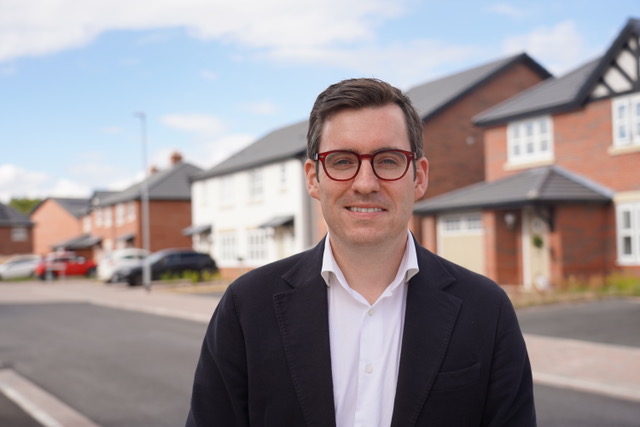
Dan Price is the Labour candidate to become Mayor of Cheshire and Warrington. Credit: via Dan Price’s mayoral campaign
Price’s plan
Price has a flagship, focussed policy: the Mayoral Homes Programme.
Through this programme he says he would enable the building of 1,000 homes for under-35s during the first mayoral term.
Some of these homes will be for rent, but supercharging home ownership would be the main driver.
These homes, he contended, would be “genuinely affordable”. He clarified that he was not using the government term for affordability (20% below local market value) but instead looking to replicate the ratio that existed when he bought his first home approximately 20 years ago.
At that time, he was an apprentice engineer for Unilever with a salary of £25,000. He bought his home in Cheshire for £113,000 – right in line with the recommended 4.5 ratio.
“I got on the ladder, and it set my life up,” he said. He pointed out the discrepancies around house pricing and wages today.
“Home ownership has been out of reach for a long period of time,” Price said. “Now it’s become out of sight.”
His homes for under-35s plan would change that.
“This is a serious challenge,” he said. “But my professional background as an engineer means I do like problems to solve.”
A strategic approach
Expect a design competition to be launched within the first 100 days to create the standardised, but flexible design for these homes. Price has a vision of predominantly two- to three-bed properties with attics or basements that could become additional bedrooms if needed.
While some may decry having a standardised design, Price thinks having a common look presents a series of opportunities. It enables delivery at scale for lower costs. And it would provide physical proof to the public that work is being done on improving housing options for young people.
“This is all part of showing the public that public services can respond to this problem, as opposed to a lot of people thinking it’s more snake oil or another failed promise,” Price said.
Plus, a standardised design does not have to mean low quality, he contended.
“I drive around this county all the time and I see hundreds of houses that were built to a very high standard that are identical and have stood the test of time,” he said. “Those are the houses that people want to move into more so than the new-builds…
“I think what people want is spacious homes with great light that they can have a family in and can put down roots – and it has to be affordable.”
Price’s homes would be built in small developments of between 10 to 30 homes on smaller parcels of land.
Public sector-owned brownfield sites would be prioritised, with an emphasis on projects near villages.
For each development, around half would be reserved for those who already live within two miles.
Renovations and conversions are also on the cards, with not every one of his proposed homes having to be new-builds.
The Mayoral Homes Programme would be delivered by registered providers and ethically minded developers, he said. Price pledged to personally vouch for these projects, challenging planning committees that are minded to reject applications.
This plan is just the starting point for Price’s housing policies. He said he was open to hearing from the property industry.
“I’m excited to hear from some of the best minds that we’ve got in this space,” he said. “I’m talking about this because I think it’s one of the biggest problems that we’ve got, and I want the business community to help solve it.”

Ben Fletcher is the Conservative Party candidate to become Mayor of Cheshire and Warrington. Credit: via Ben Fletcher’s mayoral campaign
Fletcher’s vision
Fletcher wants to see 50,000 homes built or having achieved planning permission by the end of the first mayoral term.
It is a lofty goal, he admits, but he said he wants to challenge the system.
In the four years between 2021 and 2025, the government’s Housing Delivery Test showed that in Cheshire and Warrington only 18,166 homes were built.
Fletcher’s approach focuses on enabling development more so than driving it – although that may change when he formally launches his housing policy at this year’s Conservative Party Conference.
Speaking to Place, he outlined how he would create the environment for high-quality housing delivery.
First, he would create the Mayoral Investment Office. This would be charged with securing private and public sector investment for the sub-region. It would spearhead the Cheshire 2040 Fund – Fletcher’s answer to Greater Manchester Combined Authority’s Good Growth Fund (“I don’t know what ‘good growth’ is – I just want growth,” he told Place).
This fund would be used to make town centre regeneration projects, which would include gentle housing density proposals, off the ground.
Gentle density is the way forward, according to Fletcher, who promotes the idea of mixed-use buildings with leisure and retail occupying the ground floor and apartments on the upper ones.
“Every successful urban regeneration has had, at its heart, a way to put people back into the town centre,” Fletcher said.
He added that this would create a sense of community, help meet housing needs, and bring in the crucial footfall that businesses need to succeed.
“I know from running retailers nationally and signing off investments for shops that the first question you always ask is ‘where is the footfall coming from?’ This helps answer that question,” he said.
Next, Fletcher would install three MDCs to drive strategic, place-centred development. The first would be Crewe, as mentioned previously. The other two would be Warrington West & Centre, running from Fiddlers Ferry to the town centre, and Ellesmere Port.
Each MDC would be required to treat social housing as integral to their plans for their coverage areas, with it weaved into spatial strategies rather than bolted on.
Reviving towns and villages
Moving from the wider MDC territory, Fletcher would require each town in Cheshire and Warrington to draft a Town Revival Plan.
This would be made through comprehensive public engagement and contain opportunities for increasing housing density. The plan would include a design code for the town and plans for shared civic spaces. Heading up this team would be a town revival commissioner, who would receive support from the Mayor’s Investment Office.
Villages would have a similar initiative, with a £1m Mayoral Parish Improvement Fund that would allow parishes to bid for cash to improve their community. This cash would not have to go through standard local authority procurement processes, Fletcher said. It would have strings attached to it, though.
To participate in the fund, there would be a village plan that, like its town counterpart, would need to identify land appropriate for development with a goal of increasing the housing stock in the village by 1% each year. This should help the increase in housing feel organic, with it delivered in a way that public infrastructure is not overwhelmed.
The plan would also have a design code. Should a developer draft a plan that complies with the code, the parish council would agree not to object to the application.
Fletcher’s preference for design codes – in addition to his town and village design codes, he believes there should be one for social housing too – is rooted in his belief that places should be visually appealing.
“I believe that everyone, irrespective of their circumstances, has a right to live beautifully,” Fletcher said. “It doesn’t matter what your economic background is, you shouldn’t have to live in ugly buildings.”
With Prime Minister Andy Burnham having put housing delivery – especially social homes – at the forefront of his agenda, one can expect the conversations around housing to continue in the lead up to May’s elections.