



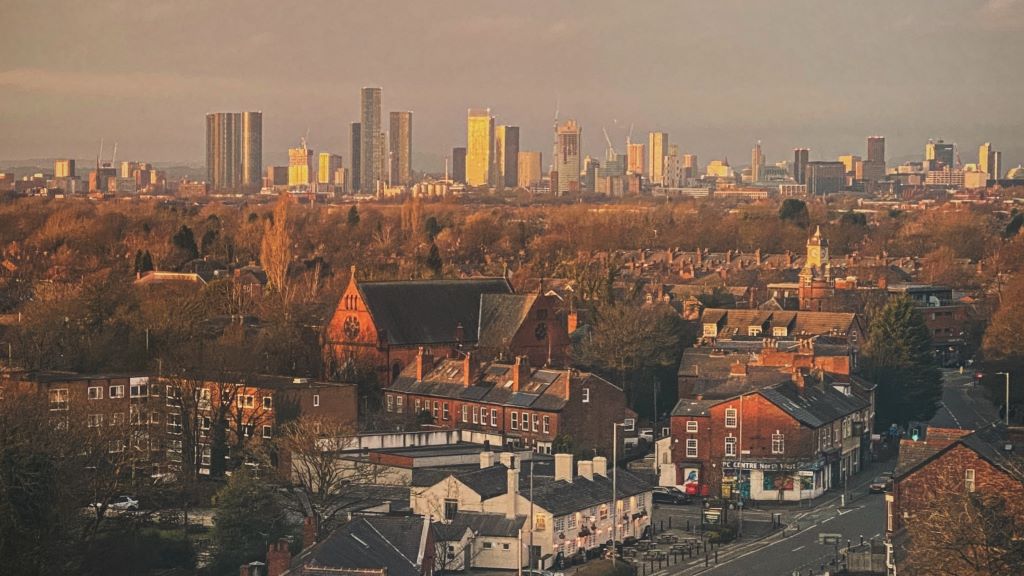
Manchester to enshrine increased affordable ask in updated local plan
The city council plans to up the amount of on-site affordable housing it asks developers for from 20% to 30% in a bid to hit its target of delivering 10,000 discounted homes across the city by 2032.
Manchester City Council is undertaking a statutory review of its local plan – the 15-year strategy document that guides development across the city.
In line with the Places for Everyone joint spatial strategy for Greater Manchester, the city council’s local plan will set out how to reach the target of 3,533 homes per year.
In addition, Manchester is looking to increase the delivery of affordable housing in line with its own target to build 10,000 such properties by 2032.
To do so, the local plan will formally increase the target of affordable homes it seeks to secure from developers on site from 20% to 30%.
The draft local plan states: “It will be expected that 30% of homes in major schemes (10 or more homes) will be affordable. Developers are expected to use the 30% target as a starting point for calculating affordable housing provision.”
It is hoped that across the city 70% of this 30% would be for social rent.
In theory this would mean that a 100-apartment scheme would feature 30 flats available at a discounted rate with 21 being for social rent.
However, this increase in policy terms might struggle for impact in reality given that many developers, especially within the city centre, claim delivering any affordable homes on site makes projects unviable.
The city council has come in for some criticism from commentators for failing to squeeze some developers for affordable housing contributions for projects in the heart of the city.
However, the authority is picking up some of this slack, delivering more council and social homes last year than it has done at any other point in the last decade, according to Cllr Gavin White, Manchester City Council’s executive member for housing and development.
White said the refreshed local plan would reflect Manchester’s “huge ambitions”.
“The Local Plan helps guide appropriate development in the city to make sure that it supports Manchester’s growth and provides a blueprint for development going through the planning process,” he said.
“In order to meet our housing ambitions, we are consulting on increasing the percentage of affordable housing required, to bring it in line with our existing housing strategy.”
“Importantly it sits alongside other key strategies, such as our housing strategy, and helps us meet our ambitious plans for Manchester’s growth and success over the next 15 years – how we attract business, create jobs, build homes and ensure our residents share in the success of our city.”
Consultation on the draft local plan will begin later this month.
Should be 90%
By Anonymous
What is the point of increasing the ‘requirement’ if they can’t even secure the current level
By Anonymous
Viability assessors are going to be busy
By Anonymous
Yet more far left and entirely self defeating utter nonsense from the Liebour party . They are clueless and deluded . And who will these homes be going to exactly . Will they be for actual Mancunians ? We all know the answer to that – a big fat no .
By Anonymous
Affordable. Affordable housing is not affordable.
By Salford Born and Bred.
Most I review are barely viable with any affordable, so what is the point? All it does is pander to their voter base and significantly slow down planning timelines & costs, but doesn’t actually deliver genuinely affordable homes.
By Anon
The draft Local Plan text for draft policy H2 makes no reference to what constitutes an acceptable development profit to determine scheme viability.
Presumably politicians think they can suppress the existing levels of development profit (currently 20%) . If they do don’t expect to see many more towers built in the city centre.
As for the 90% suggestion…………….
By Anonymous
You can set out how to reach the requirement although whether the market can provide based on a brownfield first, apartment led housing provision is another thing. To date most viability assessments are suggesting they can’t provide any on these city centre schemes. Also,I suspect there will be a kickback from the ‘creative class’ city dwellers and forward funders to having social renters in the same block despite their supposed environmental, social and governance credentials
By Utopian dreamer
Utter nonsense, as their currently policy is argued away at every corner under viability grounds unless it is delivered by RPs with grant funding! They should stop trying to force these mixed blocks, take what they can through S106 agreements under their current policy and focus on delivery of affordable homes directly through RPs, where it makes the most sense and they’re set up to manage these tenures as well as having a strong track record of delivery in the region.
By Anonymous
Anonymous 11.54 – if private developers were required to build 90% of their projects as affordable they wouldn’t build any housing. It isn’t rocket science.
Anonymous 1.05pm I could explain why Manchester people will get allocated these properties by explaining the local plan, section 106 agreements and nomination rights but you wouldn’t understand it, so I won’t.
The main issue is that private developers will challenge the 30% figure on viability grounds, so it’s unlikely the affordable properties will get delivered in these numbers anyway.
By Anonymous
Don’t be greedy or unrealistic, you’ll probably find that the developments which are already saddled with increased regulation and extreme build costs will be reduced by a third, thus leading to no more additional affordable housing, than you’re already achieving.
By Lexi
Affordable. Affordable housing is not viable
By Alan Partridge
Landowners should be taking a haircut to fund this – simple as.
If this is baked in at the start and actually enforced land values will adjust.
By Anonymous
What many don’t get is that the more you increase the affordable housing requirement, the less attractive it is to developers to develop in your city and the fewer houses – including affordable houses – will be developed. It is entirely possible to increase the affordable requirement and drive down the overall numbers such that you end up delivering fewer affordable houses overall.
By John
If any council anywhere in the country ever actually enforces the agreements that they and their Developer Friends make in order to make their plans slightly more acceptable I will be absolutely amazed.
They propose ‘Affordable Housing ‘, Infrastructure Improvements, Investment in Local Facilities, Greenspace Access, Access to Public Transport and anything else that sounds good. Then as soon as they have Planning Permission the Council start allowing changes, hidden in the small print, to the commitments made during the detailed planning which is done on an ongoing basis and the local population have run out of steam.
The simple solution to this is to make the Developers put up all the money for their commitments, including a contingency, before the plans are even put before the planning committee.
By Anonymous
They are took good at ducking out of it… oh dear
By Renaker won't
Have they published a viability study or is this just kite flying?
By UnaPlanner
Staggering ignorance abounds from those most assured of their knowledge.
Others have picked up some of the nonsense, but Anonymous @2.44pm might want to understand how finances work before offering self-confessed simple solutions to complex issues. Aside from the fact you can easily find many examples of schemes delivering what was required, and whilst I’m not here to defend developers who certainly will try to play the system, it’s difficult to extract all of the money from a scheme that hasn’t generated any money. Or perhaps, to use an imperfect comparison, anonymous assumes people should pay off all of their mortgage before they’ve earned any money?
By Green Belt Ben