



Commentary
Why workplace strategy can’t wait
As many of the UK’s property professionals prepare to head to UKREiiF, there promises to be plenty of scope for robust conversations about what really matters when it comes to strategically reimagining office space to underpin business objectives, writes Dan Pilling of TSK.
Typically, TSK works with property professionals and/or their professional advisers to deliver expert workplace strategy projects of scale. During a busy few days at UKREiiF, there will be three main points I will be reiterating to deepen understanding about why getting a succinct and solid strategy in place matters.
Looking beyond the balance sheet
In workplace terms, Return on Investment (ROI) brings with it a myriad of complicated discussions from various perspectives of a business. Historically ROI measurement has been predominantly assessed by comparing measurable financial benefits like revenue per employee, utilisation improvements or retention gains against total occupancy and capital investment costs over time.
This thankfully has evolved, and instead, we’re presented with the real opportunity: shifting the conversation from ROI to a broader “return on what matters.” It’s an important and distinct recognition that workplace decisions influence people, performance, environmental impact and organisational resilience. These outcomes don’t always appear directly on a balance sheet, but they shape how effectively organisations operate and compete.
Therefore, in my view, ROI is best interpreted through different lenses: Economic performance – capital efficiency, lifecycle cost and long-term financial risk; Human potential – engagement, culture, organisational capability and talent retention; Sustainability – environmental performance, regulatory exposure and long-term resilience.
These aren’t competing definitions of return. They’re different facets of the same conversation, and all help to make strategic workplace decisions which help to bring together every part of the business to meet combined objectives.
The real risk and cost of inertia
Inaction is still a decision; and often an expensive one.
Doing nothing about the workplace is a decision that often carries hidden commercial, cultural and operational costs.
Few organisations actively choose a static workplace strategy. More often, they drift into one: lease events are deferred, refurbishments postponed, hybrid models left unresolved. Investment is delayed in pursuit of “more clarity,” all while the business continues to evolve.
My warning here is that what feels cautious quickly becomes costly.
1. Underused space still carries full rent and running costs without delivering value. Delayed upgrades increase maintenance and energy spend. Outdated environments can drive employee churn. Missed lease events reduce flexibility.
2. There’s also a strategic cost. Organisations constantly evolve, through growth, contraction or restructuring. A workplace that can’t flex becomes a constraint, limiting adaptability and increasing future risk.
3. Without a proactive strategy, businesses risk reduced employee engagement, limited flexibility under hybrid working, and greater volatility in future capital spend. The impact is not just financial, it affects resilience.
This isn’t about alarmism, but rather about intent. Every workplace decision – whether to expand, reduce, redesign or relocate – should be grounded in a long-term business plan.
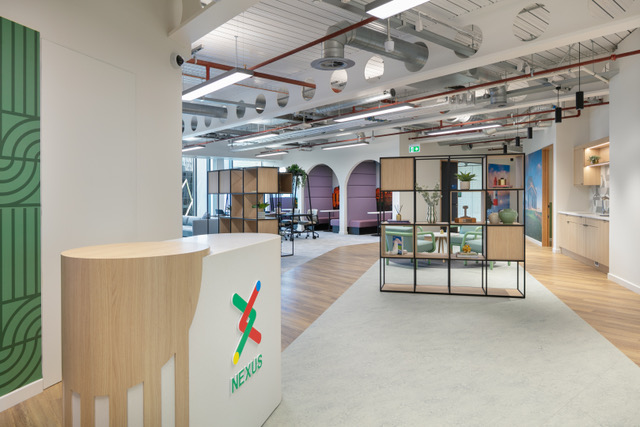
TSK worked with Nexus in the North East. Credit: TSK
Timing is everything
With limited office availability in major cities driving up demand and costs, organisations are increasingly faced with a choice: act early or delay. For the reasons above, early action wins.
And for the reasons I’ve set out above, I’d urge people to move early rather than wait. At TSK, we work with some of the biggest companies across the UK – Allianz, The Medical Protection Society, Brabners, The Post Office, Oliver Wyman and Dr Oetker to name a few – to implement workplace strategies early – to better inform what should come next.
The common thread is collaboration and planning, working closely with clients and their advisers to stay ahead.
So what do I mean by ‘early’? Well in my view, any company looking to secure their footing needs to be thinking a minimum of three years ahead for their workplace strategy. That may feel daunting but those firms that get ahead really do reap the rewards; they tend to find office occupancy is much healthier and their ability to attract and retain the best talent is strong.
I’m looking forward to some productive sessions at UKREiiF. If you’re attending, I’d welcome a conversation about how workplace strategy, design and delivery can create measurable value for your organisation.
• Dan Pilling is workplace strategy director at TSK.