



Commentary
How the Building Safety Act 2022 is shaping the UK’s residential developments
It’s been just under a month since UKREiiF returned to Leeds, which serves as a timely backdrop for reflecting on the continued strength of residential development across the North of England, writes David Sandbrook of Curtins.
That focus feels particularly relevant given the momentum in Northern residential markets. From city centre high-rise living to large-scale waterfront regeneration, the North West and Yorkshire continue to set the pace for new housing delivery, investment and placemaking. It’s a landscape Curtins knows well, with four offices across Kendal, Liverpool, Manchester and Leeds, and a portfolio of projects that reflects both the scale and ambition of the region.
Across these cities, developments are redefining how people live. In Manchester, Circle Square rises 36 storeys to deliver more than 400 luxury apartments with panoramic views across the city. In Leeds, Whitehall Riverside is reshaping urban living through two striking high-rise buildings that blend residential, work and social spaces. Meanwhile, on the Wirral waterfront, Millers Quay at Wirral Waters brings forward a vibrant, sustainable neighbourhood with a strong sense of identity.
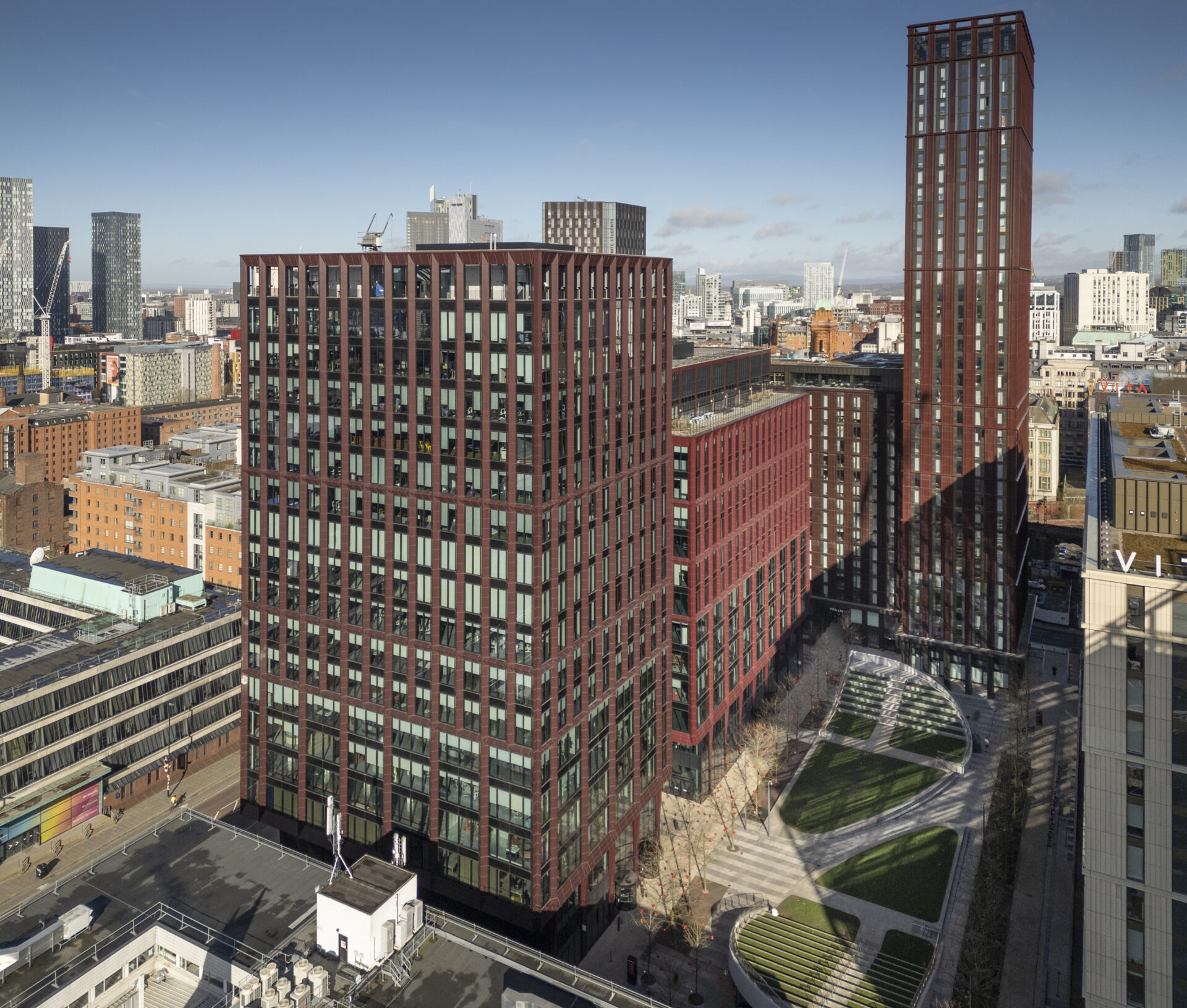
Circle Square, Manchester c, Paul McMullin
Together, these schemes highlight the depth and diversity of residential development across the North – and why the region continues to command attention, both during UKREiiF and well beyond it.
How the Building Safety Act changed the design process
In the life-span of all these major schemes has been a fundamental shift in how buildings must now be designed, documented and delivered. The introduction of the Building Safety Act 2022 has reshaped the industry for developers, designers and contractors, placing new emphasis on competency, accountability and comprehensive, early-stage design. A welcome regulation, and one that has put Curtins at the forefront of delivering new design, golden thread and Gateway requirements.
The BSA applies to all buildings but introduces a specialised and more rigorous process for High-Risk Buildings , which are those of 18 metres, or seven storeys, and above, with at least two residential units. In cities where student accommodation can tower, Build to Rent is expanding, and office-to-residential conversions are increasingly common, this captures a significant proportion of new development.
What the BSA means for HRB owners
This means that many of the most ambitious schemes must navigate Gateway 2 approvals with fully complete detailed design, stringent change control processes, demonstrable competency from all design teams and a robust Golden Thread of information maintained throughout a building’s lifecycle.
This is a major adjustment to tall building design and construction. Gateway 2 submissions must include all information that allows the building to be constructed, including construction ready drawings, calculations for all structural members, reinforcement intents and connection forces. Although design changes after Gateway 2 are allowed, they must pass through a formal change control process that has the potential to delay operations on site if not managed carefully.
Gaining clarity on HRB requirements
Curtins has been active in the UK for more than 65 years, helping shape major cities and towns city through landmark buildings, regeneration frameworks and major mixed‑use neighbourhoods. As the BSA continues to be embedded across the industry, our teams are working closely with clients, designers and contractors to prepare Gateway-ready design packages, provide clarity around HRB requirements, and build robust Golden Thread information for long-term asset management.
Earlier engagement will be key in the development pipeline. Our structural engineers, geo-environmentalists and transport planners can engage on sites from pre-acquisition for site due diligence and feasibility, all the way through to construction handover – providing our clients with assurance on competency, site knowledge and golden thread information.
As the residential market continues to expand the North and the rest of the UK, the Building Safety Act ensures that the quality and accountability behind that growth is just as robust and the tall buildings and infrastructure we design for.
- David Sandbrook is the business unit director at Curtins



One impact, not mentioned here, is that act has seriously impacted the viability of taller development, that over the 18m threshold, in many localities, meaning that town centre development is not always able to be delivered at densities which make the best of the location/setting.
By Anonymous
@June 09, 2026 at 1:29 pm
By Anonymous
I think you’re confusing density and height. Townhouses and mansion blocks allow for large amounts of ‘gentle’ density without taller buildings. See Paris, Kensington and Chelsea et al.
By Rye
Oh no elephant….that doesn’t sound like our dear old pachyderm…….some one must surely be mascarading as him. It would surely help to rebalance the community here
By Davo
@ June 09 2026at 3.02
Thats all fine in Paris, Kensington and Chelsea but we’re talking Oldham, Wigan and Bolton et al……bit of a difference when we look at values and viability !!!🤷
By Anonymous
June 09, 2026 at 3:41 pm
By Anonymous
I’m referring to the urbanism those places have. Ironically, your Oldhams, Wigans and Bolton’s use the very aforementioned gentle density I talked about, often in terraces and townhouses villas.
By Rye