Court orders Urban Splash companies to pay £46.5m for building safety work
Five organisations linked to the developer will have to pay the government the majority of the £60.6m incurred making fire safety improvements to seven buildings in Manchester.
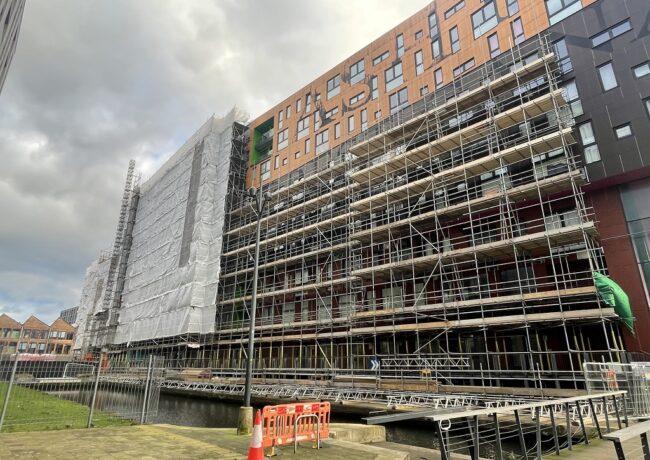
The buildings at the heart of the case are:
- Burton Place, Castlefield, Manchester M15 4LR
- Chips Building, 1 New Islington, Manchester M4 6BU
- Christabel House, Dalton Street, Manchester M40 7EH
- Emmeline House, Dalton Street, Manchester M40 7EB
- Moho Building, Ellesmere Street, Manchester M15 4FQ
- Sylvia House, Dalton Street, Manchester M40 7ED
- The Box Works, 4 Worsley Street, Manchester M15 4NU
The buildings in question were developed two decades ago, with several winning awards since then.
However, government inspectors found that they had considerable defects in terms of the use of combustible materials, cavity barriers, fire-stopping measures, and compartmentation that would prevent fire from spreading.
The government undertook the buildings’ remediation itself, using finances from the Building Safety Fund. Most of this money, the government had successfully argued, should be repaid by the developer.
Urban Splash contended it was not able to do so due to financial reasons and also that the work that was done cost more than it would have if Urban Splash had led the project.
The government disagreed, with the courts backing up arguments that Urban Splash, Urban Splash Developments, Urban Splash Group Holdings, Urban Splash Work, and Stubbs Mill LLP should all pay for the work.
Urban Splash having to pay is relatively straightforward – it was the developer of the seven buildings. The company underwent a restructure in 2013, at which point Urban Splash Developments emerged as the main vehicle for development business.
Urban Splash Group Holdings is the parent company, with the court decision noting that USGH had continued to keep the original Urban Splash around “because of the economic benefit of its accumulated tax losses.” The company’s leaders include a group the court referred to as “The Urban Splash Five”: Tom Bloxham, Nathan Cornish, Julian Curnuck, Jonathan Falkingham, and Simon Gawthorpe.
Urban Splash Work owns and manages property, however, the court found that its longstanding relationship with the Urban Splash company as a whole, including having had common directors; merited the inclusion in this case.
Stubbs Mill LLP seems like the odd man out of the line-up. It was established after the completion of the seven buildings and was focussed on another project: the transformation of an 1880s-built mill into 25,000 sq ft of commercial space.
However, the court agreed it was liable to pay for the remediation work because its leadership comprised of the Urban Splash Five. The court stated that by forming Stubbs Mill LLP, the Urban Splash Five were able to secure tax relief that Urban Splash itself wouldn’t otherwise been able to – and to invest personal capital outside of the main company. Stubbs Mill was also eventually acquired by Urban Splash.
A spokesperson for Urban Splash voiced the company’s disappointment over the choice to target the five organisations, noting that not all had played a direct role in the original development of the buildings.
“This illustrates the extraordinary and far-reaching consequences of ‘no-fault’ Building Safety Act which allows liability to extend beyond the original developer to associated companies which played no part in the original development of the buildings concerned,” the spokesperson said.
Government priced the remediation work as £60.6, inclusive of VAT. The government said it would only seek £46.5m in an acknowledgement of its own role in building safety.
Most of that money will go to the Ministry of Housing, Communities, and Local Government. The management company of Moho Building will receive £741,600, for the costs it incurred for bringing the complex into compliance.
The court’s statement noted that the argument that Urban Splash had “failed to do the right thing” in funding the remediation was not helpful.
“The issue is not whether a respondent met some undefined moral standard, but whether its conduct affects the fairness of requiring it to contribute,” the decision read.
“We accept that Urban Splash provided useful and responsible assistance with the post-Grenfell investigations into the safety of these buildings. But there is an important distinction between assisting those investigations and accepting financial responsibility for the resulting remediation, which [Urban Splash] did not do.
“Its present insolvency and the apparent difficulty of recovering contributions from others involved with the original developments do not outweigh the powerful case for requiring [Urban Splash], as developer, rather than the taxpayer, to bear the remediation cost.”
Urban Splash’s spokesperson said that “making buildings safe and protecting residents and leaseholders is of fundamental importance” to the company.
They added: “The scale of the liability identified by the tribunal is significant for a business of our size.
“Throughout these proceedings, we have continued to work closely and constructively with government. We are particularly reassured that government and its agencies have continued to support and fund a number of Urban Splash development and regeneration projects.
“Our focus is firmly on the future rather than the past.”
The spokesperson continued: “The challenges created by the Building Safety Act are not unique to Urban Splash. This is not simply about one company. It is about finding a way in which the objectives of building safety, housing delivery and regeneration can all be achieved together.
“The outcome of the tribunal means we are now seeking to implement and work through a plan in partnership with the government, and our other stakeholders. Our priority is to protect all stakeholder interests; preserve jobs and our valuable regeneration expertise; and maintain our capacity to deliver the much-needed homes and regeneration projects in our pipeline.”
Urban Splash has delivered more than 5,000 homes and 2m sq ft of workspace throughout its 30-year history.