




Commentary
The North West office market isn’t in decline – it’s being redefined
Rightmoveʼs Q1 figures: context matters
Rightmove’s Commercial Insights Tracker for Q1 2026 showed that nationally, demand to lease offices fell by 3% year on year, while demand to invest in office property declined by 9% over the same period. In the North West, meanwhile, leasing demand for offices fell by 3%, so mirroring the national average, but investment demand fell by just short of 20%, writes Andy Miles of Rightmove.
This obviously required a closer look at the figures. Going further back, it is clear that investment demand was exceptionally high in the first quarter of 2025, so this year’s figures were being compared to a very high base. Moreover, demand to invest in offices in the North West is still 59% higher than it was two years ago.
North West demand is shifting, not vanishing
What is unambiguous is that the nature of demand, both in terms of leasing and investment, is changing. The office market in cities such as Manchester and Liverpool is not shrinking in any simple sense. Instead, it is being reshaped—more selective, more polarised and arguably more purposeful than before.
Data from Savills, JLL and CBRE consistently shows that take-up remains broadly in line with long-term averages. Businesses are still leasing offices. The difference is that they are doing so on different terms. Deals are smaller, decisions take longer, and the emphasis has moved away from quantity towards quality.
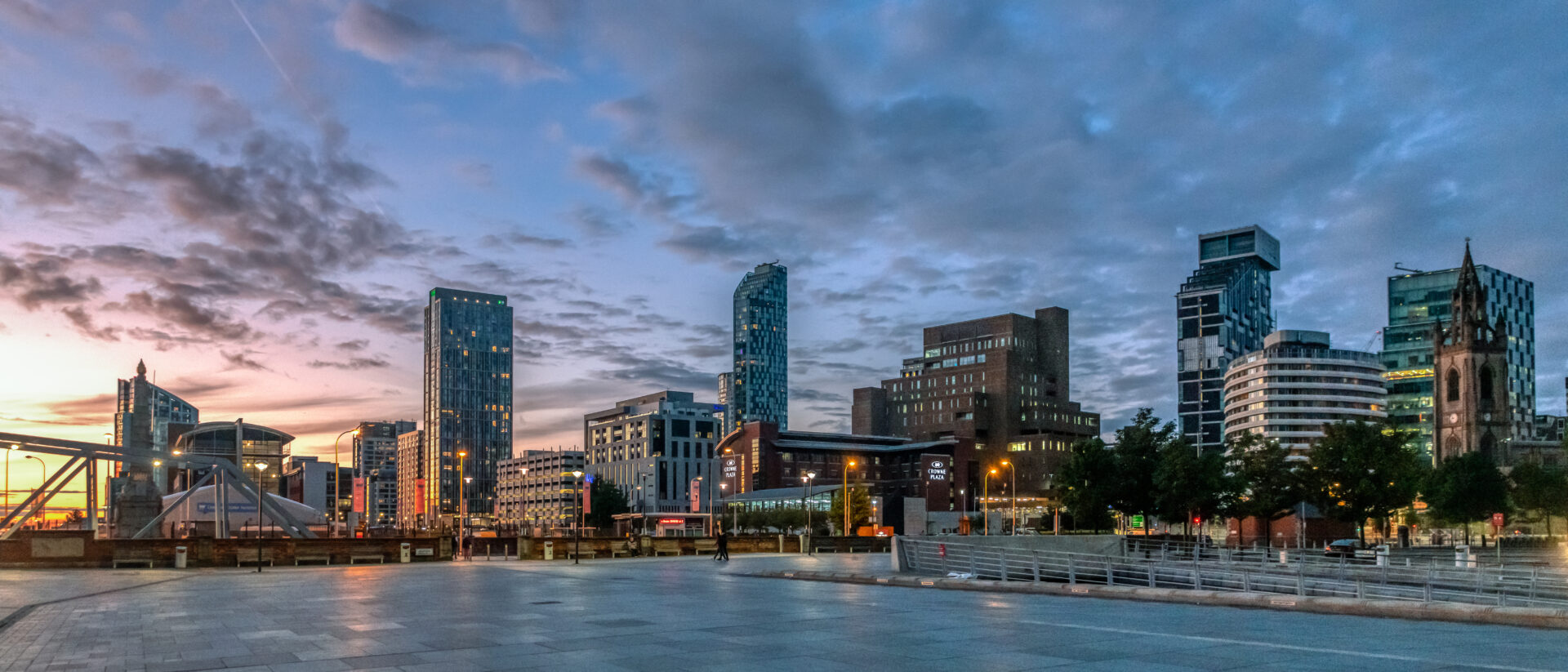
Office buildings in Liverpool. Credit: Christian Mihart
The office is back – but only the right one
This shift reflects a deeper change in how companies think about space post-pandemic. The office is no longer a default location for work; it is a deliberate choice. If employees are only coming in two or three days a week, the space they use needs to justify the commute. That has pushed occupiers towards better buildings in better locations, with stronger design, better amenities and higher environmental standards.
Flight to quality: prime holds, secondary slips
This is what underpins the now well-established ‘flight to quality’. Prime office space in Manchester is performing strongly, with low vacancy rates and stable or rising rents. In contrast, secondary buildings are struggling. This is not a temporary imbalance but a structural divide that is likely to widen. In effect, the market is splitting into two: one part that aligns with modern working patterns and one that does not.
Landlords face a reset: invest or reposition
For landlords, that presents a stark choice: invest or fall behind. The volume of older office stock across the North West is substantial and much of it no longer meets occupier expectations. Refurbishment is becoming less of an option and more of a necessity. Where that is not viable, conversion to alternative uses may become increasingly common. The idea that all office space will remain office space is no longer realistic.
Prime supply is tight, and rents reflect it
At the same time, the supply of new, high-quality buildings is constrained. Development activity has been held back by high construction costs, expensive financing and economic uncertainty. This has created a paradox at the heart of the market. On paper, there is plenty of office space available. In reality, there is a shortage of the kind of space that occupiers actually want.
This imbalance is one of the key reasons why prime rents have held firm and, in some cases, continued to grow. It also suggests that the best buildings will remain relatively insulated from wider market pressures. For investors, this reinforces the appeal of prime assets, even in a sector that has faced significant challenges in recent years.
Investment appetite: stabilising after the rate rises
The investment market itself is beginning to stabilise after a difficult period. Rising interest rates from the end of 2021 to the summer of 2024 led to falling values and reduced transaction volumes. However, there are signs that the market has found a floor. Yields have stabilised and investor confidence is gradually returning, particularly for well-located, high-quality assets.
The takeaway: a re-focused office market
Clearly, in a situation such as this there will be winners and losers, but to describe the office market in the North West as in decline would be a mistake. The kaleidoscope was shaken by the pandemic, but the pieces are gradually falling into place, albeit in different positions.
• Andy Miles is managing director, commercial at Rightmove

The decline in demand for secondary space is probably being exacerbated by the uncertainties generated by AI and just how many office bods are going to be needed in the future. Always going to need good quality space for the boss though.
By WayFay
Who wants to sit in glass open plan box all day that’s extremely energy inefficient?.The property industry would like you to for it’s own interest but young people don’t want to and those with talent increasingly reject this as employment location.
By James Reynolds
We see similar patterns in north Wales, market is polarising into higher quality purpose built environments. Investment market still weak but improving, very dependant on availability and cost of funding. On the occupier side demand still very strong on well managed and attractive schemes.
By Mark Evans