


Manchester to beef up Piccadilly station development team
Recognising the chance to make an underground station at Piccadilly a reality, city council chiefs have secured backing to add firepower to the division charged with making the detailed case to government.
Manchester City Council’s executive today signed off a request made in a report to add resource to its transport teams. The report was authored by Becca Heron, strategic director of growth & development, and Pat Bartoli, director of city centre growth & infrastructure.
As today’s meeting was told by Leader Cllr Bev Craig, Manchester believes the Labour government’s promise of £45bn for Northern Powerhouse Rail is a weightier proposition than the vague transport promises made by earlier administrations.
Cllr Craig told the meeting: “Our pitch to successive governments has been that Manchester has driven levels of growth not seen elsewhere in the UK. But we know we’ll reach a point where we are constrained, and the connectivity and reliability of rail services are not good enough.
“For the first time, the reworked Northern Powerhouse Rail plan commits serious funding to the possibility of an underground station – something which shouldn’t be beyond our ambitions.”
Both Cllr Craig and MCC chief executive Tom Stannard reiterated that the level Manchester is working at, in the campact Agreement agreed earlier this year, is a key difference to earlier attempts.
What happens now
The report that went to executive today set out how £1m business rates growth reserve has been allocated to support initial delivery of commissioned work for 2026/27, as MCC works with Transport for Greater Manchester, government, and GMCA to map out Piccadilly’s development under the NPR programme.
The report said: “The city centre growth and infrastructure team is currently small, comprising a rail team and a growth team with a combined total of six full-time equivalent posts.
“Given the scale and complexity of the programme, the structure needs to be strengthened, requiring an additional resource in the current financial year, assuming new roles are filled within six months.”
The report continued: “A key element of this programme is economic analysis to assess the net benefits, whole-life value, and opportunity costs of alternative Manchester Piccadilly station options, including wider economic, productivity, and connectivity impacts using established land-use and transport modelling approaches.”
This work is jointly funded by MCC and the Department for Transport, with the report noting that “additional technical evidence will also be required to support the council’s case at the forthcoming Select Committee in relation to the NPR route and station, with further specialist commissions likely, although associated costs are still to be confirmed”.
The context
A compact agreement was signed in January between GM Mayor Andy Burnham and government, setting out a shared ambition to unlock growth across the Northern Growth Corridor and address historic under-investment in the North’s rail network.
Under this agreement, MCC, GMCA, TfGM and government are working jointly and collaboratively to assess the options for the Northern Powerhouse Rail station at Manchester Piccadilly.
The compact’s working agreement is that “An underground solution at Manchester Piccadilly could be a catalyst and enabler for major regeneration and economic growth for Greater Manchester and the wider North by unlocking land for redevelopment and additional connectivity”, and that “the option needs testing further in terms of value for money and delivering the right pan northern growth and transport objectives”.
The other major point in the timeline thus far came in January, when chancellor Rachel Reeves published the Northern Growth Strategy: Case for Change (NGS), followed in March by a ‘next steps’ publication that set out government’s plan to grow the Northern economy over the coming decades.
The NGS expands on the key priorities set out in the compact agreement, with early action focused on unlocking agglomeration benefits and enabling business investment, building out from Northern Powerhouse Rail.
As set out in the NGS, “better intercity connections, through an underground Piccadilly station, will make it easier for people to access jobs, education and opportunities; and easier for businesses to find the skills they need”.
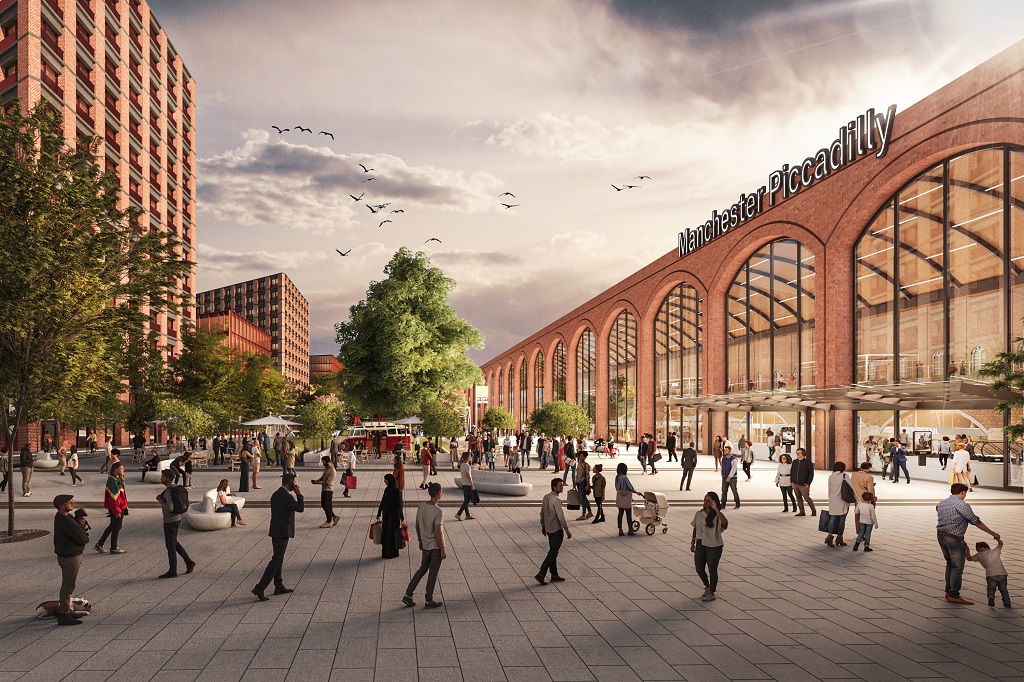
Piccadilly potential
In addition to NPR, other potential Piccadilly investments as set out are:
- Manchester Piccadilly Additional Platforms (A & B): Likely to be the first significant investment at Piccadilly, the scheme will reshape operations, passenger flow, and the station environment — requiring an integrated long-term vision. This would help realise the benefits of the Trans Pennine Route Upgrade programme.
- HS2 Connectivity: Although the northern leg of HS2 has been cancelled, HS2 trains are still expected to run into Manchester by the mid-2030s. Piccadilly must provide a fitting gateway for the UK’s premier train service at its final destination.
- Platforms 13 & 14: Planned investment in passenger experience and safety on Piccadilly’s two congested through platforms must align with the wider Piccadilly vision and future capacity requirements.
- Bee Network integration: Piccadilly is the core rail hub within the Bee Network, and the centrepiece of the GM Rail Vision. It should reflect Greater Manchester’s ambitions for a seamless, high-quality public transport system.
- Seven Stations programme: Piccadilly is the flagship station within thus, and “should set the benchmark for design quality, accessibility, and multimodal integration”
The report noted that the £45bn commitment to NPR is joined by £10.4bn investment in local transport, and £1.7 bn City Investment Funds, and a commitment to develop a roadmap for future fiscal devolution.
MCC, therefore, “needs to maximise the opportunities that will be made available from this investment”.
Building up the team will give Manchester and its partners an enhanced resource to build its evidential case. The report said that further pieces of work are also being commissioned by TfGM to identify the benefits of the NPR scheme as a whole including improvements to services, journey times and other operational outcomes.
The analyses, taken together, will be aligned to a Green Book evidential case setting out the benefits to be achieved over the coming decades.
The work required is complex and of significant scale, said the report, concluding: “It is crucial that the Council commissions this work, and also works in partnership with the CA, TfGM and government, if we are to ensure we achieve the right outcomes with the maximum potential benefits in support of our growth objectives.”