



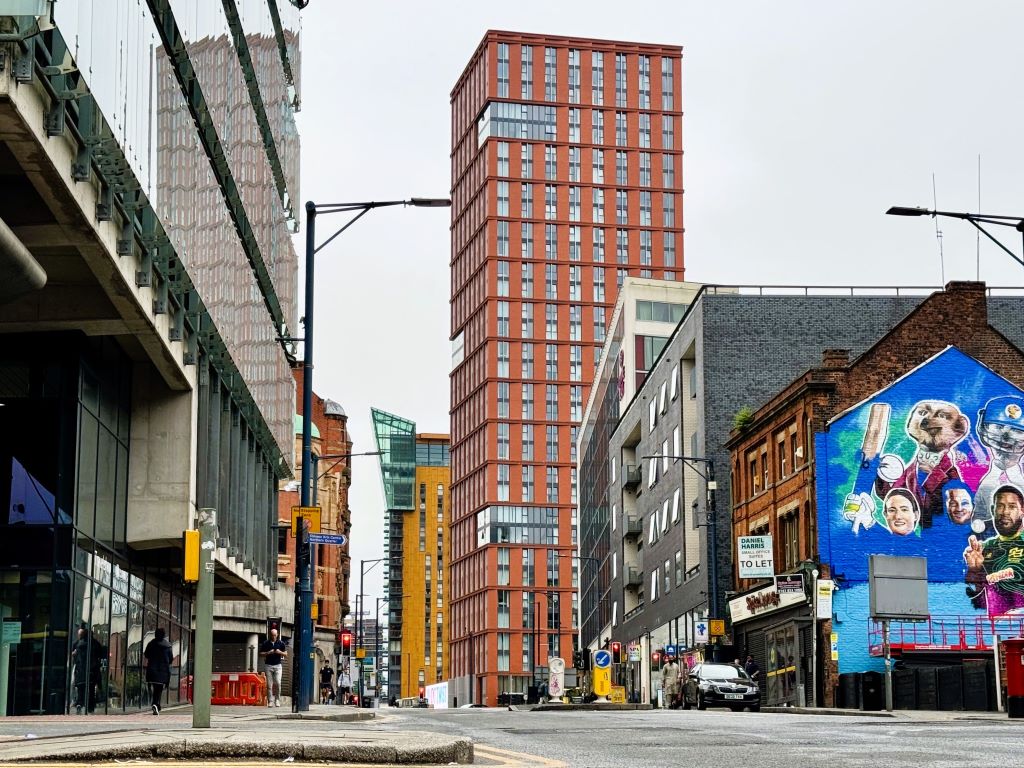
Manchester claws back £700,000 from Swan Street House developer
Ridgeback Group’s 31-storey residential block has triggered a viability recalculation, leading to a revised Section 106 figure.
Manchester City Council has attached a number of reconciliation clauses to S106 agreements over the years. These clauses require the viability of a project to be reassessed after a certain amount of time after planning permission is granted.
This ensures that should circumstances change and the project’s potential profits prove to be higher than expected that the city council can capture part of that uplift to improve the city.
The Ridgeback Group scheme off Swan Street, known as Swan Street House, was shown as an example of such a clause being implemented in the city council’s latest Annual S106 Monitoring Report.
Completed in 2024 by main contractor RG Group, the SimpsonHaugh-designed towers boasts 385 apartments. The building is made up of two towers – one 31 storeys and the other 13 – and also includes 4,000 sq ft of groundfloor retail.
When planning permission was granted in 2019, the agreement stipulated that there would be 19 homes designed as affordable housing. This represented 5% of the total apartments, a figure well below the usual city council target of 20% because of viability concerns. The agreement also stated that the scheme’s viability be reassessed after 75% of the flats were built.
The city council noted that a recent assessment saw that an additional contribution of £700,529 was due to the city council.
That is just one instance of a successful clawbacks. The city council did not have stats regarding the number of reconciliation clauses that had been implemented over the years.
Overall, S106 agreements were down for the financial year 2024/2025 – with only 21 signed compared to 38 the year before.
Those 21 agreements proved to be far less lucrative as well. For the year 2023/2024, Manchester City Council raked in £5.7m in S106 deals and spent £1.8m. Last year, only £1.7m was garnered and £459,200 spent.
The report also listed a few instances where S106 funds had been deployed by the city council’s Housing Affordability Fund – including £2m to help deliver 38 living rent homes at This City’s No1 Ancoats Green.
For those interested, the original planning application for Swan Street House can be found by searching reference number 121380/FO/2018 on Manchester City Council’s planning portal.
Related Articles
Analysis
Remembering Eamonn Boylan: Greater Manchester’s placemaker
Eamonn Boylan never sought the spotlight. Throughout his 45-year-career as a public servant, he seemed content to just get on with the actual doing of things. Rather than lead, he preferred to guide. His impact was no less transformative.
Shouldn’t the S.106 money collected be spent on project defined at the time of agreement?
By Anonymous
any s106 taken from the big shiny towers charging £2000 a month for a white shoe box?
By salford fred
Silly
By Anonymous
Good luck getting any s.106 money next 3-5 years. New starts on sites are gonna be very few and far between due to viability and BSA
By John W
@anon I believe as per the article above this simply represents an adjustment of the S.106 in light of increased profitability. Seems like a smart move for the public purse
By H
You can define a pot or group of long term schemes rather than an individual project for S106.
By Watcherzero
I wonder if this clawback is being applied consistently and robustly across all developers and developments, I somewhat doubt it!
By Digbuth O'Hooligan