



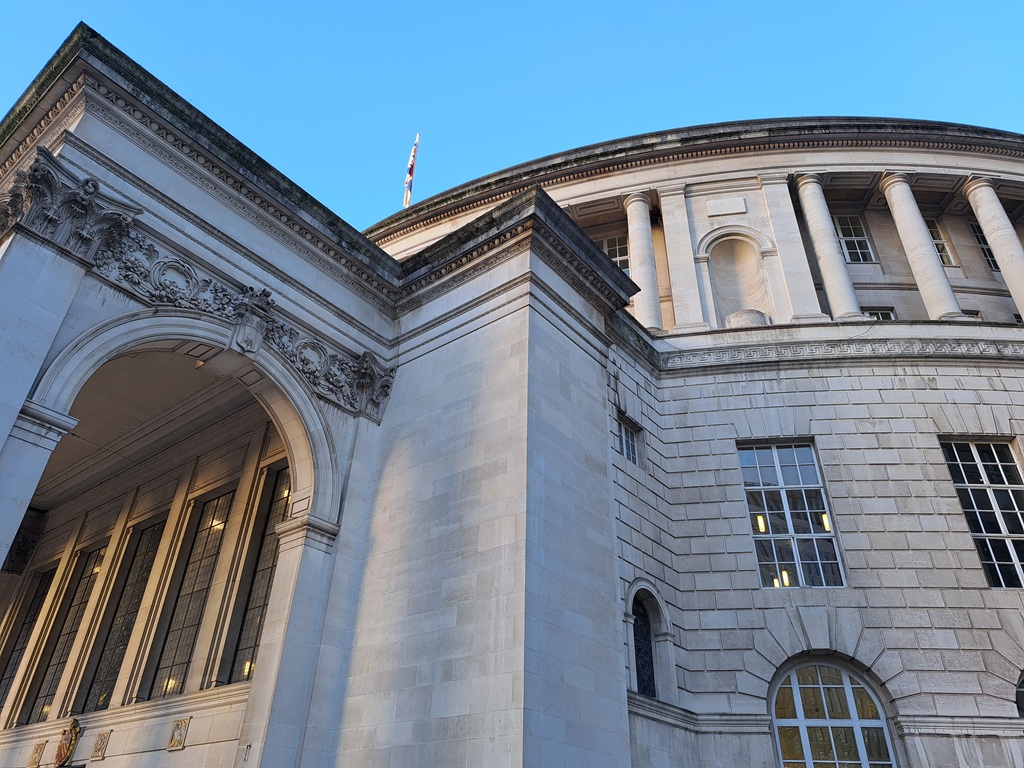
Central Library tops poll as Manchester’s most important building
Place North West readers have spoken and the St Peter’s Square destination has been voted as the building from the last 100 years that has had the biggest impact on the city.
Central Library, opened in 1934 and the second-largest public lending library in Britain, received several nominations ahead of voting and was among the most popular throughout the process.
The library triumphed ahead of second-placed 100 King Street, with Beetham Tower, the most popular of the 21st century offerings on the shortlist, rounding out the three podium places.
From the 1960s (albeit with a late 1990s overhaul) and 1970s respectively, the Arndale Centre and the Levitt Bernstein-designed Royal Exchange Theatre were placed fourth and fifth.
Central Library
The Manic Street Preachers famously said that “libraries gave us power”. Manchester has a rich supply: the John Rylands, the Portico, Chetham’s, and the Central Library.
For a long time known as the Central Reference Library, E. Vincent Harris’ creation was delivered for Manchester Corporation in 1932 and was popular from the start, with Ewan MacColl and King George V on the record praising the facility.
We can’t put it better than the nomination received from WSP’s Laurie Mentiplay:
“Manchester Central Library is a place where people from all walks of life come together. It’s a beautiful building that lifts the spirits and engages the mind. A building full of surprises.
“It’s a place to read, study, apply for a job. Meet a friend. See an exhibition. A refuge from the winter cold.
“Manchester was the first local authority to provide a public lending and reference library. It continued to innovate with the new Central Library in 1934, and then again with a major refurbishment and transformation completed in 2014.
“The Central Library continues to give us opportunities to improve our lives for the better. It’s free to visit, welcoming and inclusive. For me, it’s our most important building.”
Reacting to the poll result, Cllr Shazia Butt, executive member for culture, leisure and libraries at Manchester City Council, said: “Manchester Central Library is an iconic landmark at the heart of the city’s civic quarter and one of Manchester’s most-loved buildings as well as a’ jewel in the crown’ of public libraries countrywide.
“We have always invested in our libraries and Central Library’s major refurbishment 15 years ago, restoring and preserving its historic features while transforming it into the modern, relevant and accessible space that it is today, is why thousands of residents and visitors continue to come through its doors every year.
“And while it thrives as a library it is also a major cultural destination, a community hub, an events space and is truly a living room for the city. It brings people together providing a welcoming space throughout the year whether as a cool refuge in the summer or a warm space in the winter.”
Cllr Butt added that MCC is committing from this month to extended opening hours in several locations, and a return to Sunday opening at four libraries immediately, with four more to follow in January, including Central Library.
100 King Street
Completed in 1932 for the Midland Bank, 100 King Street was famously Sir Edwin Lutyens’ only major Manchester commission, and towers over its neighbours at the heart of Manchester’s historic core around Spring Gardens.
Built in Portland stone in a Neoclassical style, it stands apart from its neighbours in part of town that, while not short on decent architectural offerings, is something of a hotchpotch.
The building is, as one reader observed, “an assured work in that simplified yet very inventive take on classicism that only Lutyens could master in this way”. The building now houses a high-end hotel and leisure offerings.
Beetham Tower
Delivered in 2006 for Beetham Organisation and designed by SimpsonHaugh, the 47-storey tower at Deansgate’s southern end is important for several reasons.
This sleek tower, with its instantly recognisable silhouette, was a totem of Manchester’s regeneration and reinvention story that had been taking shape for 15 years or more. The very fact of its delivery set rival cities scrambling for their own version, only for 2008’s market correction subdue some wild ambitions.
And thirdly, it laid down a marker for where Manchester was heading. Renaker’s Deansgate Square has, over the last decade, led a charge skywards that has made this end of town unrecognisable, leading to the whole “Manchattan” nickname.
A 2006 poll on ‘what is the ‘capital of the North?’ may have been inconclusive. In 2026, Manchester feels the obvious answer. That is not all down to one tower. But it was, and is, undeniably important.
Thoughts and takeaways
This feature started life as a loose idea to throw some light on some buildings that are under-recognised or even maligned. Developments that, despite drawbacks and imperfections, have contributed to a city’s growth.
One of those in mind, One Piccadilly Gardens, didn’t make the shortlist, but the Arndale did. Something that saw a huge swathe of the historic street grid wiped out, and was notoriously pilloried by writer Bill Bryson in the 1990s, was far from celebrated for a long time.
Following its post-IRA bomb reinvention, the Arndale still might not be adored, but the footfall and occupancy rates show the value of an asset that continues to pull young people into town. Enough people like it that it made the top five here.
A striking aspect of the buildings nominated was the age range. Several of the strongest contenders – including the winner – only just made the “last 100 years” qualifying threshold.
But from the post-war period right up to the present day, there were buildings suggested that either made the shortlist or just missed out: 1960s towers, a remarkably inventive 1970s theatre, Bridgewater Hall from the mid-1990s, several cultural projects from this century. Only the 1980s was conspicuous by its absence.
So, the people have spoken – and we’d like to offer our sincere thanks to everyone who joined the debate, offered nominations, and voted in the poll.
In a city where the pace of change over the last 30 years has been pretty hectic, Central Library feels like a deserved winner as it closes in on its century. More recent additions tower over it. But opening onto the one of Manchester’s main civic spaces, easily accessible and recognisable, handsome inside and out, it is a building for everybody.
To pick out words from Laurie Mentiplay’s nomination, many would say that being “welcoming and inclusive” is what Manchester is known for – certainly what they would like it to be known for. So perhaps it is fitting to celebrate a building that has those attributes baked into its very being.
I’ve said that 👍🏻
By G J Kitchener
madness that no Manchester airport building was included. Central Library is important but in the scheme of things no where near as the airport for Manchester
By Anonymous
The Terminal One building made our shortlist, but unfortunately did not receive many votes.
By Julia Hatmaker
Good choice but not a great many to choose from.
By Peter Stewart
Where did the other buildings finish? Give us the full list!
By Nick
Your wish is my command.
1. Central Library
2. 100 King Street
3. Beetham Tower
4. Arndale Centre
5. Royal Exchange Theatre
6. CIS Tower
7. Daily Express Building
8. Sunlight House
9. Bridgewater Hall
10. Urbis
11. Stoller Hall and Chetham’s School of Music
12. Terminal One, Manchester Airport
By Julia Hatmaker
Wow I thought Express building is second but actually not. 😧
By G J Kitchener
I worked in number 6 on the list, the CIS Tower, for 44 years. It’s been empty for years, so it’s in need of a bit of TLC.
By Francis
“…2008’s market correction…”😂
By Idi
Terminal 1 with chandeliers yes. Without No.
By Christopher
A well deserved winner.
By Chris
I don’t disagree that the Arndale isn’t an important building based on the number of people that visit it daily but as the article points out, it only achieves this by having destroyed a quarter square mile of city streets. Who’s to say had it not gone ahead, with more limited and gradual renewal of that area the city would be attractive to many more people? Certainly you wouldn’t be faced with a huge chunk of the city centre being an effective dead zone after the shops shut and you might find a greater diversity of shops. Thus, the Arndale is only really important for its owners and from a narrow commercial perspective.
By Arndale realist
Shame that there was no room for Ship Canal House, described by the Manchester Guardian as Manchester’s first ‘skyscraper’ and of much greater economic impact than the Lutyen’s bank building further up the street (even if it may be a better building from an architectural point of view).
By Harry S Fairhurst
The Arndale remains to this day one of the worst planning decisions ever made by Manchester City Council. That said in its far better since the refurb.
By Jon P
Wonderful, but your definition of ‘Manchrster’ is unfortunate. What about the Working Class. Movement Libray, and the 24 Carnegie libraries.
Overall, no city can match it.
By John Carpenter. Immediate Past Chair of the Portico Library