



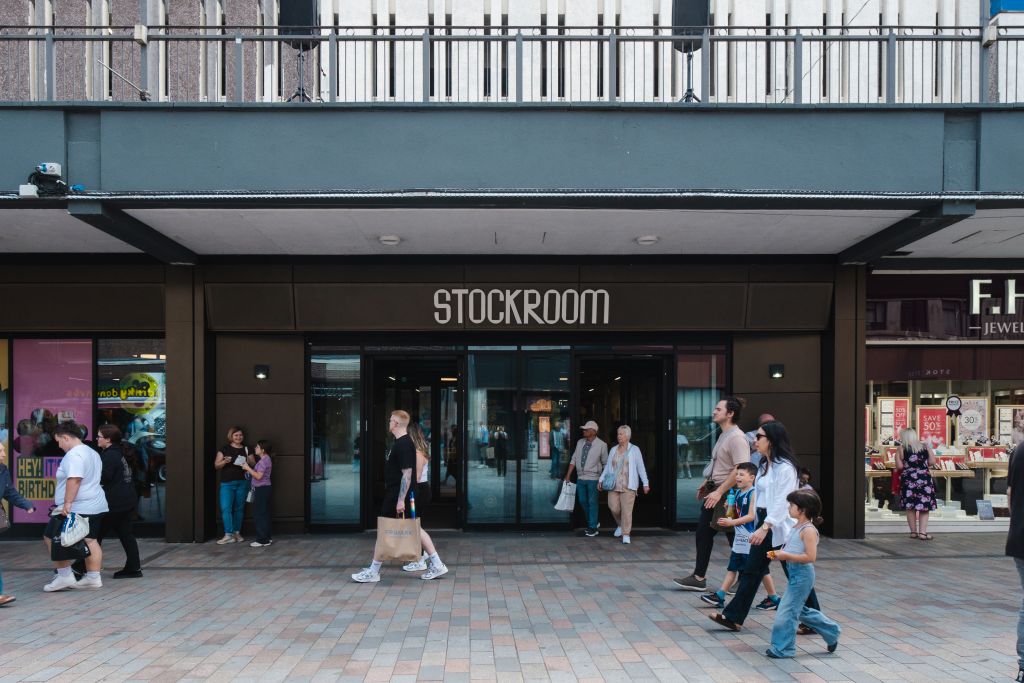
IN FOCUS | Stockport’s solution to high street decline and improved council services
A little over a year since opening its doors for the first time, Stockroom has welcomed more than a million visitors and contributed to a 15% rise in footfall at the council-owned Merseyway Shopping Centre.
The facility has provided a welcome fillip to Stockport’s town centre at a time when councils across the country are searching for interventions that can fill the voids left by the of retail decline.
In 2011, The Guardian reported that Stockport had the highest rates of vacant retail space of any large urban centre in the country at nearly 30%.
Fast forward 15 years and, while the town centre is undoubtedly quieter than in the heyday of high street retail, the picture is altogether rosier. It is a Monday morning in June and a steady stream of people is flowing up and down the newly paved Merseyway thoroughfare.
Many of them stop outside Stockroom, forming a queue ahead of its opening at 10am.
What is Stockroom?
The 135,000 sq ft facility, designed by AEW Architects and created out of vacant retail space previously occupied by Topshop and Mothercare, offers a library and a cafe. It is also home to the town’s archives, event space, and acts as a touchpoint for residents using several council-led support services from registering births to help with breastfeeding.
It also boasts some of the best public toilets you’re likely to find anywhere in the country, picking up three gongs at this year’s Loo of the Year awards.
At 10 o’clock on the dot the doors open and people young and old disappear inside, grabbing a coffee, nabbing a chair at one of the computers upstairs, or just taking a seat on one of the comfy sofas.
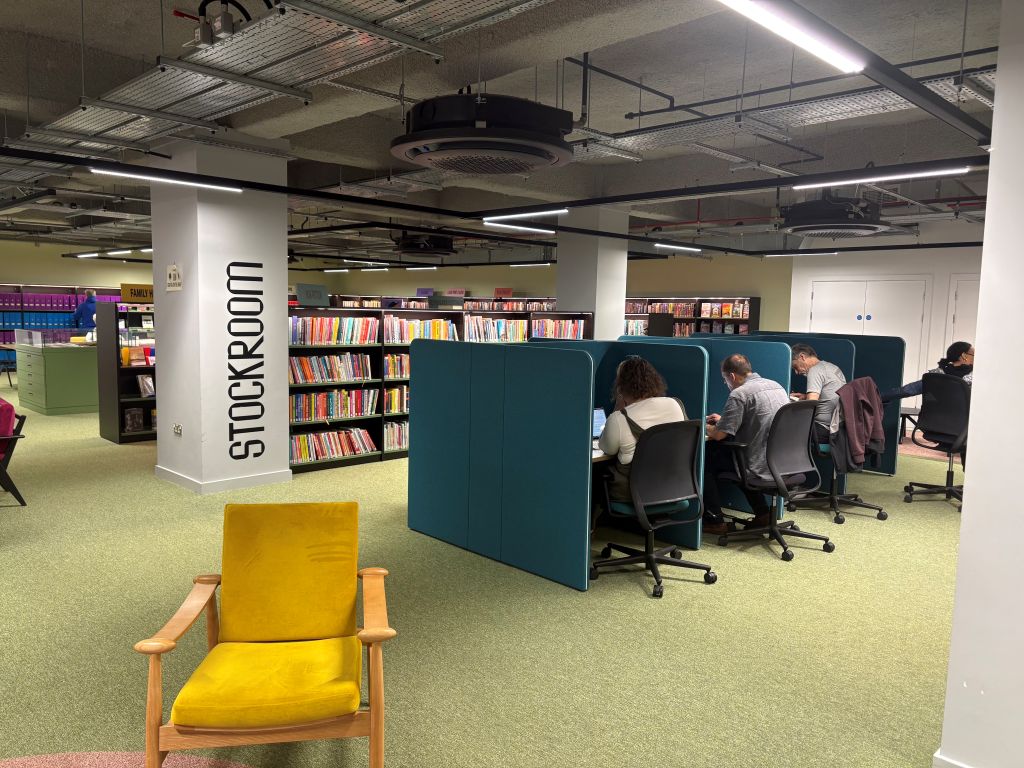
The first floor is a quieter place for study and features Stockport’s archives. Credit: PNW
Stockroom offers plenty to do. But it is also a place to just be. Janet, a woman in her sixties is among the early arrivals. She is here to meet her sister.
She likes Stockroom. Her only complaint is that it doesn’t open earlier.
But homes alone are not enough. Hence schemes like Stockroom.
The central element of the development is the library. Stockport already had a library, located within a much-loved but tired building on Wellington Road, that notched up around 100,000 visits annually.
Stockroom achieved that in its first month.
Who owns Stockroom?
One of the biggest contributors to the scheme’s success is how it disguises the fact it is a council-run facility, according to Kathryn Rees, the council’s executive director for corporate and support services.
“We consciously wanted to make Stockroom look and feel like it’s its own identity, so it doesn’t look like it’s the council’s,” she said.
“We did that on purpose because we co-designed the branding with local people, we thought about what is to make it feel special and have an identity in its own.”
That identity is distinctly Stopfordian. Art work and photographs depicting the town and its landmarks can be found around every corner. The Cool Like You signage Stockport band Blossoms used as the cover art for its second album has been donated to Stockroom and brings a local touch to the cafe.
The lack of apparent affiliation with the council has a “destigmatising” effect on how people experience the space, which makes visitors more comfortable to engage with certain support services around employment and mental health, Rees added.
“[The concept of] community ownership doesn’t work if we slap our logo on it,” said Paul Richards, deputy chief executive of Stockport Council.
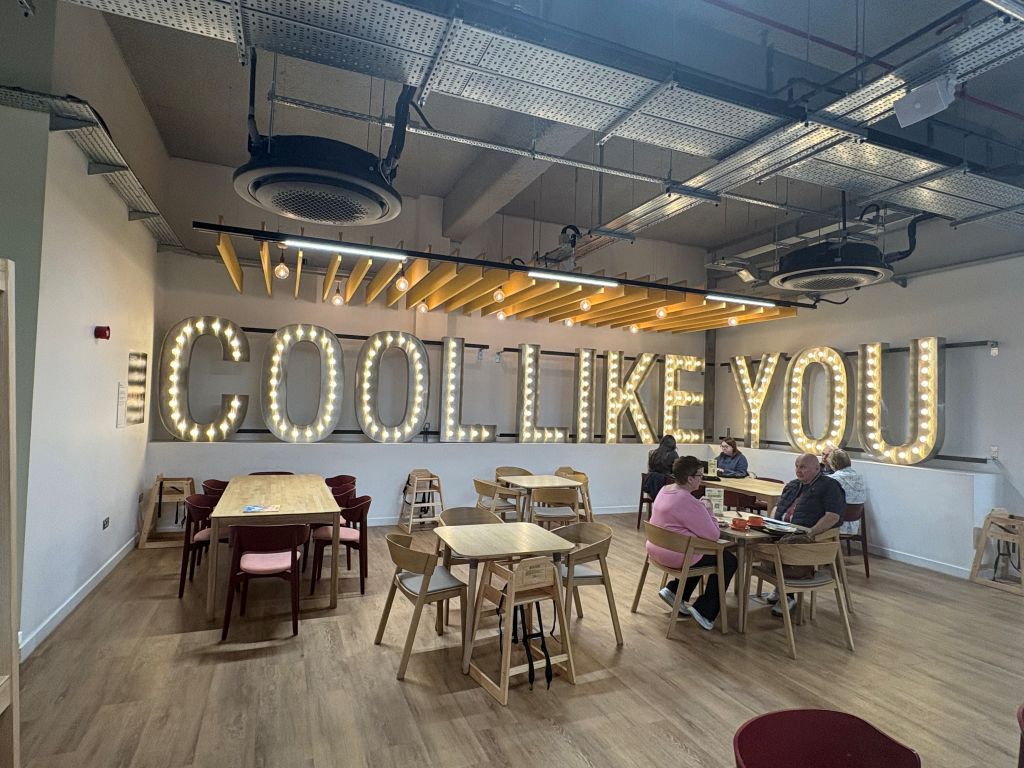
Signage used on the front of Blossoms’ second album can be found in the cafe. Credit: PNW
The regeneration jigsaw
There are several ways to inject life back into a place. Take Altrincham Market, an intervention lauded for transforming the fortunes of the town following the arrival of the Trafford Centre, which did so much damage Alty’s commercial heart.
Another common method being employed by regeneration practitioners is to build homes in town centres that will bring people in to replace the day-tripping shoppers, many of whom have long since left.
That is the plan in Bolton, where a mixed-use scheme anchored by hundreds of homes will replace the defunct Crompton Place Shopping Centre, and in Buxton, where the failing Springs retail complex is being redeveloped into homes.
Elsewhere in Stockport, not too far away from the retail-led enclave of Merseyway, the same tactic is being employed. The plan is for 8,000 new homes across the town centre by 2040 to inject vitality into areas that were previously crumbling mills or soulless bus depots.
Richards has hosted visits to the £14.5m Stockroom scheme by other councils who have heard good things and are keen to understand how such a project can contribute to the wider regeneration of a place.
The building is one of the standout elements of Stockport’s ongoing evolution, along with the bus interchange, Stockport Exchange office district, and the subsequent emergence of the Underbanks as one of Greater Manchester’s most popular places to eat and drink.

Stockport Interchange is a key part of Stockport’s regeneration. Credit: PNW
Stockport’s development momentum means the town is having its moment in spotlight as one of the country’s places to watch.
Tower cranes on the skyline demonstrate that the Stockport is a place where things are happening but projects like Stockroom are just as important as the more eye-catching ones.
That being said, while an apartment building will generate returns, Stockroom will not. Its creation was only possible thanks to government grant.
“The thing that’s hardest [about regeneration] is definitely that social infrastructure,” Richards said. “We are 10 years in and we are only just delivering [Stockroom].”
Who uses Stockroom?
When a regeneration wave sweeps a town, a council can come in for criticism for placing a greater level of importance to attracting new people than looking after existing ones. Stockroom is about tackling those concerns heard on, Richards said.
“We want anybody to be able to come through the door and find something that appeals to them.
“It’s a games compendium; you might not like snakes and ladders, but you might like checkers,” he said.
In the cafe, Chloe, a new mum from Woodley is feeding her daughter Isla. It is the first time she has visited Stockroom and she will “definitely be coming back”.
Upstairs, Jonathan from Didsbury tells me he comes to Stockroom once a fortnight to do research for the horticultural qualification he is studying for. “I think a lot of places really need spaces like this where people can access materials they need and study away from home,” he says.
Avril, who has travelled in from Denton with her friend Eddie, is excited to bring her son to Stockroom when he visits from Australia.
A mother plays with her daughter in the library space, which has a kind of wooden climbing frame with a slide in the centre, while her husband, with the youngest strapped to his chest, responds to some emails. Later they sit down together for lunch in the cafe.
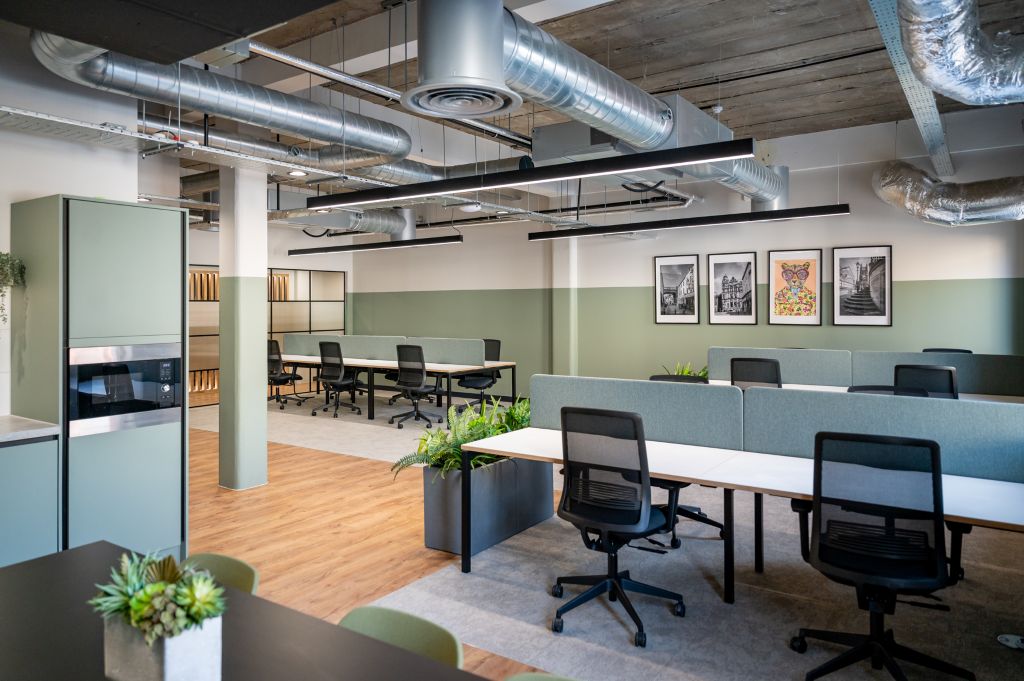
Stok, once an M&S, has become a plug-and-play workspace in Stockport. Credit: via Tandem Investments
For Cllr Dan Oliver, the council’s cabinet member for communities, culture and public protection, Stockroom epitomises what regeneration should be about.
“Regeneration is about communities. The space is powerful, particularly in challenging times. This is a space where we can celebrate everyone.”
The success of the space has presented challenges. Recruitment of more staff to man it is ongoing, which is an additional cost for the council. The sheer diversity of people using the space means that the content – the art exhibitions, the events programme – needs to be continually refreshed by the creative team led by Gwen Riley Jones.
Young people, who can be hard to reach, engage with the space but require specialised support, as a result, Oliver is working to get more youth workers based in Stockroom. These are what a football manager would call “good problems to have”.
The changing face of Merseyway
As for the wider Merseyway complex, it is still evolving following the departure of several household names.
Opposite Stockroom, the former M&S is now a fully let office development, the old Debenhams is home to a local furniture retailer, and the former BHS unit is now split between Poundland and JD Sports. The first floors of the old Next and Metro Gym at the shopping centre are home to the Merseyway Innovation Centre, which features 15,000 q ft of flexible serviced offices and co-working space.
“A decade ago, this whole high street looked completely different,” Oliver said. “I think we had a piece done about a decade ago about how many empty shop units we had.
“If anything, now the reverse is true. We’re getting positive news for not having as many empty shop units compared to so many other places.”
Oliver, like many other Stopfordians his age, spent much of his youth at Merseyway, using his limited funds to buy the latest trends from shops like Topman.
“It’s crazy to think this space used to be those shops, and now it has had a million people through the door,” he said.
Related Articles


Analysis
Councils take on futile fight against national planning changes
Four local authorities have drawn lines in the sand, refusing to amend their constitutions to adopt the latest statutory government guidance that would see officers become the default body for deciding most planning applications across England.