

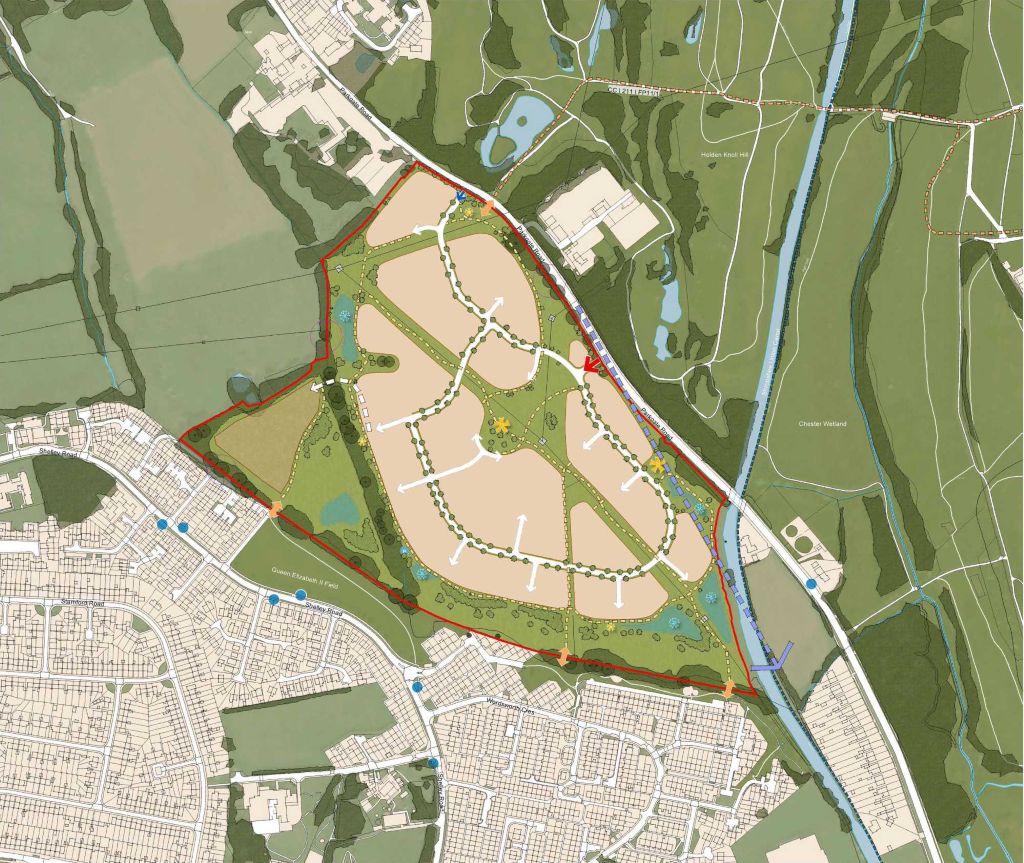
Bailrigg Lane, Gladman Developments, c Google Earth

The Bailrigg Lane scheme was rejected initially in 2023. Credit: Google Earth

High court overturns Lancaster rejection of 644 homes

Siding with Gladman Developments over the Planning Inspectorate and city council, a judge ruled that it was wrong to dismiss the application just because of a lack of sequential test for flood risk.

The high court decision was the checkmate needed for Gladman, which had deliberately used its plans for 644 homes on 97 acres of Green Belt off Bailrigg Lane as a means to challenge an increase in sequential-test-based refusals in the planning sector.

The verdict saw the conclusion of a two-year chess match that began with Lancaster City Council’s initial refusal of the project in December 2023.

At that time, flood risks and a lack of sequential test had been among the reasons for refusal. This was in spite of only a small part of its western boundary being within flood zones two and three, neither the Environment Agency nor Lead Local Authority had objected, and Gladman’s proposed surface water drainage strategy would actually reduce the risk of flooding on the site.

In November 2024, the Planning Inspectorate agreed with the city council. However, the inspector dismissed three grounds for refusal from the city council: qualms over urban design, impact on nearby heritage, and effects on nearby protected sites. One reason for rection did stand: the lack of a sequential test due to flood risk.

Acting for Gladman, Melissa Murphy, King’s counsel at Landmark Chambers, argued that the inspector erred in law by seeing the lack of a sequential test as reason for an automatic dismissal.

The High Court justice agreed with Murphy, noting that the project, by the inspector’s own admission, would lower the likelihood of flood risk. The justice said that the inspector had not weighed the planning balance accurately by giving the lack of a sequential test the power to torpedo an application without consideration of other factors.

Planning policy also had moved on by the time of the High Court decision. September’s Planning Policy Guidance update elaborated on sequential tests and when they were necessary – in the case of projects where a flood risk assessment can demonstrate that surface water flooding will decrease flood risk then a sequential test is not necessary. This fits the bill with the Bailrigg project.

You can read the full decision on Murphy’s LinkedIn page.

Lancaster City Council and Gladman were both approached for comment.

Whether Bailrigg will be delivered remains unclear. The site was earmarked in December 2024 to become the new home of the Royal Lancaster Infirmary. At the time, a land deal between University Hospitals of Morecambe Bay NHS Foundation Trust and the private landowner was in the works, with Savills acting for the landowner.

To learn more about the Bailrigg project, search reference 19/01135/OUT on Lancaster City Council’s planning portal.

Your Comments

Read our comments policy

Not enough doctors surgery’s or hospital’s

By Anonymous

The builders only build big expensive houses. The young people cannot afford. No one thinks a out the sewage.. traffic or the lack of schools. Hospitals and dentists. The A6 cannot cope with more traffic. Too many traffic lights. There are six sets of lights in less than 2 miles. Galgate cannot cope with more vehicles. The company planning to build do not know the roads

By Anonymous

Start a petition to get people to say they will not buy these horrible identikit houses. Leave the developer withh 677 empty shells they cant get rid of

By Anonymous

The Judge is an expert in flooding, when it goes wrong should pay from their own pocket.

By Anon

Some of the comments fail to recognise that the site has since been sold to the NHS for a new hospital that currently has no funding to get it started.Looks like a pyrric victory for Gladman unless they can recover costs. Lancaster still has a woeful shortfall in housing land

By Max Homes

Regardless of all the overarching problems, subsequent suggested land sale, Lancaster City Council’s handling of the Bailrigg Lane case reveals local councils significant failures in judgment, policy interpretation, and strategic awareness.
By prioritising a procedural omission (the sequential test) over substantive evidence, and by failing to adapt to national guidance updates, the council contributed to a costly legal confrontation, a preventable High Court defeat, obstacles to wider regional land‑use planning
The case stands as another cautionary example of how overly rigid, outdated, or misapplied planning policy can undermine sound decision‑making and public trust.
If the council has indeed sold the land, as has been suggested, then it would be entirely understandable for the developer to seek to recover its losses through the courts. Given the circumstances, the expense associated with this application appears to have been driven in large part by the council’s poor decision‑making and what could reasonably be seen as acting in bad faith.

By Steve5839

• The decision to quash the appeal decision did not relate to the City Council’s handling of the case. The High Court determined that the Planning Inspector (at the Planning Inspctorate) had erred in law, hence the decision reported above.
• The Council never owned the land in question, so the observation in the comments that the Council “sold the land” is incorrect. The land was privately sold to the NHS.
• The changes to national guidance regarding the sequential test occurred after the Council had made its original planning application decision, and also after the Planning Inspector’s decision.

By Lancaster City Council

Related Articles

Sign up to receive the Place Daily Briefing

Join more than 13,000+ property professionals and receive your free daily round-up of built environment news direct to your inbox

Subscribe

Join more than 13,000+ property professionals and sign up to receive your free daily round-up of built environment news direct to your inbox.

By subscribing, you are agreeing to our Terms & Conditions and Privacy Policy.

"*" indicates required fields

Your Job Field*
Other Regional Publications - Select below
Your Location*