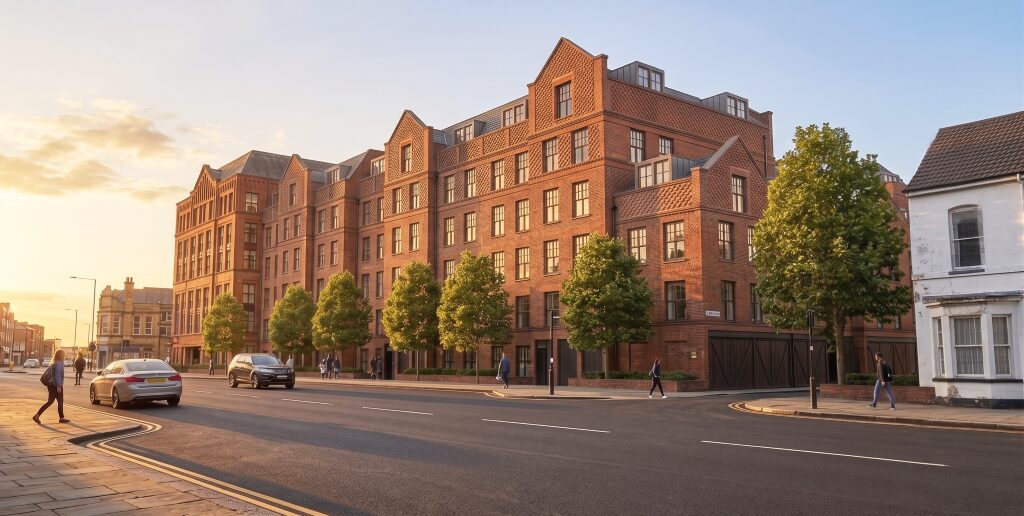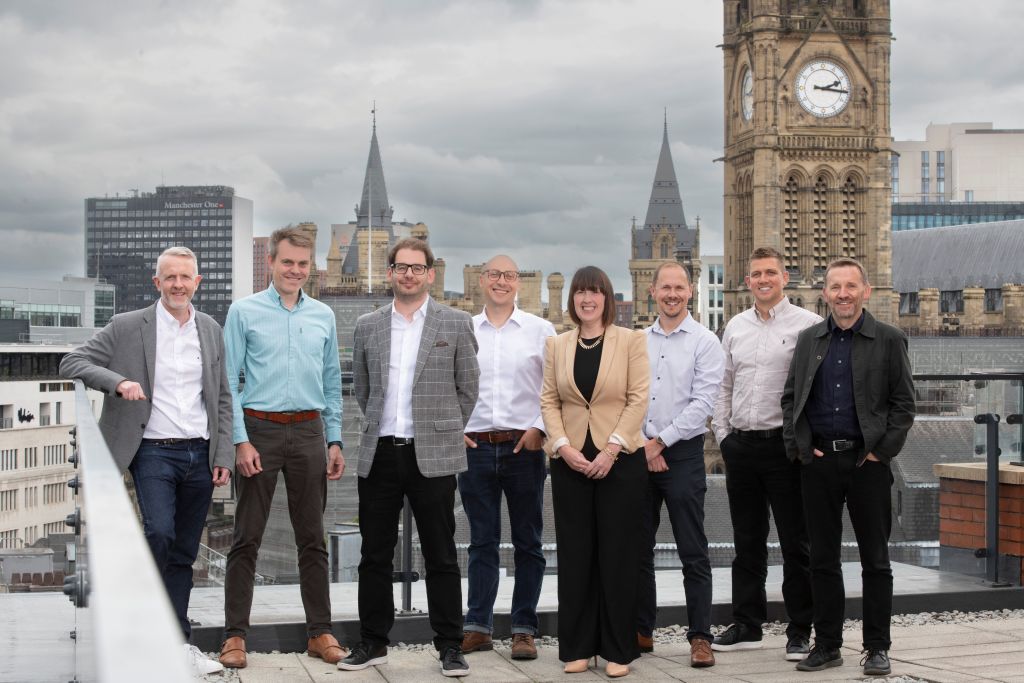




IN FOCUS | How Salford is taking a grip of its design destiny
A year after Salford City Council launched its independent design review forum, members and users of the service have spoken to Place North West about how the initiative, one of few of its kind in the North, is achieving what it set out to.
The Salford Design Review Forum, which has 35 panel members, held its first session in October 2025 and since then has had a say on nine major schemes at pre-app stage. These include the masterplan for the regeneration of Eccles and the recently submitted Salford Business School designed by BPD.
Four or five members of the panel Salford City Council appointed last year review each scheme, and the meetings are facilitated either by chair Stephen Gleave or vice-chair Ernst ter Horst.
It works like this: a project team presents a scheme and then a discussion ensues, whereby forum members use their design expertise and knowledge of Salford to ask questions and make suggestions. The scheme is then evaluated by the forum on elements including built form, nature, and movement and feedback is provided to the project team.
The forum adds another layer of rigour into the design process for major schemes in the city, in the hopes of producing high-quality buildings and, perhaps more importantly, enhancing the places in which they sit.
There are other ways for councils to elevate design standards. Manchester City Council is known for articulating its expectations through the use of strategic regeneration frameworks for particular areas of the city, while Trafford Council’s design code sets out expectations for development across the borough in a handy document.
Salford is the first local authority in Greater Manchester to launch a design review forum.
A Salford-focused forum
The forum offers an alternative to Places Matter, the RIBA-run peer review service. For Kurt Partington, director of regeneration at Salford City Council, the initiative is about providing advice that is specific to the city and supports its aims.
“It was about ensuring that people [are not giving] standard off the shelf [advice] that could relate to any part of any plot anywhere in the country,” he said.
“It was about having people who fully understood what Salford is about, the journey it’s been on, the long-term growth strategies.”
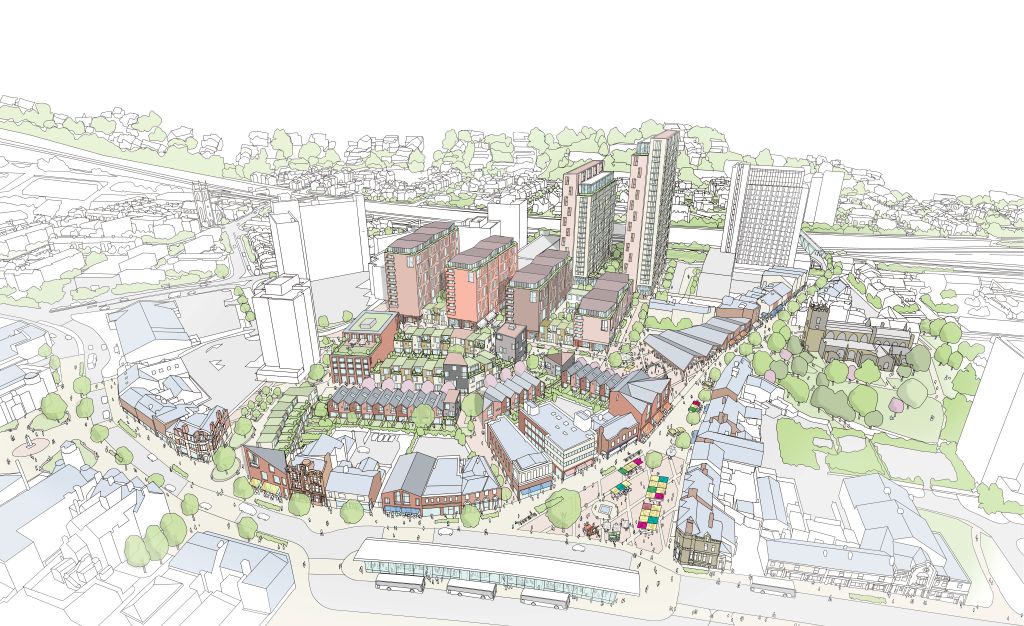
The Eccles scheme features plans for 1,270 homes. Credit: via Turley Strategic Comms
If Salford had come up with the idea of creating a forum aimed at elevating design standards in the built environment 15 or 20 years ago, the market might have scoffed at the audacity of a place few saw as a viable investment proposition.
These days, the city is very much a shining light in Greater Manchester’s growth story. Its skyline transformed following the emergence of MediaCity, residential skyscrapers at Greengate, and the redevelopment of surface level car parks in central Salford into the thriving New Bailey office district.
“Kurt always says Salford used to be Manchester’s car park,” said forum vice chair and MCAU director Ernst ter Horst. “We’ve come on massively in the last 20 years.”
Considering viability
While the city council encourages anyone seeking to deliver a large project to go through its design review forum, the process is not mandatory. Sceptics might think that a meeting with the forum will result in a scheme being saddled with thousands of pounds of extra costs as members mandate extra balconies or plush facade systems.
However, Tim Groom, who has sat on both sides of the table during design reviews, said the realities of a challenging market are front and centre of discussions.
“There’s no point being an architect designing things that don’t get built,” he said.
“What’s the point in designing it if you can’t deliver it?”
Financial literacy and an understanding of what might turn a green viability appraisal red are crucial to being able to provide constructive advice.
Muse is the developer behind much of Salford’s physical transformation over the last two decades and is currently regenerating towns and cities across the country where a sympathetic and constructive view on viability is required.
The company created New Bailey – an office district home to government departments and private sector giants that replaced acres of tarmac. That project forms part of the wider £1bn Salford Central masterplan, which has also delivered more than 1,000 homes.
A little further west, Muse is leading the creation of Crescent Salford, a £2.5bn vision for more homes and employment space in and around the city’s university.
Away from the centre, the developer is working on a masterplan for Eccles, a town that has suffered in the wake of high street retail’s decline and is in need of a shot in the arm.
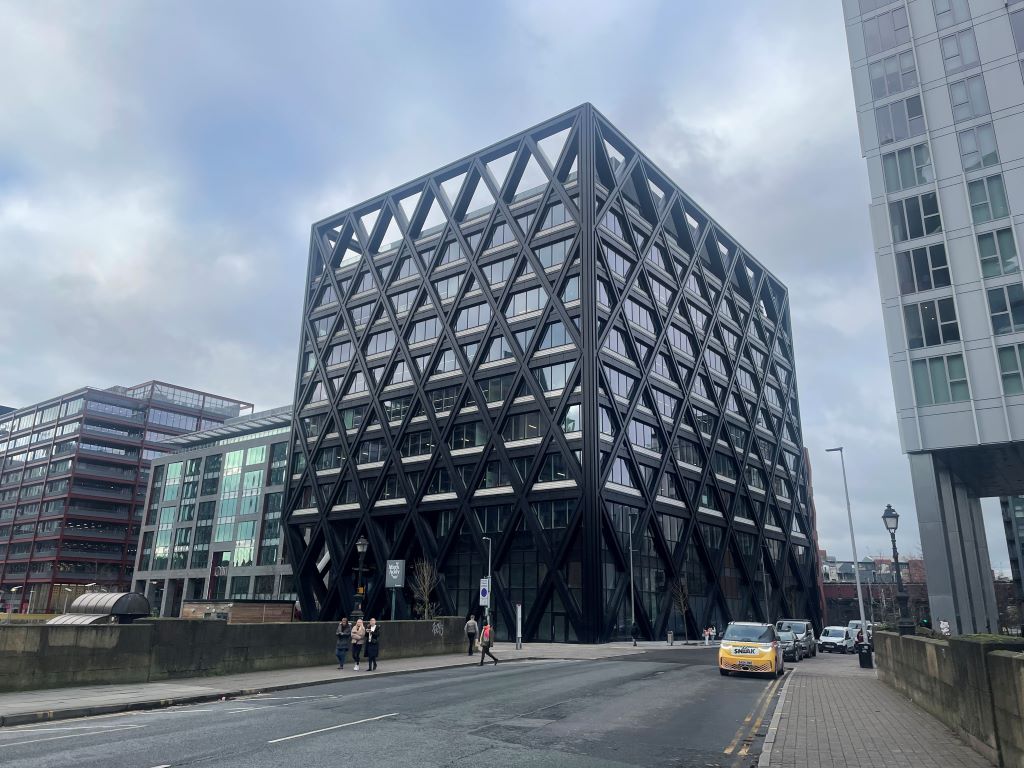
New Bailey is home to government departments and international businesses. Credit: PNW
Alex Vogel, senior development manager at Muse, and architect Jon Matthews took the Eccles masterplan to Salford’s design review forum. Following some bruising past experiences with similar fora in London, Vogel was pleasantly surprised.
“I was a little bit apprehensive about it,” he admits. “Salford, by far, is a lot more collaborative. It’s not ‘we’re going to tear this to pieces’, it’s the complete opposite.”
Striking the right tone
Architects and project teams are prepared to be put through their paces at design review as long as the feedback is constructive and delivered the right way, Groom said.
Like Vogel, Groom has also been hurt before. During one design review session early on in his career a panel member described one of his scheme’s designs as “average”.
“It got my back up straight away,” he said.
One of the main reasons for having a design review panel is to smooth the route through the planning process. In theory, schemes that have been tweaked, refined, and improved based on advice from professionals au fait with what a council wants, have a better chance of being approved.
When a design review meeting is held, the focus is as much on getting a project ready to face a planners and a committee as it is about improving how it looks, according to ter Horst.
“The mantra is ‘we’re here to help’,” he said. “We are trying to tell people that this is going to help speed up your process for you. It is not all about bells and whistles.”
Design review fora can also act as an arbiter in conflicts between project teams and local planning authorities, according to Dominique Oliver, managing partner at architect Pollard Thomas Edwards, who is one of three chairs of Lewisham Council’s design review panel.
“Where the applicant and the planning team are at loggerheads, the planners can use the design review panel to get an objective view on it that may or may not support [their] view,” she said.

Kurt Partington said the city council is in a position to stand up to poor quality design. Credit: via Salford City Council
Lewisham’s panel is more than a decade old and has and runs in a very similar way to Salford’s. Gareth Clegg, Salford City Council’s head of development management, was instrumental in setting up Salford’s forum having spent time working at Lewisham Council.
For him the idea of the forum is to provide a safe space for collaboration, rather than an opportunity to take a red marker to proposals.
“I think some people see it as a hurdle or a hoop they have to jump through,” he said.
“You’ve got this opportunity to have really great experts help you [and] maybe see solutions that you might not have seen and add value to your scheme.”
This could be by removing or reducing an element, adding something in, or opening up a road to improve permeability between the scheme and the wider area, as was the case with one scheme that came to review.
A collaborative, holistic approach
How constructive a session depends on the quality of the chair, Oliver said.
“Where they have a good chair who is able to manage a really objective discussion, it works. If it has a chair who is possibly too opinionated, it can become quite difficult.”
The chair of the Salford Design Review Forum is Stephen Gleave, a veteran of the Greater Manchester property scene best known for being managing director of Taylor Young, which was bought by IBI in 2012.
“I was very keen that it wasn’t just an architectural design panel,” he said about his approach to the role.
“There is a quite a lot around context that’s being discussed and relationship with neighbours, and relationship with roots, and so on.”
The holistic approach to design review Gleave and Salford take is well-timed; the recently revised National Planning Policy framework gives greater credence to schemes that “enhance” their surroundings, rather than merely being in-keeping with them.
Euan Kellie, the eponymous founder of a town planning consultancy in Manchester, said Partington’s desire to have “Salford-minded” people on the forum is paying off in that respect.
“To get the best advice, you need to have people who understand the true dynamics [of a place],” he said.
“Planning applications have obviously got firm red-line boundaries but you have got to be understanding of how it all ties in.”
Salford is not Manchester’s ‘tin pot neighbour’, Groom said. Credit: Euan Kellie
The independence question
When the forum was established it would have been reasonable to assume that feathers at Places Matter might have been ruffled.
But Iain Taylor, panel manager at Places Matter, said he would rather a scheme go down a different design review route than not at all.
“It’s great to see that projects are being taken to design review and that local authorities, developers, and investors see the value in the process,” he said.
He said that Places Matter can and does offer “tailored” panels with strong knowledge of a particular area so that advice given is bespoke rather than boilerplate.
While being supportive of design review in general, Taylor did raise concerns about the independence of local authority-run panels, which are far more prevalent in the South than the North.
“[Places Matter] is independent of all parties in a way that local panels, by their nature, can’t be,” he said.
“If the local authority is also the planning authority, is also a material stakeholder to the design and facilitating the review, there’s the opportunity for a lower threshold of independence.”
Gleave does not see it that way.
“I don’t see any downside to it,” he said. “It can save time, it can save money, it can improve the design, it can build consensus, done right.”
Salford’s decision to establish the forum, which charges between £2,950 and £5,750 for a review compared to Places Matter’s £4,000 to £6,000 range, speaks to how far the city has come, according to Groom.
“Salford as a city is doing really well,” he said. “It’s not like it’s Manchester’s tin pot next door neighbour, is it? Far from it.”
One undoubted flaw in the design review system is that it is not mandatory, it requires willing participants. It is possible then that the schemes that most need the scrutiny of design review are the very ones who would be most likely to swerve it.
The last two decades have seen Salford emerge as one of the country’s success stories when it comes to regeneration. The city council has played a huge part in turning its fortunes around whether through enticing the BBC to MediaCity or taking wrapper leases on offices at New Bailey to improve their viability.
Setting up the design review forum is another intervention the authority has made to improve the quality of its built environment.
“We’ve worked in a period where nobody wanted to come and invest and population was in decline,” Partington said. “To get the very best has been difficult. I do see schemes now and I think they could have been better, but let’s not take away from the context that was happening at that time.”
Things are different now.
“We’re quite happy to refuse something if it isn’t good enough. That might not have been the case historically,” Partington said.