


Burnham outlines plans for council housing and growth
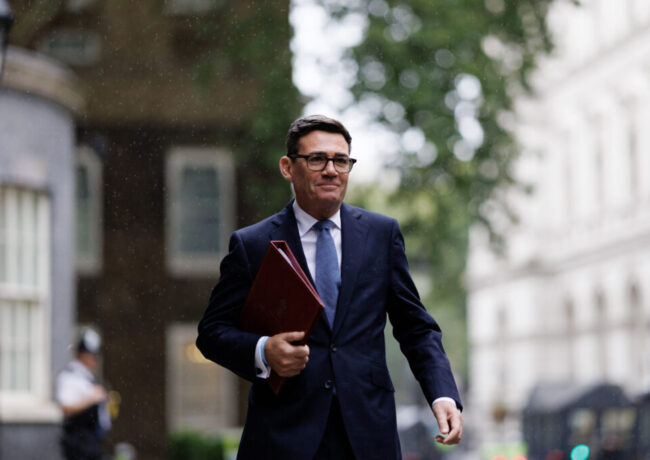
An emotional Prime Minister Andy Burnham paid tribute to his late father as he laid out his vision for a “rewired” Britain in Liverpool this afternoon, promising to roll out his Greater Manchester-honed economic recipe to every area of the country.
During an hour-long speech to the Labour Party conference, the Prime Minister said he would export a model for growth from the North West of England, which he said involved greater public control of utilities and housing, with extra powers devolved to regional mayors.
Pledging to draw a line under a “decade of drift and division”, he said he would hit the reset button on the country’s long-term relationship with the Europe and lay out “different options” for the UK’s dealings with the European Union.
“Britain has been on the wrong path for a long time,” he said.
“Deindustrialisation, deregulation, privatisation, austerity, Brexit. And what has it given us? A country for vested interests not in the public interest, with power held in too few hands and too many places left to drift.
“Today we draw the line on a decade of division… and we put the country on a new path. Britain with belief again, people with hope again.”
On housing, echoing previous announcements, Burnham said he wanted to oversee the largest council-house building programme in a generation – promising fresh powers for local authorities to build on unused public land.
He said councils would be given greater powers to act against absentee landlords, including compulsory purchasing powers for empty or poorly maintained private rented homes.
- Debate the Prime Minister’s housing strategy. Book your ticket to Place RESI
Action on utilities and the cost of living also came under the Prime Minister’s spotlight, with the plans to establish an electricity infrastructure division of GB Energy, known as GB Grid, which would compete with private firms to provide new grid connections.
The fledgling firm will reportedly be handed up to £4bn to co-invest alongside private sector companies on new energy transmission projects, aimed at getting work completed more quickly and cheaply than established network companies.
Burnham said the move would form part of a national energy plan, which would include devolved powers for regional mayors and local administrations, although he stopped short of policy specifics.
As part of plans to reform a “broken energy network”, he also said regional mayors would also be given greater powers to hold water companies to account, backed up with action to close loopholes which allow executives of failing firms to be paid large bonuses.
As expected, a long-trailed national care service was also launched, despite Burnham fearing he would “pay a political price” for changes to the welfare system.
“Our landmark policy, as significant as the creation of the NHS itself and utterly essential to securing its future: NHS savings from fewer ambulance callouts, A&E admissions, and vulnerable people being stuck unnecessarily in hospital,” he said.
“Someone has to go through the pain barrier and rip the plaster off.
“There’s only one real answer. A person-centred, high-quality care service that starts in the home. A system in the best traditions of this party where everyone contributes and everyone is covered. Free at the point of use and no care charges paid out of your basic state pension.”
On pensions, and linked to plans for the national care service, he pledged to scrap the pensions triple lock after 2029, with the state pension set to go up in line with prices, or by 2.5% each year, after the next election.
Defending the policy, he said it was still a “good deal” for pensioners, but said the “significant” savings would be used to pay for wider care service plans.
An anticipated move on electoral reform was also confirmed, with the announcement of a cross-party electoral commission to look at proportional representation ahead of the next election cycle and a commitment to include any changes on Labour’s 2029 manifesto.
“I have a theory of growth. It starts by retaking control of the essentials that make a place work or not,” he told the conference.
“You’ve got to have that control over the fundamental things that everybody needs, and from there, you devolve more power to places, to put them in charge and decide their own destiny.
“It’s time to draw a line, to move beyond a decade of drift and division, to bring a spirit of unity and positivity back to our country, to unlock that working class aspiration that is still there in every postcode.”