



The Subplot
The Subplot | Liverpool planning, Places for Everyone, new rail plans
THIS WEEK
- Julia Hatmaker examines whether the planning tide is changing in Liverpool
- Elevator pitch: your weekly rundown of what is going up and what is heading the other way

TIDES OF CHANGE
After years caught in a riptide of planning department cuts, council corruption scandals, and dodgy development deals – Liverpool may finally be making its way to the safety of shore. But are reforms from the city council head of planning Samantha Campbell the lifeline Liverpool needs?
Campbell has been part of Liverpool planning since 1999, taking on the head role in 2018. Her tenure was hit first by the city council scandal, then by the Covid-19 pandemic – a double whammy that, when you factor in austerity cuts, has meant the planning department has been doing its best to tread water. That could now be changing.
Drowning in the Mersey
Liverpool’s planning department has been understaffed and underfunded for more than a decade. Like many councils, austerity hit Liverpool hard – to the tune of £441m in spending cuts since 2010.
The planning and development services departments, which includes building control and economic development, were especially hard hit. In 2010, reports show the city council spent £55m on planning and development services. In 2021, the authority spent £19m (but only budgeted £6m). Meanwhile, Manchester spent £31m on planning and development services in 2021.
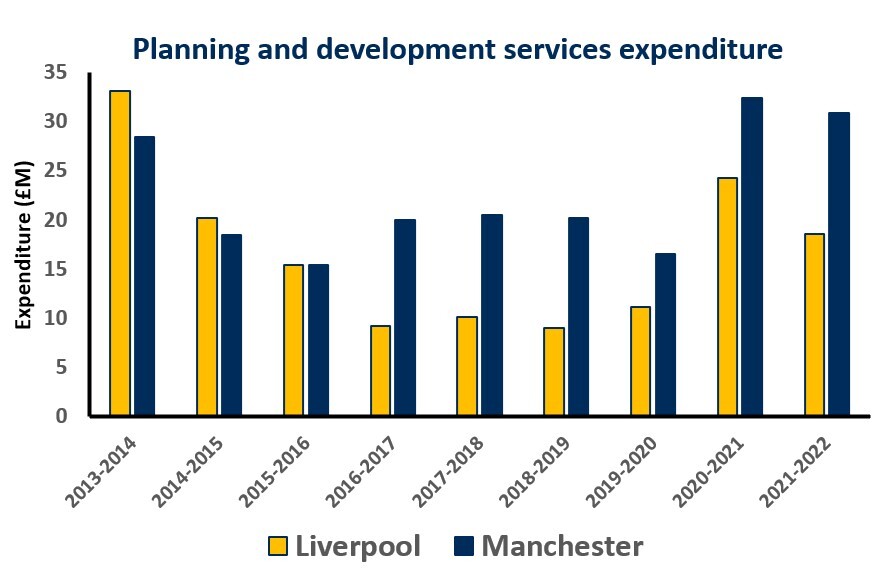
Source: Office for National Statistics
Cost cutting meant a staff reduction – since 2010, the Liverpool City Council planning department has lost around a third of its workers, going from a staff of 120 to 80.
We all know the result. Liverpool has become synonymous with a glacially paced planning system. It is no wonder that government commissioners listed planning department investment as a priority to get the local authority back on track – noting that its backlog of 300 applications was “clearly constraining development in the city”.
Financial life rafts
With commissioner endorsement, the council has increased the budget for the planning and development services department for the 2022/2023 financial year to bring it more in line with what these services actually cost. At £12m, it is still a fraction of the pre-austerity spend, but at least double what was budgeted the year before.
Zeroing in on Campbell’s planning department, the team has seen a financial uplift of £2m this financial year. This has enabled Campbell to recruit 15 more planning officers, outsource some straightforward applications, and have more time to focus on long-term strategies.
“I could do with another £2m,” Campbell tells Subplot with a laugh. “We’re not going to be up to the full fat of other core cities, but definitely we are on a really positive journey.”
Frameworks ahoy
Campbell knows what the property community says about Liverpool – that it is too slow, not transparent, and keen to deny applications. She does take issue with claims that the council is too scared to make decisions.
“We’re not afraid of making decisions – absolutely not,” she says. “We are becoming clearer with the advice I would say. But if it’s not good enough, and not good enough quality, we’re going to be pushing back because we need the best possible development we can get for Liverpool.”
In an effort to open up communication lines between private and public sectors, Campbell and her team met with architects at an RIBA event to collaborate on a vision for the city. Campbell says she wants to have another such event with the RTPI next year.
Campbell hopes that the release of a series of frameworks and supplementary planning documents will help with transparency efforts.
Tomorrow, Liverpool City Council’s cabinet votes to approve three strategic regeneration frameworks as SPDs: Commercial Business District, Cavern Quarter and Williamson Square, and Baltic Triangle. The Liverpool Public Realm Strategy SPD is also up for approval. Earlier this year, a consultation was held on a future tall buildings SPD.
These frameworks will guide development, giving those in the property industry a sense of what kind of projects the council wants to see, where they should be built, and the quality expected.
“I know what developers are saying and what they want and require from us,” Campbell says, acknowledging the need for clear decision-making. “That certainty is coming.”
Making waves
Outsourcing the planning applications has allowed the council to steadily chip away at its considerable backlog. Planning decisions are coming faster this year than in the past two. By the end of November, 3,266 applications had been decided. The entirety of 2021 only saw 2,443 applications reach that point.
Campbell beams when talking about her team and its work thus far. “I’m very proud of them,” she says. “They’re hard-working and they are objective – very objective. They’re in a much better place now that they’ve got the local plan which creates more certainty in terms of assessing applications.”
Call in the coastguard
Remember the staff that Campbell is bringing on board? They will be bolstering two new teams within the planning department: major projects and placemaking.
Campbell describes the major projects team as dedicated towards working with investors to help guide projects through the development system.
The placemaking team is focused on being proactive and establishing clear guidance for what Liverpool wants to see – such as creating the frameworks and SPDs referenced earlier.
The heads of both placemaking and major projects were internal appointments, but Campbell plans to grow the teams’ numbers (and expertise) externally – as well as use some of the allocated 15 hires to raise the expertise of the general development management team.
Staying afloat
Growing the planning department, issuing more clarity on design demands, and creating a major projects team were all initiatives met with positivity by those property industry professionals Subplot spoke to.
“On face value that’s great news,” says one Liverpool insider. “Investors want clarity, direction, and place.” This kind of planning reform and investment provides that, they argue.
Darren Muir, associate planner with Liverpool-based Pegasus Group, says he is “cautiously optimistic” about the changes and what they mean for development in the city.
“We have had some good discussions with the planning team about major development projects recently,” Muir says. “Additional staff will undoubtedly improve performance and help unlock economic stimulus across the city.”
The right course
Adam Hall, founder of Liverpool-based architect Falconer Chester Hall, was one of the architects brought in for an RIBA meeting with Liverpool’s planning team. More meetings like that are needed, he thinks.
“Let’s all come together and work together,” he says. That’s the way to ensure quality development in the city, he believes.
Colette McCormack, head of planning and partner at law firm Winckworth Sherwood, is advising on Peel L&P’s £4.5bn Liverpool Waters project, which has meant a lot of time with Liverpool City Council’s planning department.
McCormack is a fan of Campbell’s plans to interact more with the community.
“Reaching out and meeting with architects is great,” she says, adding: “There needs to be meetings with developers as well.”
McCormack will also be keeping an eye on the major projects team, an idea both she and Hall praise. The success of that team will come down to its leader.
“Whoever has that role has to understand the development process and how investment operates,” McCormack says. If the major projects team fails in that department, the whole team will be meaningless.
Hall thinks Campbell could find inspiration in London and embrace planning performance agreements.
“Issues such as hold-over costs can have a major impact on viability and a PPA essentially caps these, bringing greater clarity to one of the key risk factors underpinning an application,” Hall says.
Andy Delaney, director at Liverpool-based surveyors Aspinall Verdi, sums up the reaction to Campbell’s planning initiatives nicely. “I think it is a good starting point,” he says.
Holes in the boat
Despite Campbell’s insistence that the Liverpool planning department is ready to work alongside developers, not everyone is so optimistic that this will actually happen.
A planner who has worked on multiple Liverpool-centric schemes was one of those sceptics. For them, the proposed changes amount to bailing water when there are holes in the boat – there is a bigger problem afoot. And that problem is attitude.
The relationship between developers and the planning department feels more adversarial than collaborative, the planner says.
Another Liverpool insider agrees. When trying to get planning in Liverpool, you get block after block after block, they say. “Everything is hard work.”
Both the planner and our insider are quick to clarify what an attitude shift would look like.
“Pro-development is not pro-shoddy development,” the insider states. “It’s engaging with developers. It’s looking at how we can work together.
“Until that attitude changes, you won’t get major investment in the city.”
 ELEVATOR PITCH
Going up, or going down? This week’s movers
Places for Everyone looks poised to make a one-way trip to the ground floor. And, are rail plans on the express service to the penthouse?
 Places for Everyone
Secretary of State Michael Gove’s relaxation of housing targets could spell the end of the long overdue joint planning strategy for Greater Manchester.
Housing targets played a fundamental role in crafting Places for Everyone, one council official tells Subplot, adding that the number of homes was used to justify the number of jobs needed. Each GM council is reliant on the others for this, they say. So if Bury cuts down its housing target, then there goes employment land in Bolton.
What is more, with the relaxation of housing targets the pressure is mounting for councils to withdraw from PfE altogether – James Daly MP for Bury North has already written to Bury Council demanding the authority pull out of the spatial framework.
Subplot has been told the housing targets relaxation is as catastrophic for PfE as Stockport Council’s withdrawal for the original spatial framework. Cue another few years of planning limbo.
 New rail plans
A new rail strategy from the CrossNorth Programme has been adopted as policy by travel think tank Sustainable Transport Midlands.
CrossNorth calls for a city centre tunnel in Manchester with four underground stations: Salford Quays, Salford Interchange, Manchester Central, and Manchester Piccadilly. These stations will connect the east-west rail services and act as the first phase of a CrossNorth railway from Liverpool to Leeds – all while easing capacity on the Castlefield Corridor and enabling a metro-style system.
With Sustainable Transport Midlands on board, now all that is left is to woo Greater Manchester Combined Authority, Transport for the North, and secure funding. Simple, right?
Get in touch with Place North West [email protected]
The Subplot is brought to you in association with Oppidan Life.