Stockport’s newest neighbourhood gears up for launch
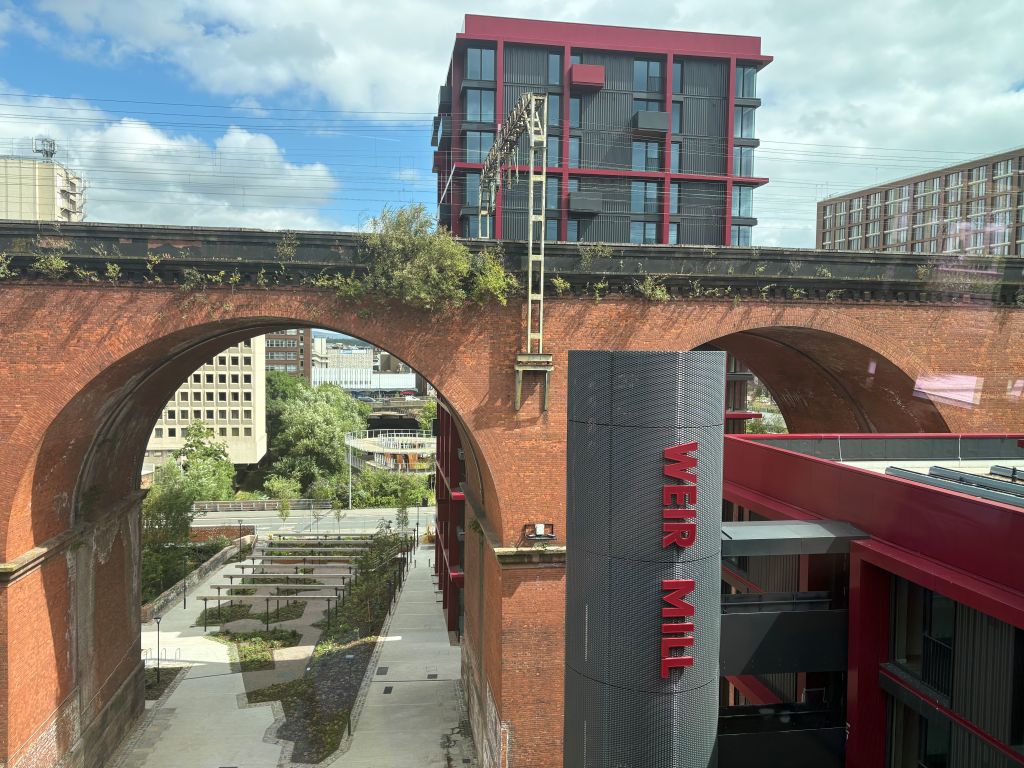
Capital&Centric’s 253-home Weir Mill is on course to complete next week and will do so with seven out of eight commercial units already spoken for after the developer opted to take a hit on rents to prioritise independent businesses it thinks will add value to the scheme as a whole.
Very often it is not until a residential scheme completes that attention turns to finding tenants for the ground floor commercial space.
At the £60m Weir Mill, the apartments will launch for rent on 22 August with a near enough full roster of restaurants, bars, cafes – and one bookshop – activating the scheme ahead of residents’ arrivals.
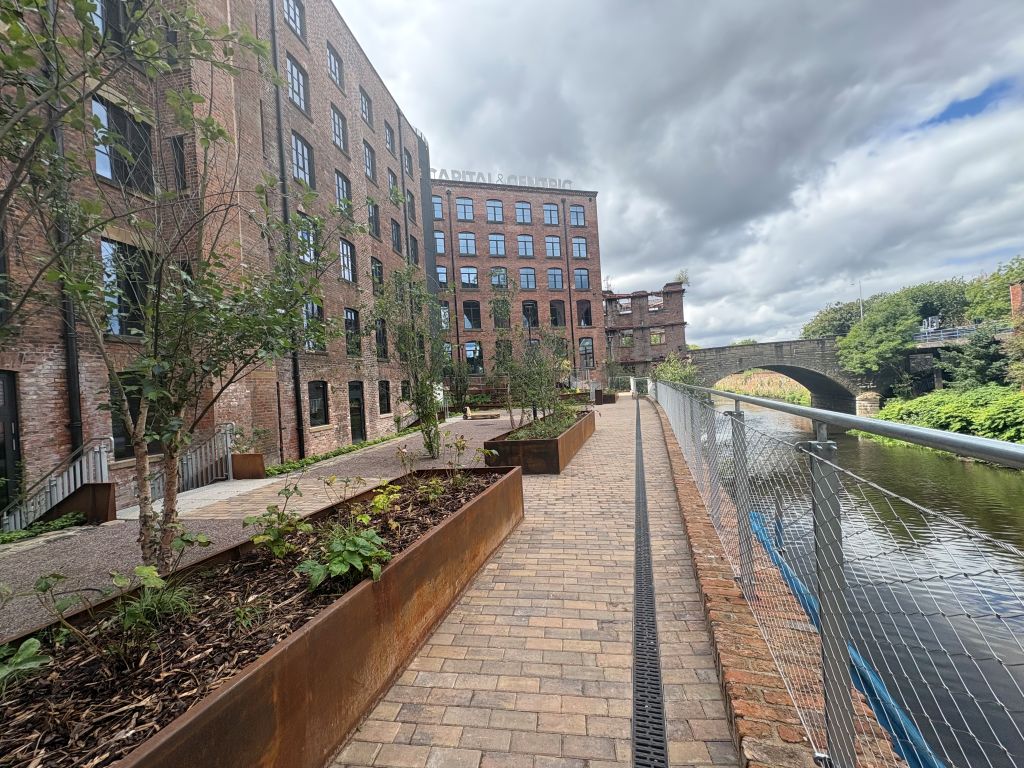
The scheme is due to complete next week. Credit: PNW
“We treat our ground floor commercial as a bit of a loss leader,” said Tom Wilmott, joint managing director of Capital&Centric.
“When we’re underwriting appraisals at the outset, we don’t put in really steamy rents on the ground floor… if we appraise this [space] with rents of £30/sq ft and no fit-out budgets…we are just setting ourselves up to fail.”
A similar approach worked at C&C’s Kampus in Manchester city centre, which also had many of its commercial operators on board prior to any residents moving in. It has become a destination in its own right and charges among the highest residential rents in the city.
A one-bed apartment at Weir Mill will cost up to £1,450 a month, which is punchy for Stockport but a £200 discount compared to Kampus. One-bed flats at Weir Mill start at £1,150 a month.
“By having a really good collective of ground floor independent operators with really good concepts, the rents on the residential will benefit from that,” Wilmott said.
“Ultimately we’re creating a place where people want to live. If we had a soulless ground floor with a load of empty units, it’s not really a place where people want to live.”

Kampus is among the most expensive rental schemes in Manchester. Credit: via Font Comms
Taking a pragmatic approach to the commercial space also provides an opportunity for independent businesses that does not have the covenant strength of a Costa Coffee or a Tesco Express the chance to grow.
“We’ll put in very conservative rents [and] very generous fit-out budgets because we know this industry is really, really tough and we know these guys need an arm around them,” Wilmott said.
“By being quite sensible from the outset in terms of what we feel we can achieve on the ground floor, we’re able to come into this setting ourselves up for success.”
The occupiers confirmed so far include Rita Ray’s, a female-led sports bar concept that, unlike many traditional sports bars, will provide a place to watch women’s sports as they grow in popularity.
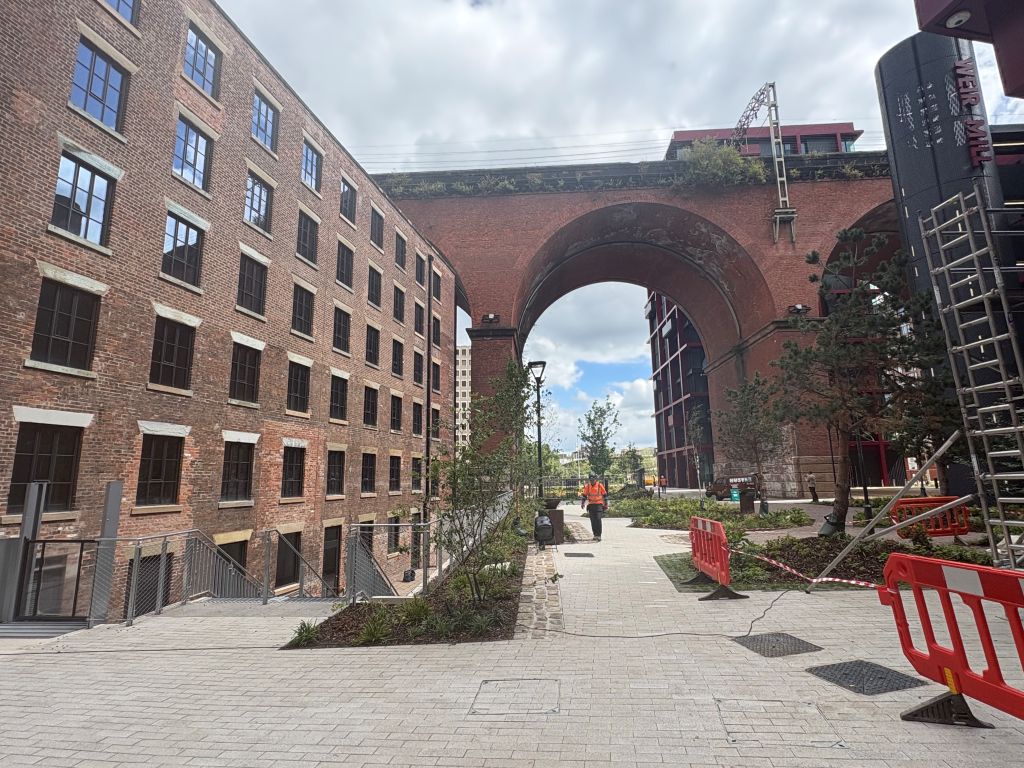
Weir Mill is located beneath Stockport’s famous viaduct. Credit: PNW
Becky Brown, founder of Rita Ray’s, explained her decision to choose Weir Mill as the location for the new concept.
“The city centre was not the right place. [I wanted] something more indie and up and coming,” she said.
“I fell in love with the scheme the first time I saw it. It feels like its own little town but it is so close to the town centre as well.”
One of her neighbours will be Social Osteria, the second venture from the team behind Social Trattoria in Poynton.
The restaurant has signed a 15-year lease at what co-founder Jeremy Hague called “very reasonable” rents.
“It is almost like they are not interested in the bog dollar, they just want a really cool place to live,” he said.
Stockport’s emergence as a foodie hotspot was also attractive to the team. Co-founder Will Okill said that if you had asked him five years ago whether he wanted to open a restaurant in the town it would have been ‘a flat no’.
But the chance to join the likes of Mekong Cat and Where the Light Gets In was too good to turn down.
Wine concept Bodega will offer wine by the glass but also offer an innovative solution for people on a budget. The bar’s subscription model will allow people to store their own wine on site and drink it in the bar.
“It will either fly or it will flop,” said Wilmott, who co-owns the business.
The full list of operators confirmed to date is:
- Social Osteria
- Rita Ray’s
- Bodega
- Pilates studio Kontrol
- Bookshop Prologue
- Bar and restaurant Jayne Eyre
Weir Mill is completing around two years later than originally planned – a delay put down mainly to the difficulties of restoring former mills that are hundreds of years old.
But regardless of the wait for what is among the most eagerly anticipated developments in the region, the council, who pumped £60m into the scheme, is pleased with the outcome.
“This kind of development shows our aspiration,” said Cllr Michaela Meikle, cabinet member for economy, regeneration and skills. “It also then helps feed into that narrative about being the best place to live.”