PLANNING | Logik tower rejected in rare Manchester refusal
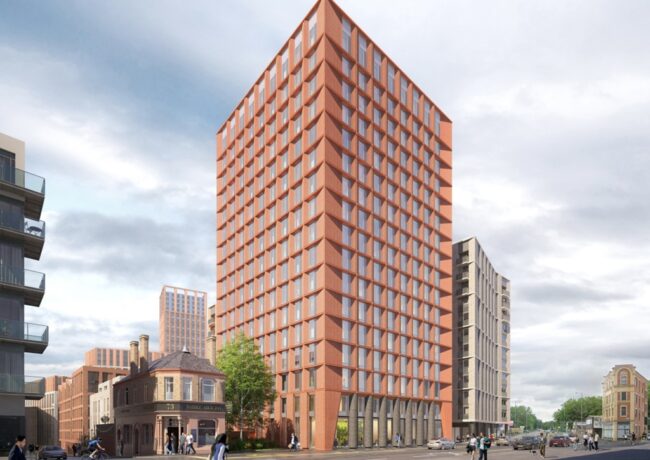
Proposals for a 35-storey tower by Andrew Flintoff-fronted developer Logik have been rejected by Manchester City Council’s planning committee, the second time this year councillors have gone against officer recommendations to approve a high-profile scheme.
Logik proposed a scheme at Arundel Street, Castlefield, designed by SimpsonHaugh and presented by planner Deloitte Real Estate that includes a total of 386 apartments in the tower, with a 10-storey building and the redevelopment of an existing low-rise warehouse alongside. The plans had already been examined at September’s committee, but a decision became deadlocked with five votes for and against.
At yesterday’s meeting, there were passionate representations against the project by the Britannia Bay Community Forum, represented by Louise Pullen, as well as Hulme ward councillors. Pullen said: “There have been no concessions, no amendments, some talk but no action. We’re not saying we don’t want development here, but we do want the committee to reject this and the proposal to be re-designed, to give Hulme something to be proud of.”
Heritage architect Stephen Levrant spoke in favour of the project, arguing that the assumption that tall buildings cannot be developed alongside heritage assets is a “fallacy”, adding that “history doesn’t stop, and these can be the heritage buildings of tomorrow”.
The committee was not won over, with Cllr James Wilson stating the view that the development would dominate the Castlefield conservation area, particularly the grade two-listed St George’s church. At the final count there were seven votes against the scheme.
This year has seen a step change in how Manchester City Council’s planning committee has dealt with projects. The council’s planning department works closely with developers prior to an application being formally submitted, meaning that by the time a scheme reaches committee it comes with a recommendation to approve. Historically the elected members on the committee followed these recommendations, but in recent months there has been heated debate in the council chamber. The start of this year saw aparthotel plans at Shudehill by developer Salboy come to committee three times; each time councillors criticised its height while planning officers justified it, and finally the project was refused.
This change has been attributed by many in the development community to last year’s departure of council chief executive Sir Howard Bernstein. Bernstein was keen on enabling construction and easing the path for investors into the city, and Manchester’s planning process was seen as an efficient one for those developers who gained his support. However since he retired from the council in March 2017, the outcome of planning committees has become less predictable.
While vocal elected members and debate over the appropriateness of developments can be viewed as a triumph for democracy, uncertainty over planning results may be off-putting for developers who previously saw Manchester as a straightforward city to build in.
Meanwhile, at the same committee MMU secured consent for its plans to build 491 apartments in blocks ranging from six to 16 storeys in height at the Birley Fields site, close to the Hulme Arch. GWP Architecture is the project’s designer, with Deloitte again advising on planning. The site had an existing outline consent for 475 apartments.
Hulme councillors objected to the project, speaking on behalf of residents of neighbouring Hornchurch Court, but the proposals won through.