



Nandy says Wigan remains open to development despite flurry of defensive moves
Cabinet minister and Wigan MP Lisa Nandy insisted the council’s opposition to some large-scale employment schemes in the Green Belt does not mean the authority is anti-growth.
Speaking to Place North West at the Labour Party Conference in Liverpool, Lisa Nandy said the local council was open to working with private sector developers but that it also had an obligation to act on residents’ concerns.
Wigan’s Labour administration is under fire from locals over the Astley warehouses debacle – the construction of large sheds close to homes that has angered residents – and has, in recent weeks, sought to appease the electorate ahead of next May’s local elections.
To do that, the local authority has pulled four Green Belt sites that had been earmarked for 5m sq ft of employment space from its emerging local plan.
“The first draft of the local plan caused a lot of anxiety for people,” Nandy said. “In some parts [of Wigan], the Green Belt land that exists there really does protect the character of those individual communities.
“It’s exactly what the Green Belt was designated to do when it was originally conceived decades ago: to make sure that communities could protect their individual identity [and] weren’t just sucked into the urban sprawl and become any place.”
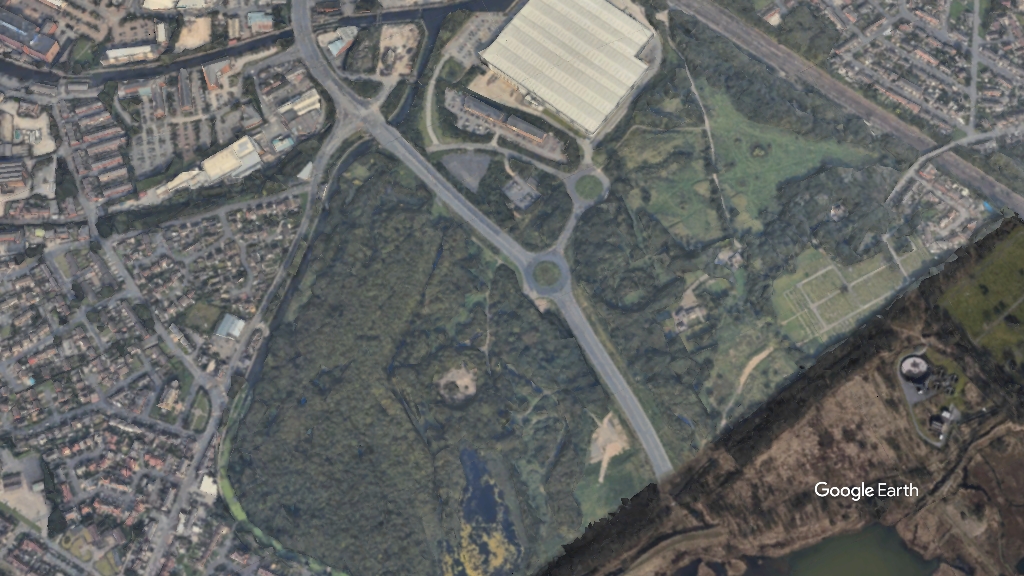
Wigan has also formally objected to Peel Land’s plans for Gibfield Park, a 173-acre mixed-use scheme featuring 375,000 sq ft sq ft of employment space. The site is earmarked for development in Places for Everyone, the joint spatial plan for Greater Manchester that Wigan voted to adopt.

Peel Land’s Gibfield Park is one scheme Wigan has voiced its opposition to. Credit: via Turley
Last week, the council also unanimously backed a motion put forward by the authority’s cabinet member for regeneration Cllr Dane Anderton to object to plans for an 8.2m sq ft logistics scheme that developer Tritax claims could create 6,000 jobs once operational. While most of Tritax’s IPL North would be located in St Helens, Wigan’s portion of the site could accommodate 2.4m sq ft of units.
The council’s change in approach to development contributed to director of place Aidan Thatcher’s decision to leave the authority earlier this month.
Nandy said Wigan is “certainly not” anti-development and believes there are brownfield sites elsewhere in the borough that could be used to create jobs.
“They may not be as lucrative to developers, but they are a better option for local people,” Nandy said. “It’s really important to us that we deliver not just for local people but businesses as well.”
Combined, Wigan Council’s recent interventions in Wigan’s project pipeline could cause private sector developers to take a more cautious approach to the borough when it comes to looking at where to deploy capital.
“My message to those developers would be: come and work with us. Wigan is a booming place…and it definitely has a council that is really, really open to working with developers.
“[Its] definitely not a hard-line approach to development,” Nandy added. “We’re not anti-growth, we’re not anti-development, but it’s got to be right for local people.”