


Muse leans on residents to wake Salford’s ‘sleeping giant’
The developer and its project team are tapping into the desires of a prideful population as they bid to reverse the 20th century planning mistakes that led to the failure of Eccles as a town centre.
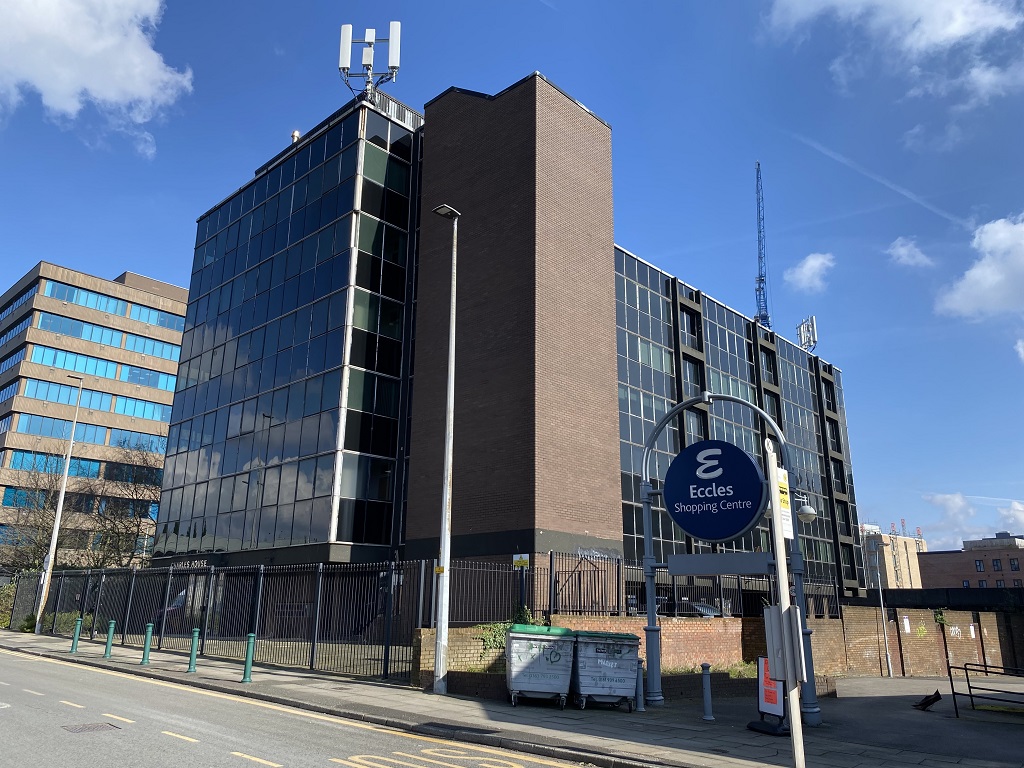
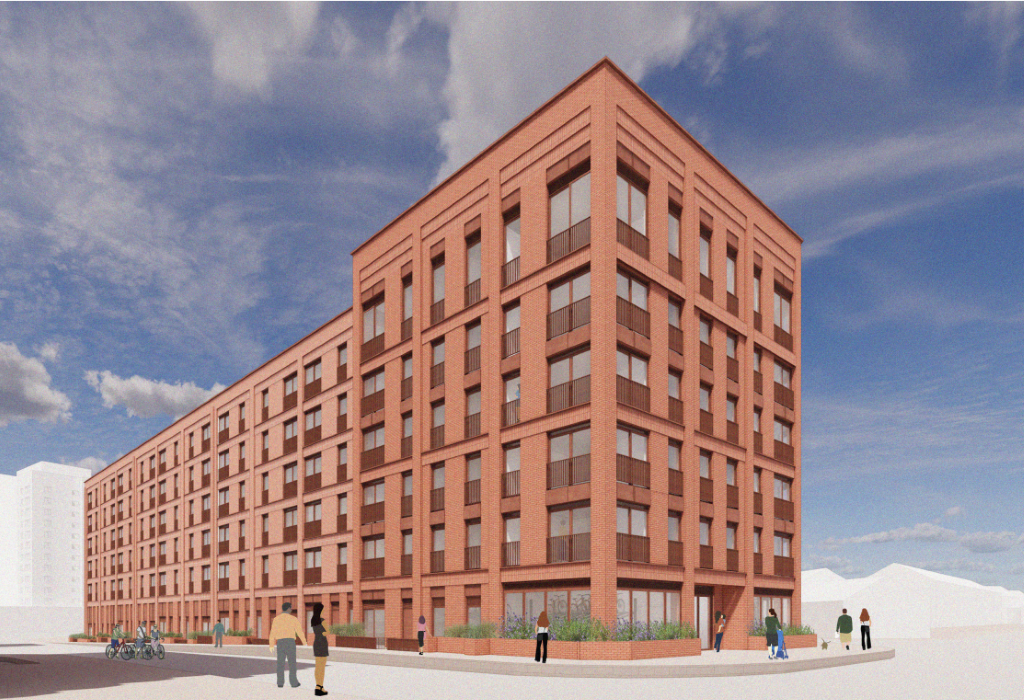
Since the beginning of March, residents have been providing their views on replacing the defunct shopping centre that the city council acquired in late 2023 with almost 1,300 homes.
Change is often hard to swallow for local residents and bulldozing a shopping centre that was much-loved and well-used for a period of time with that many homes is the type of thing that can rub people up the wrong way.
However, in Eccles, the local community appears to be on board with the vision being put forward by Muse and its design team.
“You can get quite a lot of aggro at public consultation,” said Jon Matthews, founder of Jon Matthews Architects, which is leading the redesign of Eccles.
“Sometimes there’s a lot of anger in the community about what’s happening. I’ve not picked that up on this one. What I’ve picked up is a lot of civic pride and people desperate for change and for a better Eccles.”
The second round of consultation on plans to regenerate Eccles ends today, but there is still time to have your say.
The team behind the proposals has immersed itself in the history of Eccles and listened to the people who know it best to understand how best to proceed.
“That shared voice is fundamental,” said Alex Vogel, senior development manager at Muse.
“You can’t go into a place not knowing anything and think that you know best and start designing things up.”
Muse is delivering large scale regeneration projects in the majority of Greater Manchester’s 10 boroughs, a fact that has raised concerns in some quarters about the risk of the conurbation becoming homogenised.
Both Vogel and Matthews remarked on the feeling of pride that emanated during conversations with locals and know that a cookie-cutter approach to regeneration will not fly in Eccles.
“You can always take learnings from other areas and from other schemes and projects but you have to be very, very careful not to just assume a blanket [approach],” Vogel said.
“Something that I take quite a lot of pride in is the fact that [Eccles] gets designed and gets shaped by the conversations that you have with the local community.”
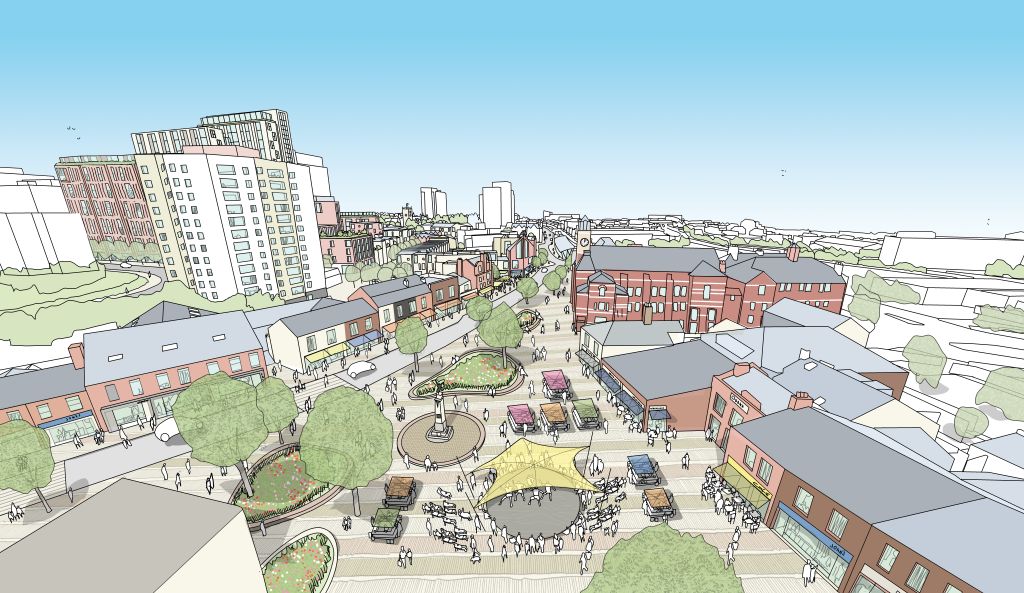
Breathing life back into Church Street is a key part of the plans. Credit: via Turley Strategic Comms
So, what do the people of Eccles want? Matthews recalls a conversation with one man at an early consultation event.
“[He said] we don’t want a new Altrincham. We just want a better Eccles.”
To some extent, Altrincham has become a byword for regeneration, at least in Greater Manchester. Its revival from failing to thriving is regularly used as an example of what is possible.
But copying and pasting the Altrincham approach would not work in Eccles, given its unique challenges.
The team leading on the regeneration effort wants to acknowledge and address what Matthews describes as “20th century planning mistakes” that caused the town centre to “fail miserably”.
Chief among these missteps was the decision to replace the town centre housing that defined Eccles in the 19th century with a shopping centre.
The scale of residential development planned in the 21st century is aimed at “repopulating” the town centre for the post-retail world.
The shopping centre, which will be pulled down, failed after the Trafford Centre and West One Retail Park opened nearby at the turn of the century. Many locals also claim Morrisons, located at the heart of the town centre, also expediated the town’s demise.
By building homes that could accommodate more than 3,000 residents, the aim is to create a consumer base to fuel a modern, consolidated retail and food and beverage offer, Matthews explained.
While Altrincham’s market is the centrepeice of its revival, Church Street, named for St Mary’s Church, understood to be the oldest grade one-listed building in Greater Manchester, will be Eccles’ crowning glory. It is envisaged the street will provide a landing spot for independent retailers, restaurants, and coffee shops.
“The overriding issue from the first consultation was the people of Eccles want Church Street revitalised back to what it was,” Matthews said.
“We want to get people back in. Getting people back in and homes back in there will drive the economic growth of the town centre,” he said.
“It is a sleeping giant. It’s a failed town centre at the moment but it could be a regionally special place.”
Crucial to the success of the scheme will be the mix of homes provided. If it is all expensive apartments or all social housing the project will fail.
“We see a really wide breadth of tenure and people because we want to attract old people, families, and young people,” Matthews said.
“We don’t see it as a middle-class ghetto or a social ghetto. We see it as something which represents the wide diversity and demographic of Eccles.”
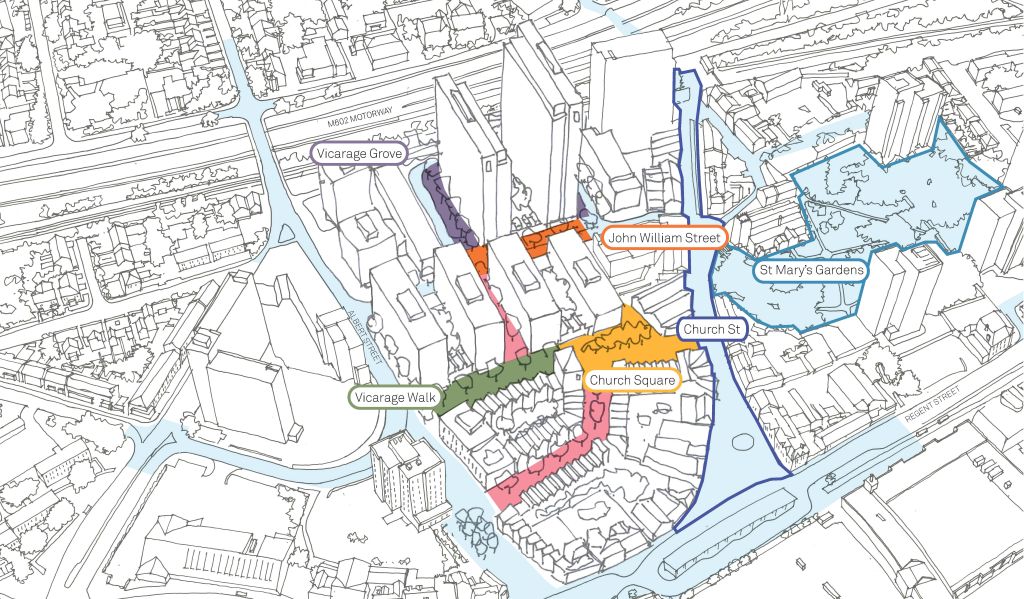
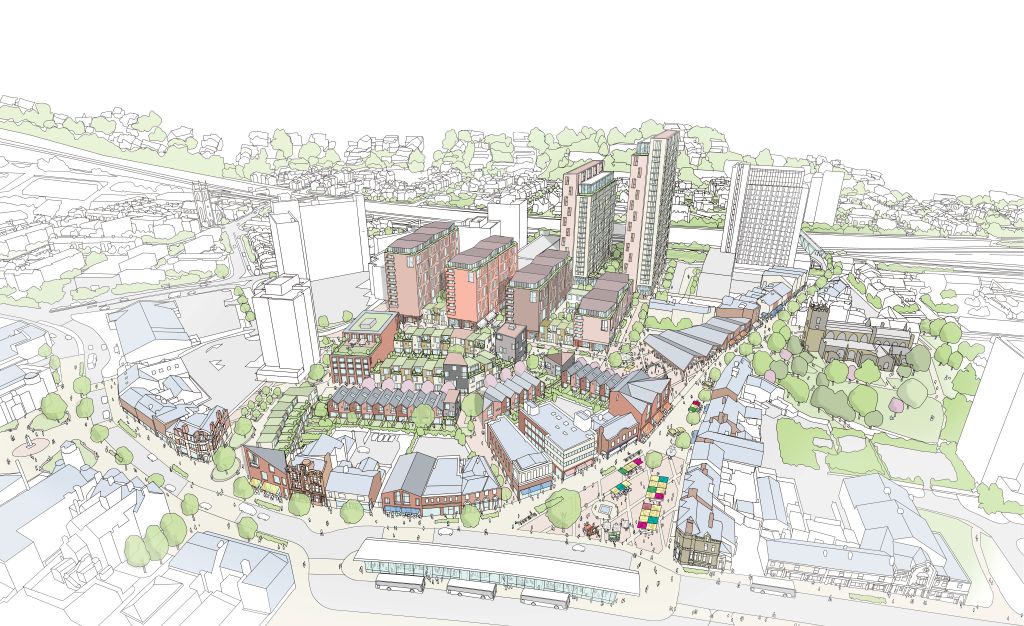
Permeability is a theme of the proposals. Credit: via Turley Strategic Comms
As well as delivering places for people to live and spend time, the regeneration of Eccles will result in a town centre that is easier to move around.
The confusing one-way system will be de-engineered, while various traffic calming measures like pedestrian crossings will be added.
Connections between Albert Street and Church Street will be drastically improved through the creation of Vicarage Walk and Church Square, which will provide a link through and public space at the heart of the town centre.
Longer term, the plan is to improve links between Eccles and the Manchester Ship Canal to the south and the areas to the north including Monton, Ellesmere Park, and the hospital, which Eccles has been cut off from since the construction of the M602 in the 1970s.
Connectivity into Manchester is often seen as Eccles biggest strength. While the motorway to the north has arguably harmed the vibrancy of the town centre it offers would-be residents quick access in and out. Eccles is also served by train, tram, and bus taking people to and from the city centre, MediaCity, and elsewhere.
Matthews recalls another conversation with a local about Eccles’ reputation as a well-connected place that punches below its weight.
“[She said] people are using those connections to get out of Eccles [and] it’d be great if those connections were used to bring people back into Eccles.”
While Eccles’ enviable transport infrastructure is undoubtedly a strength it also presents a challenge to Muse. Strong fundamentals coupled with an ambitious regeneration vision mean that the town is at risk of becoming gentrified.
Vogel admits the balance between regeneration and gentrification is “difficult” to strike.
In Eccles, he said, the aim, is to create a place that can accommodate current residents and attract new ones who might not have considered it as a place to live before. The vision is also to preserve its community, culture, heritage, and identity “rather than just going, okay, we’ll throw Gail’s in there”, Vogel added.
Coffee shop chain Gail’s has, in the eyes of many, come to represent gentrification and its arrival has been resisted in many places.
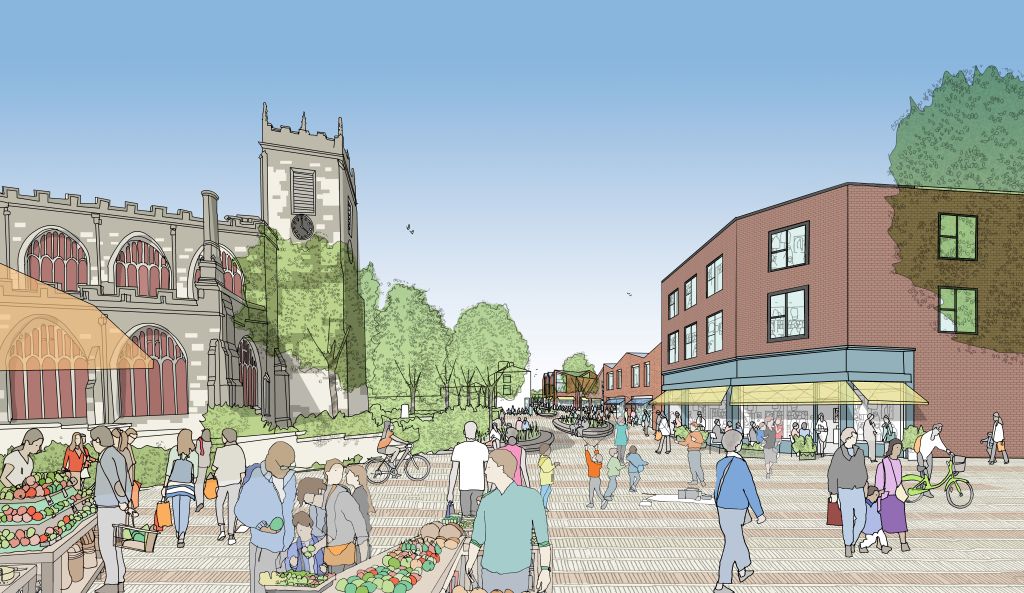
Muse wants to make more of St Mary’s Church’s history and proximity to the scheme. Credit: via Turley Strategic Comms
If residents feel like Eccles is being stripped of its identity, they will let Vogel know.
The pride residents have in being from Eccles is the town’s biggest asset, he said.
“[We have had] hundreds of people turning up [to consultation events] because they’re interested. They’re excited themselves,” he said.
“It’s been one of the most well-attended conversations that we’ve had and probably the most fun.”
Fun is not a word developers might typically use to describe a public consultation event, which bring to mind visions of protests in parish halls.
However, by taking a grassroots approach to the redevelopment proposals, Vogel claims much of the usual animosity has been avoided.
“The first [consultation event] was back in the autumn last year. It was very much, [about asking] what do you want to see? What do you think works? What do you think doesn’t work?” Vogel said.
“You’re working with the community to develop it so they can almost see their own ideas come to fruition and understand how it works and why it’s been done.”
One of the biggest gripes people tend to have with regeneration is how long it takes or, even worse, suspicion that it might not happen at all.
The chances of the Eccles regeneration being made flesh are enhanced significantly by the fact it happens to be in Greater Manchester, where the political will, policy framework, and, as of recently, financial firepower, exist to turn ideas into reality.
Muse has already benefitted from the GMCA’s £2bn Good Growth Fund to the tune of more than £100m for projects in Stockport, Oldham, Prestwich, Wythenshawe, and Salford Central.
Eccles could be next; the town, a place in urgent need of a new lease of life, fits the bill for what Mayor Andy Burnham is trying to achieve with the Good Growth Fund. And, if the project comes forward how Muse and its team want it to, there is no reason why Eccles cannot become as synonymous with town centre renewal in the middle part of the century as Altrincham has been in the early part.
“There’s a there’s a big weight of responsibility on the whole team, because we need to get this right. We need to stop that decline,” Matthews said.
“If you put a microphone in someone’s face in 15 years and they said, ‘I’m really proud to live here’ I think that is what success would look like.”