



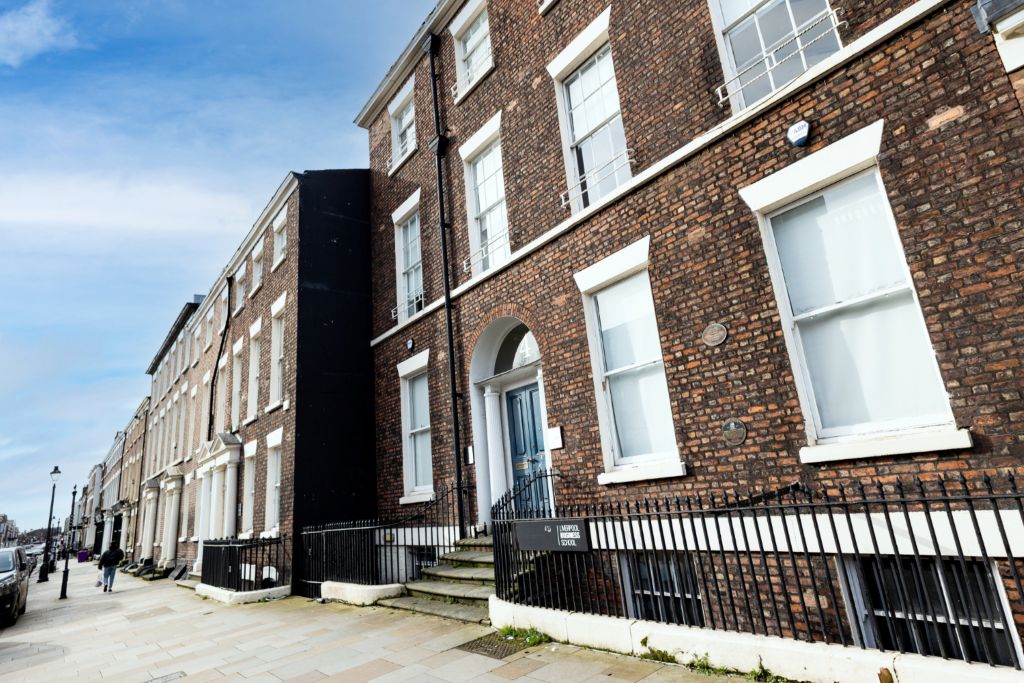
LJMU puts Rodney Street buildings on market
Liverpool John Moores University has decided to sell two Georgian townhouses with redevelopment potential, with a guide price of £2.7m for both.
Both buildings are former teaching spaces and no longer needed by the university. Combined they offer more than 17,400 sq ft of space in the midst of Liverpool’s Knowledge Quarter.
The largest of the buildings is 4-6 Rodney Street, which is being used by Liverpool Business School. It comprises a 12,000 sq ft main building with two gatehouses and parking spaces to its rear. The guide price for this building is £2.1m.
The smaller is 10 Rodney Street, a vacant building of 5,400 sq ft with rear parking. Offers of more than £600,000 are being accepted for this property.
Keppie Massie is marketing the Rodney Street buildings for LJMU.
“These properties are located in one of Liverpool’s most elegant and historic streets and both are suitable for a range of different uses, so we anticipate a high level of demand from institutional investors, developers and individual buyers,” said Keppie Massie director Tim Garnett.
He added later: “This is indeed a rare opportunity to acquire a slice of Liverpool’s history and repurpose each townhouse to enjoy a prosperous future.”
LJMU has been consolidating its estate over the past year, while investing in refurbishing buildings to be carbon neutral. The university put its 20-acre IM Marsh site in Aigburth on the market last year. Also due to hit the market soon will be 2 Rodney Street, as per the university’s estate’s strategy.
One for your esteemed editor: Number 4 Rodney Street was the United States of America’s first overseas diplomatic mission, opening in 1790 as its Consulate. James Maury was the Consul General.
By More Anonymous than the Others
Oooh that is a very fun fact! Shame I don’t have £2.1m to return the property to American hands.
By Julia Hatmaker
@MATTO 3:51. I Was always under the impression that the first site was in Paradise street with the American Eagle above the door. They later moved to the Washington buildings in Brunswick Street.
Was Rodney Street, the Consulars private residence by any chance?
By Liverpolitis
Another one for the editor, during the American Civil War there was an unofficial Confederate Embassy further up Mount Pleasant at19 Abercromby Square.
By Anonymous
And another…the US government was so incensed at Liverpool’s role in arming the Confederates and its role in funding and running its navy during the Civil War that it threatened military action against the UK.
The dispute was settled by the Treaty of Washington 1871, which saw the UK cough up the equivalent of £1.5bn in reparations and officially apologise for Liverpool’s, er, errant ways.
By Historian
Oh, go on then… The final act of the American Civil War was the surrender of the Confederate raider the CSS Shenandoah on the steps of Liverpool Town Hall a full six months after hostilities had ended.
The captain, whilst raiding near Seattle, learned of the end of the war and death sentence that awaited all crew as pirates, so circumnavigated the globe, returning to the ship’s home port of Liverpool where he negotiated the surrender of the ship to British authorities in return for clemency. This was granted after a full legal review.
By Anonymous
@Liverpolitis is indeed correct: the consulate was on Paradise Street, whilst No 4 Rodney Street served as the consul’s very fine home. Would be good to see it restored to a private residence.
By More Anonymous than the others
Another interesting note from the past, it can be claimed that the American Civil war began and ended with Liverpool connections the cannons that fired upon Fort Sumpter were cast in Duke Street and the last Confederate vessel the Shenadoah as mentioned surrender on Liverpool, with many of the crew settling there.
So this could be a great opportunity for some enterprising group to develop the building into a musuem or themed Town House for our colonial cousins to stay at?
By Liverpolitis
Totally agree with Liverpoolopolis- so much rich history and connections between Liverpool and events of the American Civil war including a huge bazaar held in St George’s Hall to support widows and children of the war. Definitely important historically and would be wonderful to see it turned into a museum to mark these connections and the history behind America and Britain during this era
By Anonymous
I did my BA (Hon) in Business Studies from 1982-1985 in this building ; and had a fantistic time there. As matured student and owned numerous businesses in Liverpool- we were allowed to smoke cigarettes in the class as liberal freedom of higher education and grabbed a couple of pints across the quiet garden by Hardman’s Street. Those were the days my friends- sorry to see it goes!
By Alumni
Oh dear. I fear for their future in this day and age. Hope someone keeps a close eye on it
By Eric
I really hope that the frontage is kept the same and the work is done in a simpathic manner because we need to keep Rodney Street as beautiful as it is in our lovely city which I dearly love 🤞
By Anonymous