



Cement producers’ pipeline plans take shape
A consultation process is live for Peak Cluster, a project led by four cement and lime companies aiming to capture the carbon dioxide they generate and store it permanently under the Irish Sea.
Named Peak Cluster, the partnership said the project will help to secure the future of Britain’s cement and lime industries – safeguarding and creating jobs and ensuring a reliable, ‘homemade’ supply of the materials. Combining public sector backing and input from the firms involved, £60m is in place to take things forward at this stage.
As Peak Cluster explains, the production of cement and lime unavoidably generates CO2 – the single largest contributor to climate change.
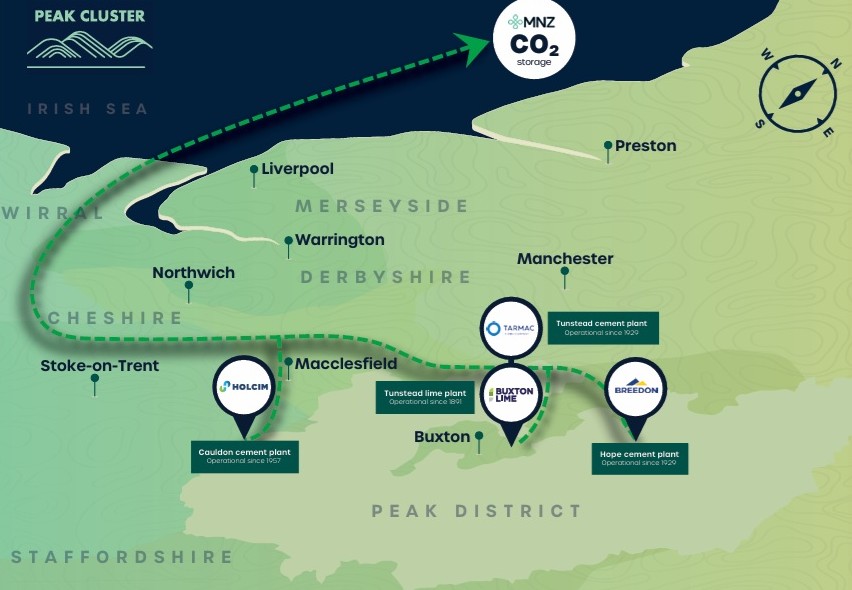
To meet this challenge, the group said it will use carbon capture technology to lock away CO2 emitted at Holcim’s Cauldon plant, Tarmac’s Tunstead cement plant, Buxton Lime’s Tunstead lime plant and Breedon’s Hope plant.
The CO2 will then be transported in a purpose-built underground pipeline through Cheshire and the Wirral to Morecambe Net Zero, a central CO2 storage facility under the seabed, to be operated by UK energy company, Spirit Energy.
The project is entirely separate from the HyNet programme, for which Liverpool Bay, which has a smaller capacity, is the intended location for carbon storage.
John Egan, Peak Cluster chief executive, said: “Peak Cluster is such an important project for Britian’s economy – helping to protect our vital industries and securing highly-skilled jobs. With cement imports having tripled in the last 20 years, and domestic production at its lowest level since the 1950s, there has never been a greater need to build a resilient, sustainable supply.
“Peak Cluster will be the world’s largest cement and lime decarbonisation project – using proven technology to establish the UK as an international leader in responsible, sustainable manufacturing.”
Derbyshire and Staffordshire firms account for 40% of the UK’s cement supply.
This is the first consultation phase for Peak Cluster, and will run until 27 February.
Early studies for the project began in 2020, and the hoped-for timeline is for the system to be operational by 2032. For that to happen, further consultation later this year would be followed by submission for a development consent order in 2027, with a DCO required by 2029.
Although carbon capture and storage projects haven’t advanced as rapidly in the UK as many would have hoped, a presentation by Egan, hosted on the Peak Cluster website, spells out how in Norway, the Sleipner and Snohvit projects have each been capturing 1m tonnes of carbon dioxide per year, for 27 years and 15 years respectively.
Closer to home, projects advancing include Heidelberg Materials’ work at Padeswood. And heading in the other direction from the East Midlands, infrastructure firm Cadent revealed plans in January for a 90-mile hydrogen pipeline connecting Nottinghamshire to the Humber.


In terms of years, how long will it take to reach storage capacity?
By Drew
Good luck trying to get built through the Wirral. You will meet fierce opposition from residents and disruptors. They dont like their countryside being dug up. And that’s goes for developers who are thinking of submitting speculative applications. Do it at your peril. You may feel emboldened by this government’s relaxation of planning regulations, but be under no illusion — you’ll face fierce opposition and disruption.
By Geoff Lewis
Would there be synergy in agreeing one pipeline for this and HyNet with them then branching off as its hits the coast to the two proposed storage fields. The pipeline proposal already seems to be creating opposition along its route so two pipelines will undoubtedly create more concern.
By Anon
– How much will the overall project cost to deliver?
– How. much will the project cost to operate?
– Who will be paying for i) the project delivery and ii) the project operation?
– How much CO2 be produced by the overall project delivery?
– What are the negative long-term implications?
– as “Anon” has suggested, surely synergy would be achieved by combining pipelines.
By Different Anon
I was noticed already ill informed opposition forming , political opportunism this is just an attempt to get votes without any real basis for opposing this important project which once the pipe is reburied it won’t be visible . Just like the hundreds of gas and water pipes already in place .fortunately this is a national project which doesn’t need local approval
By George
Who ever did the above map needs his eyes testing Northwich is actually to the right of warrington!
By Northwich
What will local residents get out of this. For example make the local area beyond the new pipe line beautiful and tidy for LIVING like the New cleaner air we are going to breathe in after the competition of this very messy job. Pipe line must be done, BEST OF LUCK.
By John Chesters
Northwich, you may need your eyes testing too. If you note the north point, you will see that Northwich is to the east of Warrington!
By Anonymous
Oh dear Northwich, think before speaking/typing
By Anonymous
Do we really need to gauge another wiggly route to the sea out of the country side?
Could the pipeline not go in the ship canal, the route we’ve already cut out but barely use anymore? Or, in the regular canal network, that is relatively barely used any more? Or, next to the long overdue improved railway lines? Or next to one of the many roads we’ve already cut into the route?
By Anonymous
You will meet fierce opposition from residents and disruptors. We dont like the countryside being ruined.And that’s goes for developers who submit speculative applications. You may think this government’s relaxation of planning regulations will allow this. I strongly disagree with these proposals.
By Ms McCourt