


Six historic North West sites ‘at risk’
Among those places added to Historic England’s Heritage at Risk Register are the grade two-listed St Alphonsa’s in Preston and Middleton Conservation Area in Rochdale.
As six historic sites in the North West have been added to the register, another three have been removed and deemed to have a secure future. These restored sites are Capernwray Hall Park and Garden in Lancaster, Church of the Ascension in Salford, and Oldknow’s limekilns in Stockport.
Sites added to the register are located across Manchester, Lancashire, and Cheshire, and include Blackpool’s North Promenade.
Being added to the register that the buildings are at risk of neglect, decay, or inappropriate development, and could be lost if nothing is done to repair or restore them. There are currently 413 North West buildings, parks, and conservation areas on the Heritage at Risk Register.
Historic England has awarded £730,000 in grants for repairs to 12 of these sites in the North West in the past year.
“Protecting our heritage is so important and it is truly inspirational to see communities coming together to help save historic buildings and places and find new uses for them”, said Catherine Dewar, Historic England’s North West regional director.
“The Heritage at Risk programme shines a light on our historic sites most in need and can help to attract funding and help.
“After a quarter of a century of the Heritage at Risk Register, we are celebrating how many places have been saved, and continue to find new ways to involve local people in caring for and enjoying their heritage”, Dewar concluded.
Arts and heritage minister Lord Parkinson of Whitley Bay added: “For a quarter of a century, the Heritage at Risk Register has helped to focus efforts to preserve cherished sites across the country.
“It is heartening to see that so many sites have had their futures secured and have been taken off the register over the past year thanks to the hard work of Historic England and local people.”
Here are the sites that have been added to the Heritage at Risk Register this year:
St. Alphonsa Of The Immaculate Conception Cathedral in Preston
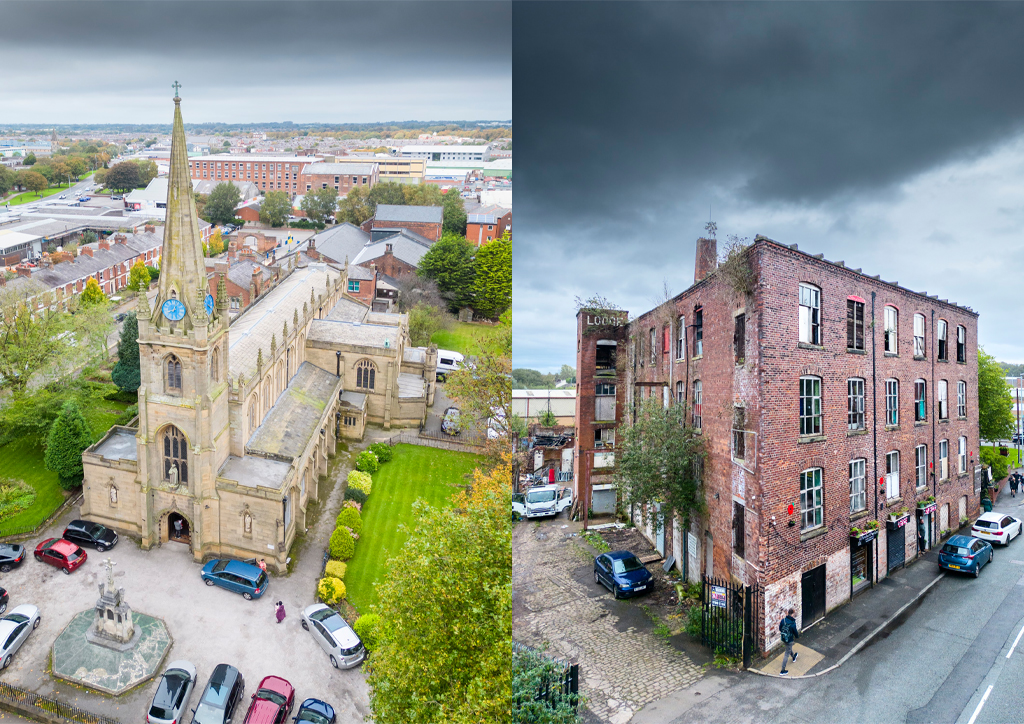
Formerly known as the Church of St Ignatius, the grade two-listed church was built in the 1830s and is the focal point of the St. Ignatius Square Conservation Area. Dating back to the 1830’s, the building has been added to the register as it is suffering from rot and movement in its high level masonry, despite various phases of repair.
Middleton Conservation Area in Rochdale
Centred in Long Street and Market Place, the area boasts a selection of works by the prominent architect Edgar Wood. Also incorporated is Jubilee Park, the grade one-listed medieval church of St Leonards, and historic industrial buildings including Lodge Mill.
Historic England is working alongside Rochdale Council, funding a combined grant of £35,000 to restore the site, which has lost its historical character and is not reaching its full potential due to recent highway alterations.
This funding will build on the local council’s recent Townscape Heritage Initiative, which resulted in the restoration of a number of historic buildings in Middleton town centre, including the Long Street Methodist Church.
Church of St Thomas the Martyr in Up Holland
Dating back to the 14th century, the grade one-listed off Church Street in the Lancashire village has been added to the register due to the poor condition of its exterior. Previous repairs have also allowed vegetation to take root and moisture to enter, resulting in a large-scale outbreak of dry rot. Despite efforts to repair, the issues causing water to enter remain.
Church of St Michael in Macclesfield
Situated at Market Place, the town centre building’s principle extensions date back from 1501 to 1628. Although recently refurbished and still fully-used, the medieval church’s principal roofs are nearing the end of their life, in addition to the gutters. Additionally, some 15th century sculptures have been damaged due to water entering the chapel.
Heaton Park Colonnade in Manchester
Formerly the entrance to Manchester’s King Street Town Hall, the grade two-listed structure is made up of four ionic columns and has been added to the register due to its deteriorating condition. Movement of the high-level pediment stones, the failure of roofs, and heavy delamination of the stone face have led to the vulnerable condition of the colonnade.
Manchester City Council has built a fence to secure the structure and gained consent for repair works in 2019, however the main works are yet to be undertaken.
North Promenade in Blackpool
The conservation has area has been added to the register with the council noting issues with high levels of unused and the loss of buildings, poor quality repairs, and poor signage, as well as a lack of maintenance. The council has highlighted that the loss of buildings and high vacancy rates in particular means that there is a high risk of further loss.