



IN FOCUS | Beleaguered hospitality sector seeks sweet relief
As a general election looms, struggling businesses will be listening closely for a hint of anything that could help them survive the economic storm that has already claimed some much-loved haunts.
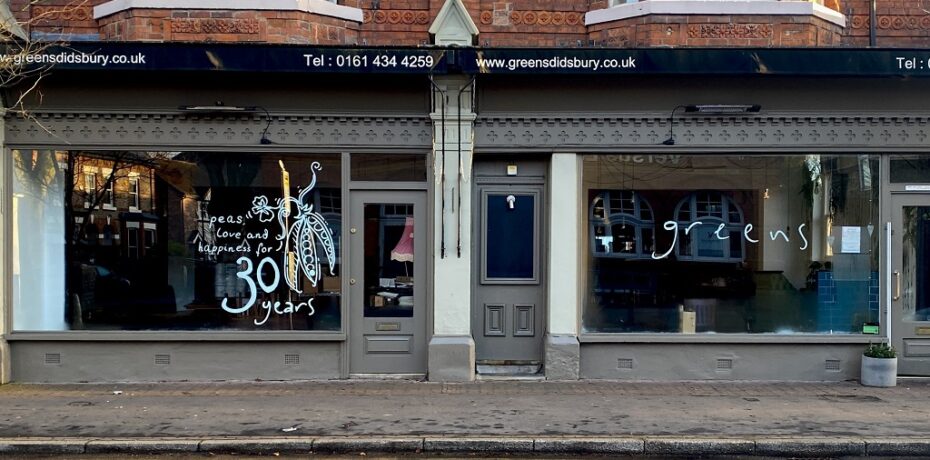
In recent weeks, several well-known outlets have succumbed to the tough market conditions. The closures of Greens in Didsbury and Evuna in Altrincham are viewed by many as the tip of the iceberg in what could be a long cruel winter for the sector.
Failure to launch
The hospitality industry should be thriving. Footfall in Manchester was up almost 10% in 2023 compared to the previous year and visitor numbers were also up in Liverpool.
Consumers are on the lookout for more experiential town and city centres and spaces left by departing retailers present opportunities for food and beverage operators to move in.
Indeed, food and beverage provision on our high streets is on the up. According to research by business consultancy CACI, the vast majority of North West towns and cities have experienced an increase in F&B provision since 2019.
“Three of the four biggest asset classes, city centres, regional malls, and satellite centres have seen a 100% increase in the share of space being given to F&B and leisure in the North West,” said Arabella Dalloz, head of leisure at CACI.
Household names like Tim Hortons, Subway, KFC, and McDonalds, as well as bars chains like Slug & Lettuce, have seen sales rise recently, according to CACI.
This will provide little comfort for independent businesses.
A perfect storm of economic unrest is making life difficult for the sector’s smaller players, which are dropping like flies because of inflation, high VAT, increased rents, and dwindling consumer spending.
“[Small businesses] won’t have the financial cushion of a larger portfolio of sites and will struggle to absorb the associated costs from increased inflation and rising living expenditures more so than their larger competitors,” said Dan Davies, director at Metis Real Estate.
Given the pressures on independents, where new openings do occur in 2024, they are more likely to be global names and chains than new market entrants.
While many of the big brands thrive, smaller outfits are left reeling from economic uncertainty.
This could have a significant impact on ongoing plans to reinvent the region’s towns. The likes of Bruntwood, Muse, Capital&Centric, and others regularly speak about the importance of creating spaces for independent bars and restaurants in the town centres of the future.
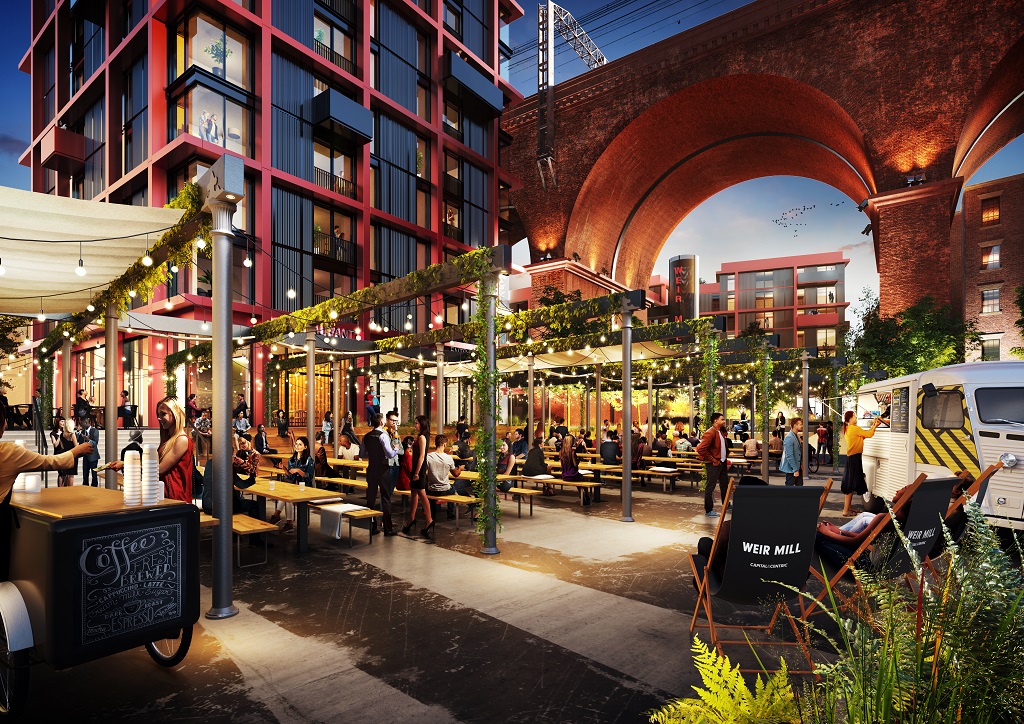
The vision for Capital&Centric’s Weir Mill in Stockport is for a bustling, independent-led commercial offer. Credit: Capital&Centric
Shutting up shop
Recent closures, like those of Greens and Evuna, have highlighted the severity of the situation facing smaller hospitality businesses and left the sector feeling uneasy.
Greens owner Simon Rimmer said the venture had become unviable due to an increase in rent. He said he was “heartbroken” to be closing the venue after 33 years.
January is a long month for hospitality businesses at the best of times as people focus more on their physical and financial health post-Christmas.
This, coupled with well-documented economic uncertainty, means more closures are likely in the coming weeks.
Sacha Lord, Greater Manchester’s nighttime economy advisor, described the demise of Greens and Evuna’s Didsbury and Altrincham outlets as worrying signs for the sector.
“The closure of these [restaurants] specifically is a stark example that even in regions of relatively high disposable income, the financial pressures on small businesses are simply no longer viable,” he said.
Constrained household budgets, even in relatively well-off areas like Altrincham and Didsbury, are putting the squeeze on hospitality as consumers tighten their belts, Lord explained.
And it is not just the suburbs that are being impacted, the city centre is not immune either. This week, Côte Brasserie announced it plans to close its Manchester restaurant. Black Dog Ballroom, a bar in the Northern Quarter, has also ceased trading.
“We’re now seeing the unfortunate damage that the turbulent economy in the past year has caused in real terms,” Lord said.
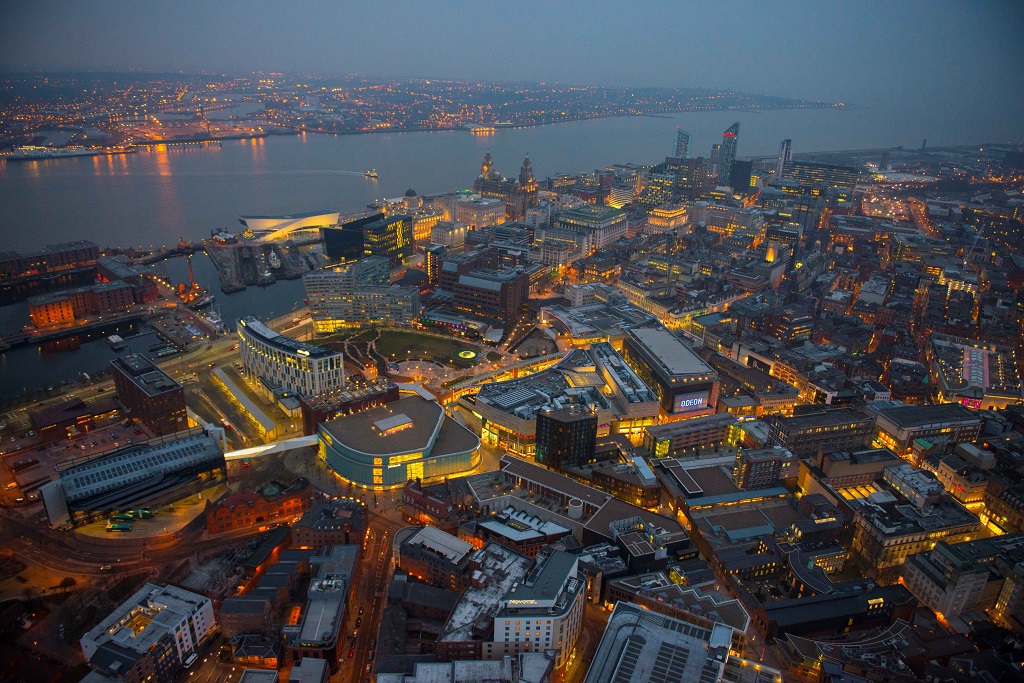
Liverpool ONE’s restaurants have been busier recently. Credit: via Aver PR
Is leisure the answer?
While there seems to be news of a restaurant closure every day, there is still a place for new operators brave enough to plunge themselves into a volatile market, according to Rob Deacon, asset management director at Liverpool ONE owner Grosvenor.
“Strong brands will prosper and have the opportunity to grow their portfolios as customers gravitate to the more relevant and appealing operators,” Deacon said.
“Equally, those that fail to evolve, or understand how consumer demand is changing, could face challenges.”
Grosvenor has proved adept at moving with the times. As the retail market has changed in the 15 years since Liverpool ONE opened, the asset manager has shifted away from shops and towards leisure and F&B.
A recent example of that saw Gravity MAX takeover a large chunk of the former Debenhams unit last year. Since the launch of the venue, footfall in Liverpool ONE is up overall and the complex’s restaurants are subsequently benefitting, according to Deacon.
“Following the opening of Gravity MAX’s flagship, sales on Liverpool ONE’s restaurant terrace, which is opposite Gravity MAX, rose by 9.6%,” he said.
Adapt or die
While being in close proximity to popular leisure outlets seems like a recipe for success, Davies believes that the most agile restaurants and bars will have a better chance of survival.
“The best operators are the ones learning to adapt in the face of adversity, from consolidating portfolios to introducing new concepts that fit social and dining trends,” he said.
It would be unfair to chalk the downfall of all independent hospitality businesses up to a failure to evolve and adapt. Many simply can’t afford to.
The biggest drains on funds for small hospitality businesses are the spiralling costs of staff, goods, and electricity, according to Jonny Heyes, co-founder of Manchester outfits Nell’s Pizza, Common, Beagle, and Port Street Beer House.
Faced with rising costs, traders have little option but to pass this on to customers, a make-or-break move that risks pushing them away.
“Although headline inflation is coming down that doesn’t mean things are getting cheaper,” he said.
“Passing our increasing costs on to our guests will always be a decision not taken lightly but it has to happen”, Hayes said.
“We have to have faith that our customers value what we do and want to come out.”
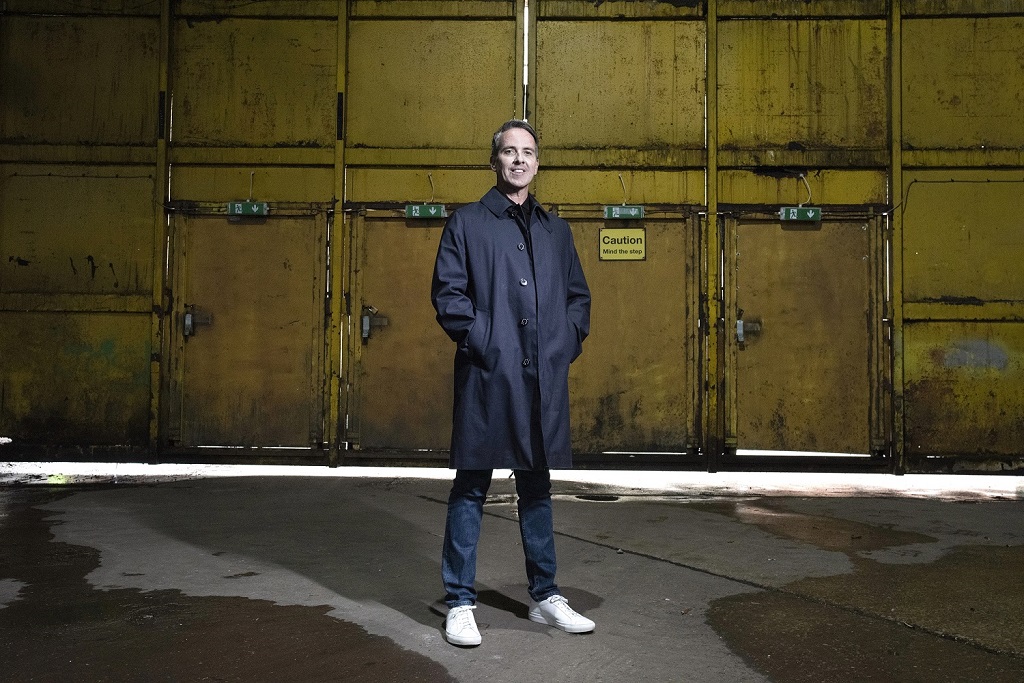
Sacha Lord is lobbying for a VAT cut. Credit: Greater Mancunians Project via Cubed Thinking
Sweet release
It is clear the hospitality industry needs help.
One way of relieving the pressure would be a reduction in VAT, something the industry has been calling for for a while.
UK food businesses pay 20% VAT, higher than the European average of around 15%, according to data from UK Hospitality, the sector’s trade body.
A reduction to 12.5% would result in additional sales of £7.7bn over the next decade, UKH claims.
Lord is leading the calls for that to be reduced to match European counterparts, while also asking for the government to investigate “crippling” energy contracts, and appoint a specific minister for hospitality.
Hayes is also backing calls for a preferential rate of VAT.
“It makes a lot of sense as leisure and retail will be the only game in town in terms of creating an experience in our town and city centres,” he said.
Cutting VAT would ease the pressure on hospitality and lower the stress levels of people like Hayes.
However, convincing a government of any colour that it is worth losing some of the £160bn revenue VAT brings in could be tricky, if not impossible.
The industry will be hoping the general election ushers in a brighter, more sustainable future.
But with months to wait before the polls open, it would come too late for many already circling the drain.