


Commentary
Curtins publishes latest embodied carbon data with key sector findings
Engineering consultancy, Curtins, has released data for 2025/26, reinforcing its commitment to transparency, collaboration, and accelerating low‑carbon design across the built environment.
Curtins’ embodied carbon database has data from more than 500 projects across varying design stages and sectors. The data shared provides a snapshot of upfront embodied carbon (A1-A5 Life Cycle Stages) for new-build projects at construction stage across key sectors.
By openly publishing this information, Curtins aims to support knowledge sharing, enable benchmarking and promote carbon reduction as a critical measure of project success.
Driving transparency to enable change
The dataset focuses on superstructure elements of new-build projects and uses industry-standard carbon factors, alongside Environmental Product Declarations (EPDs) where available. This consistent approach allows meaningful comparisons across sectors and helps build a stronger evidence base for reducing embodied carbon.
Niamh McCloskey, technical associate ofsustainability at Curtins, said“Sharing embodied carbon data is essential to driving meaningful change across the industry. By making our findings transparent, we’re enabling better understanding of embodied carbon, encouraging collaboration and supporting the adoption of lower-carbon solutions at scale.”
Sector performance highlights
The findings reveal a varied picture across sectors, with several outperforming industry benchmarks:
- Higher Education projects are leading performance, with an average of 128 kgCO₂e/m², significantly below the UK Net Zero Carbon Buildings Standard (UKNZCBS) 2030 target of 144 kgCO₂e/m²*
- Commercial offices and healthcare buildings are also performing strongly, averaging 196 kgCO₂e/m² and 212 kgCO₂e/m² respectively – both within their applicable UKNZCBS limits*
In education, results are more mixed:
- School projects averaged 150 kgCO₂e/m², below the Cf25 upper threshold but above more ambitious future targets
- Further Education showed higher embodied carbon at 288 kgCO₂e/m², highlighting an opportunity for further reduction
Meanwhile, residential projects averaged 245 kgCO₂e/m², exceeding the UKNZCBS 2030 target of 208 kgCO₂e/m² and signalling a key priority area for innovation and improvement.
*based on industry estimated % allowance for structural frame within whole target
Exceeding internal targets ahead of 2030
Curtins set its first embodied carbon reduction targets in 2022, aiming to reduce the average embodied carbon of its projects from 340 kgCO₂e/m² to 295 kgCO₂e/m² by 2030 (a 15% reduction). As of 2026, Curtins had achieved a reduction of 11%, outperforming the targeting trajectory.
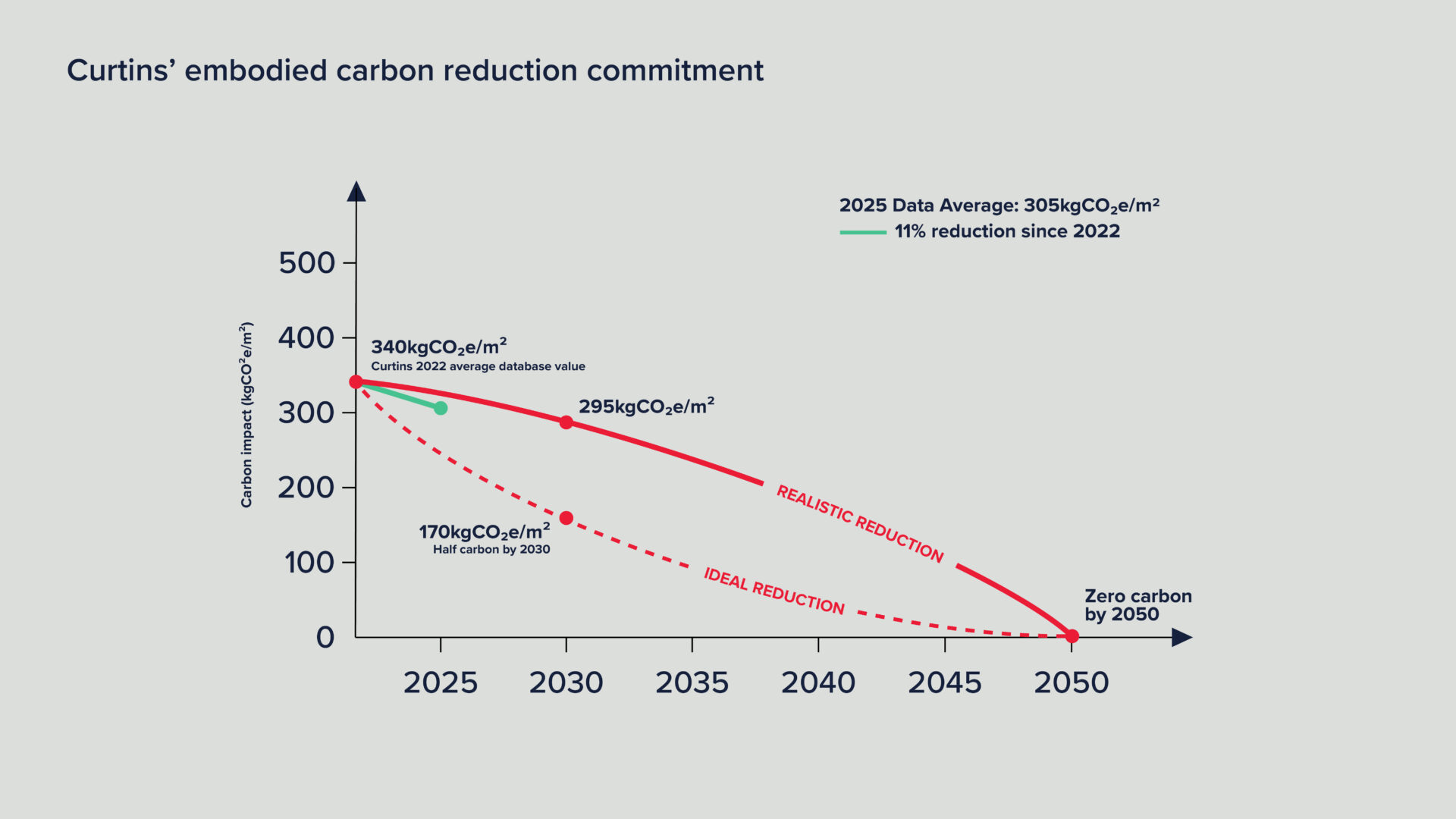
This progress reflects a combination of early-stage design influence, material efficiency and a growing emphasis on whole-life carbon assessment across projects.
A collective responsibility
Curtins emphasises that reducing embodied carbon is a shared challenge requiring action across the entire supply chain – from designers and engineers to contractors and manufacturers.
The firm became members of the Engineers Reuse Collective (tERC) earlier in the year – a not‑for‑profit group of practising engineers dedicated to mainstreaming material and structural reuse across the built environment, reducing embodied carbon and regenerative design practices while supporting the UK’s transition to net zero.
Alongside this, recognising there is a limit to the amount of carbon reduction which can be done without innovation to low carbon materials, Curtins has recently joined Innovate UK’s AMC for Low Carbon Concrete. An important step in delivering our sustainability commitments, accelerating the development and adoption of low‑carbon solutions and playing an active role in shaping the future of the industry.
As the built environment continues to focus on decarbonisation, Curtins’ latest data underscores both the progress being made and the work still required – particularly in high-impact sectors.
Through continued transparency and targeted action, Curtins aims to make a measurable impact on carbon reduction and support the transition to a more sustainable, resilient future.
To view Curtins’ carbon data results, go to https://www.curtins.com/carbon-data/
- Curtins is an independent engineering consultancy in the UK

Related Articles
Analysis - Event Summary
Energy and Power 2026 | Summary + gallery
Providing 50% of England’s renewable power and 40% of the UK’s electricity, the North is ready to write the nation’s next chapter in its energy future. To make that chapter as illustrious as it should be, Place North’s latest conference delved into the obstacles to be overcome, opportunities to be realised, and the work to be done.