



Report: HS2 gives reasons for Manchester station stance
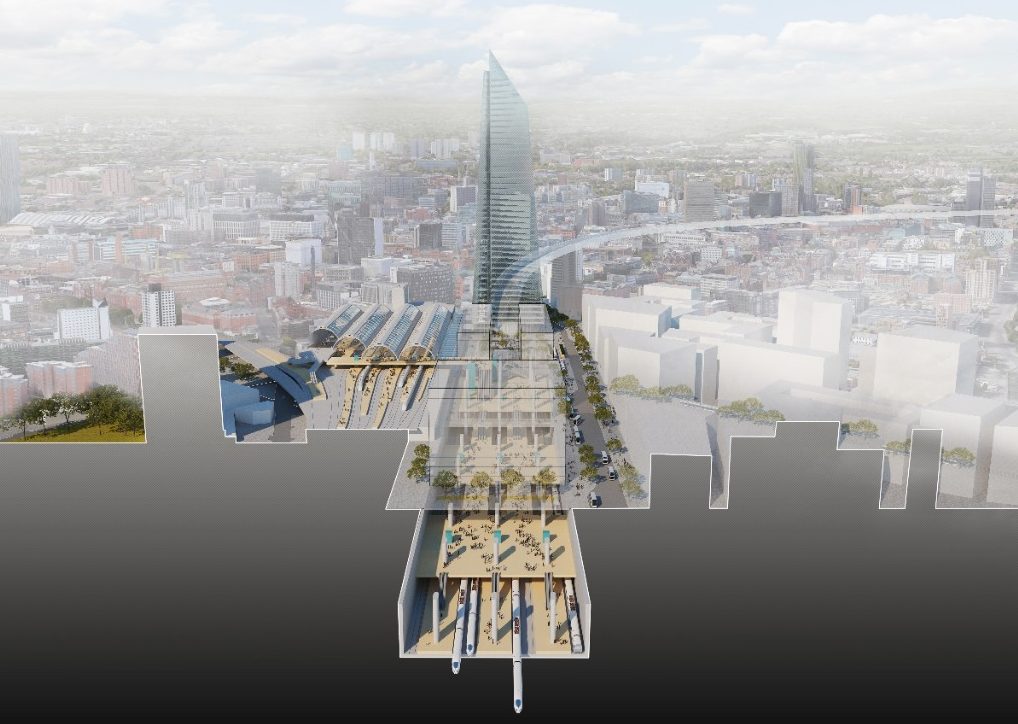
An underground station at Manchester Piccadilly would take up to 13 years longer to build and cost around £12bn, compared to £7bn for the existing above-ground proposal, according to a report.
Manchester City Council and Greater Manchester Mayor Andy Burnham have repeatedly called on the government to rethink its approach to the city’s HS2 station but Whitehall has been unyielding.
Manchester politicians and business leaders claim that pushing ahead with a surface-level station would significantly diminish the regeneration potential HS2 brings.
By changing tack on the station plan, Manchester City Council claims the local economy could benefit from £333m more a year than if the overground station goes ahead.
Read more about Manchester’s concerns over the current HS2 station plan.
In response to calls for a rethink, HS2 Ltd has this week published a report detailing why Manchester’s preferred option will not work.
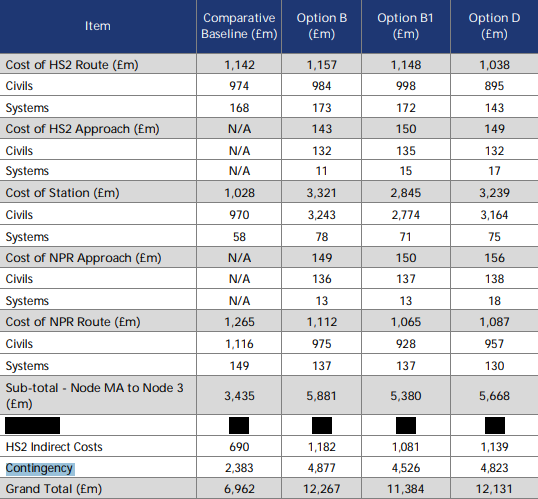
A breakdown of the comparative cost of the underground options. Credit: via report
Cost
Three underground models assessed by HS2 were found to be on average £5bn more expensive to deliver than the above-ground option.
The three options would cost £12.1bn, £12.3bn and £11.4bn, according to the report. The main additional cost is contingency.
The contingency rate attached to the existing proposal is 45.2%. The underground options are appraised at 66% “to reflect the conceptual nature of the designs and the lack of survey and design details”, according to the report.
In response to the findings, Cllr Bev Craig, leader of Manchester City Council, said the authority “remains convinced that an optimised design could deliver an underground station for considerably less”.
Construction time
If an underground station was to be delivered, it might not be ready until 2049, 13 years later than the estimated delivery date for the current plan, according to the report.
Estimated durations for each of the three underground options vary between seven and 13 years.
Safety
Up to 45,000 additional HGV journeys could be required to deliver an underground station, the report states, while two of the three underground options would pose “significant risk both in terms of safety and of damage to existing structures” due to the amount of mining required.
Those two options present construction challenges that would be “unprecedented in scale and nature in the UK”, according to the report.
The report concludes that the surface station remains HS2’s preferred option and that the underground comparators were all inferior on issues including construction feasibility, health and safety, cost, and schedule/delivery-into-service when compared to the existing proposal.
Council response
Craig said: “We are still looking at the detail of this report but it’s fair to say that while HS2 Ltd has shared its estimated cost for an underground station, they have not shared the basis on which this figure was arrived at.
“Even allowing for this, our case remains that it’s essential to look at the station’s value for money over its lifetime. The fact that it will deliver £333m a year more for our economy shows how much more beneficial an underground station would be for the city and the region’s economy. We would encourage HS2 Ltd and the government to take a longer term, more strategic view.”

They could afford to spend extra and over run on the Elizabeth line…
By Anonymous
Let’s be honest here, there’s more chance of it never raining again in Manchester than there is of an underground station getting built. The government are never going to spend that kind of money in the north.
By Manc Man
All fine and good luck to Manchester but there are other important major cities in the Northwest that also need HS2/HS3 as Manchester does not carry Liverpool ?
By Anonymous
Fine for Old Oak Common to get a no expense spared underground station but when Manchester asks for one suddenly cost is an issue. The surface level station would mean Liverpool to Leeds trains would have to switch back, and there would be little scope to increase capacity any further
By Disgruntled Goat
Please, please, please make the investment and go for the underground option and link it to Leeds! It will be worth every penny!
By MC
13 years longer because us Northerners don’t know our arse from our elbow apparently. What a load of old cobblers!
By Verticality
if Labour win the next election the underground station will get the nod and that is why Burnham is making all the noises about it now, Labour will not hesitate to bulk-up their flagship metro region.
By Anonymous
Would you believe anything this Government says – forget that the report is from HS2 – they are a puppet of the Department of Transport!!
And yes Liverpool, Leeds, Sheffield and other northern cities should get the world class rail infrastructure that is needed to strengthen the north’s economic competitiveness so don’t carp on about Manchester – we need to be united in our opposition to this rank awful Government
By Anonymous
The worst thing Theresa May did for us, when she became PM ,was sack George Osborne. He had genuine vision for the North. We lost our champion when he left politics. Since then everything regarding a clear plan, has been bitty and disappointing.
By Elephant
Would it be easier to build the HS2 station outside the City Centre and provide an short underground line similar to the City -Waterloo line in London to Piccadilly?
I am not a rail expert, could this be possible?
By Oh Mr Porter!
They delivered an underground through station directly adjacent to Paddington station for Crossrail. Sure the geological challenges may be different and HS2 is on a larger scale but it shows that the technical and logistical constraints of tunnelling and constructing a sub surface station box next to a 100+ year old main line train station are far from insurmountable on a congested city centre site.
By Paddington Bear
Get ready for the above ground station costing 12bn and in 2049 then
By hmmm
wont happen
By Anonymous
What about Liverpool?
By Anonymous
Compete white elephant. Scrap the whole thing. The world will have moved on by 2049
By Anonymous
One way of addressing the financial challenges might be for MCC to underwrite the contingency.
By Anonymous
We “need to be united” whenever it suits Manchester. The authorities actively worked against Liverpool’s efforts.
You got a detailed response to the platinum request. We got stonewalled for years over the basics, and had to rely on whistleblowers.
By Jeff
Don’t agree to HS2 coming to Manchester
By Alexander F.
What’s good enough for London is good enough for Manchester
By Percy B Shelley
quick honest question to all who currently have to use the present rail network, given the truly eye watering and frankly disgusting cost of rail travel , its essentially a tax on the regions to do business in “our capital ” what will be the cost of a HS2 Journey ?. I personally think its a complete waste of time and funding of local regional rail would be have the price and twice the benefit. Stuff London sort out Liverpool to Manchester and Leeds for example. We still have Pacer Diesels , from the 1960,s leveling up ?? i rest my case
By Paul M
Comparing a developed above-ground reasonably-developed design with an under-ground undeveloped design, then saying the former is cheaper because it requires less contingency is pure smoke and mirrors. Do more design work on the underground options, then you can assume a lower contingency percentage. Currently not comparing like-with-like
By SandM
“The underground options are appraised at 66% “to reflect the conceptual nature of the designs and the lack of survey and design details””
The numbers show it wouldn’t work because we fudged the numbers to show it wouldn’t work.
By ...
We will have flying trains in 100 years, this is a waste of money
By Anonymous
We don’t have pacers anymore, and they were from the 1980s.
You also have the Liverpool region to thank for those new trains, given that the region contributes two times the metropolitan train journeys, and four times the metropolitan train journeys per person, versus miss moneybags greater Manchester.
Northern isn’t exactly a profitable rail company, but it would a total basket case without Liverpool’s City Lines.
By Jeff
Funny how London gets all these underground stations and lines. Manchester wants 1 underground station and suddenly there’s no money and there are safety concerns. What a joke. Free the North! Northern Independence NOW.
By AR86
Absolute rubbish…London Johnies dictating to us in the North ..we’ll have our ‘levelling up’ built underground thank you 😡👍🏻
By Rodders
I’ve worked on HS2 in Birmingham. The project we were on should have been three months. Just left after 16 months. Doubtless the budget will be billions over, Manchester doesn’t have a chance of an underground station. If it was the other way round I bet London would make sure it happened.
By Anonymous
Paul M – Pacer trains were from the 80’s not 60’s …I doubt we have have 60 year old trains running on our network, all Pacers have gone now.
By Boom
@Paul M
I have also had this thought since inception that it will be eye watering for a season ticket.
This is a joke of a project with little benefit to the north. If they had any clue of the impact they would have gained trust by starting in the north
By JB
How many km of this high speed line have actually been built so far?.The answer is zero.Now years after it was first announced they still done nothing but make plans.In the same time period China has built thousands of km of high speed line.This is all about the transferring money to landowners along the route in so called compensation,it’s not a serious intention to actually build a new railway line.
By Anonymous
I’m not surprised by the report’s findings. Even before the watering down of HS2 Phase 2b and more importantly, NPR, the proposals did not properly address the horrible bottleneck that is Platforms 13 and 14 at Piccadilly. To all the Liverpool/Leeds readers, this is what the original idea of an underground station was about: proper transformational East-West connectivity with connection to HS2… not an upgraded terminus at Manchester which is what we’ve got now.
By Superhans
HS1, Crossrail, never ending upgrades to the underground, a load of new stations. But yeah spending over budget in the north is unthinkable
By Anonymous
And how much is Crossrail 2 going to cost? 40 billion. But that is in London so no problem.
By Perpetually enraged
Other major cities in the North use this money to connect them ? it’s not all about Manchester , we all wont to our cities grow not just one .
By Anonymous
HS2 is a total waste of money, destruction of 108 Ancient – Forests & Wildlife area’s, given the go ahead in a pandemic, where is the logical thinking in that ?
Energy bills gone up, if all that was put into Solar Farms with crops under, the consumer you & me would be far better off, do we all use a Fast Train in the UK to get us there 0.5 hours quicker, NO we don’t
No Logical Thinking in HS2 whatsoever from the start, & the public will keep on suffering for mistakes on that we will be paying for that in TAX’s etc & farmers will suffer etc the list goes on & on
By Philip D
It’s an absurd amount of money to knock ten minutes off the journey to and from London. The money would be far better spent improving journeys across the North West and into Yorkshire.
By Poorly Painted Person
HS2 is a project primarily to allow Londoners to get back to London before nightfall when the North is too scary for them.
If it was for Manchester, then there would be a connection for Eurostar to come to Manchester. If you want to get to Paris from Manchester after HS2 is built, it’ll be 250mph to London Euston, 4 mph walk for 15 minutes to Waterloo, dragging all your baggage, then 250mph to Paris. Is that a service for Mancunians? No, it’s all about London, and always will be. Unless HS2 means Eurostar to Manchester, it should be scrapped.
By Paul
Yeah gotta agree with most here for the money quoted manchester should pull out of this completely and focus on a proper network across the North hs railway won’t be that clever if it only runs to Birmingham and by the time it’s built and obviously hugely over budget transport will have moved on bin this white elephant and invest in infrastructure and issues in the North instead of lining the pockets of the powerful
By Jtothag
Labour spend that kind of money in Manchester? Oh no no no…that would never happen , no more than any other political party..just no evidence at all .
By Anonymous
Good that the work has actually started at last and demolition is beginning. Underground station would have been nice but hardly likely given where the purse strings are controlled. Manchester will consolidate and even grow its position as Northern capital in terms of economic power and jobs but so much more to be done if the billions are to spent wisely. There are many more Civil service jobs yet to find a home in the North and two and a half thousand should be just a start.
By No romanc
And the annoying thing is it wouldn’t matter one bit which political party was in power, the answer would be the same. Only help we’ve had for a while was George Osbourne because he actually represented this neck of the woods. The scouser who runs Manchester might eventually run for Labour leader, not holding my breath mind but you never know.
By Anonymous
Crossrail gets a blank cheque – ‘cos it’s London but HS2 cannot afford to implement a solution that not only makes for a better city – but will probably free up development plots for HS2 above ground. Their resolute determination to ignore a better solution illustrates that the “consultation” is a sham and it’s all been cooked up in advance by myopic gravy train engineers.
By Anonymous
Liverpool, Sheffield and Leeds will be royally screwed if an above ground shed is built in Manchester. If the already underground HS2 line continues underground to a through station then it can connect easily to the cities to the East and West for NPR without reversing trains and drivers running 300 meters from one end of a train to the other (no really that’s the current plan overground plan)… A simple look at those figures shows the madness of not building underground with the probably inflated 2000 mill extra figure paid back in 6 years. It’d be easier and quicker to build despite what they’ve said.
By Dr B
This county needs to plan for the long term and Manchester needs an underground HS2 station at Piccadilly so it can open up the key opportunity to run through trains to Leeds and other cities in the North. It could form the key hub station for HS3 in the future – an East – West link from Hull and York through to Liverpool and North Wales. If we were in France, Germany, Italy, this is what would be being planned. It might take longer, but in the decades to come it will be the wise investment, not just for the North but the whole prosperity of the country.
By Anonymous
I was wondering if this issue was raised at the conference at Manchester Central the other day.The case for a new faster line to Leeds with a stop at Rochdale/Oldham is strong and I think together with the ‘Atom Valley’ proposal from the Mayor that it would be hugely beneficial to the regeneration of North East G M’cr.
By Robert Fuller
Dear Manc Man, “Rainy Manchester” is a myth. Manchester is one of the driest cities in the UK and Europe.
By Anonymous
Another day, another argument about trains. The 5th biggest economy in the world cannot afford to link its three economic hubs without NIMBYS going on about the view from their kitchen window being spoilt.God what an embarrassing joke, this country has become.
By Elephant