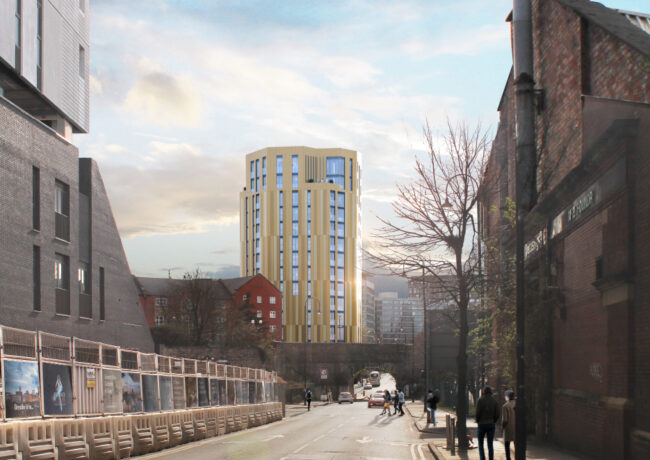
Distinctive gold block among Manchester schemes tipped for consent
Almost 600 apartments and a controversial 261-bedroom student development in Hulme are in line for permission when Manchester City Council’s planning committee meets next Tuesday.
The major projects that will be discussed at next week’s meeting are:
- Vita Group’s 485-apartment development on Port Street
- M1 Piccadilly’s 54-flat gold block on Store Street
- Curlew’s redevelopment of the former Gamecock pub on Boundary Lane into a 261-bedroom student complex.
Port Street
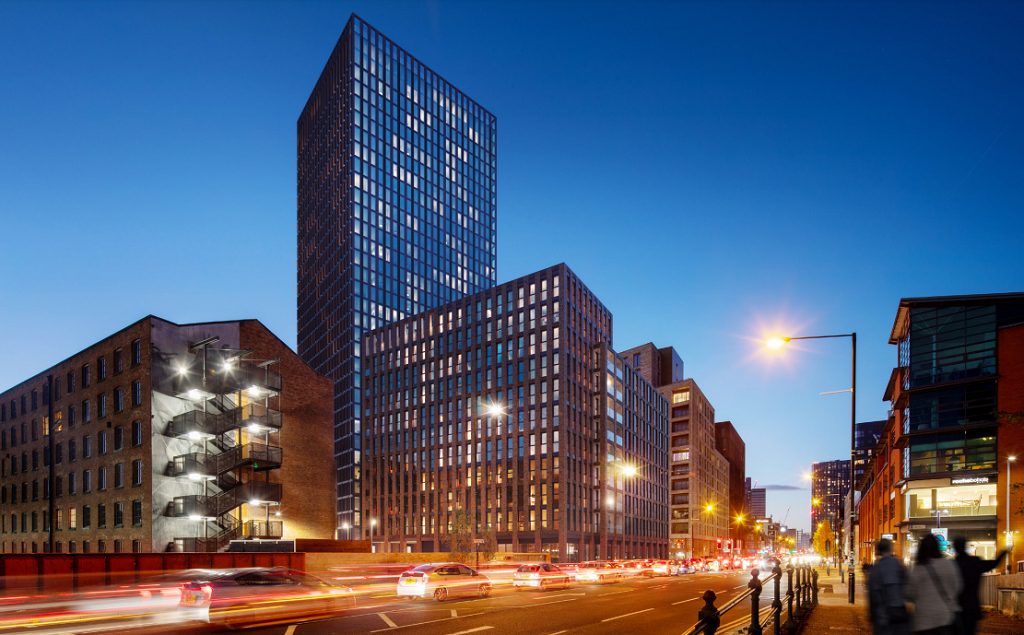
The scheme will reach 34 storeys at its tallest point. Credit: via planning documents
Developer: Affinity Living, part of Vita Group
Architect: SimpsonHaugh Architects
Planner: Deloitte Real Estate
Reaching 34 storeys at its tallest point, the scheme would see the delivery of 485 apartments on a site off Great Ancoats Street.
The apartments, to be operated under Vita’s Affinity Living brand, would be a mix of one-, two- and three-bedroom properties available for rent. The development would also feature co-working spaces, cinema rooms and a residents’ gym.
A viability report submitted to Manchester City Council estimates the project’s gross development value is £154.4m, reflecting a developer profit of 15%.
Following two rounds of public consultation on the scheme, the city council received 210 letters of objection raising concerns about issues including design and a lack of affordable homes.
Vita has offered an initial contribution of £1m towards offsite affordable housing, according to a report to the council’s planning committee.

Credit: via planning documents
The developer bought the Port Street site, currently used as a surface level car park, from Leeds-based Town Centre Securities.
The proposals aim to link Ancoats and Piccadilly Basin and have been guided by the design principles set out in the Piccadilly Basin Strategic Regeneration Framework.
Earlier stages of Piccadilly Basin’s regeneration featured the creation of the 160,000 sq ft Urban Exchange Retail Park, a 232-space multistorey car park on Tariff Street, and the Dakota Hotel on Ducie Street.
The project team also includes Re-form as landscape architect and Stephen Levrant Heritage Architecture.
Store Street
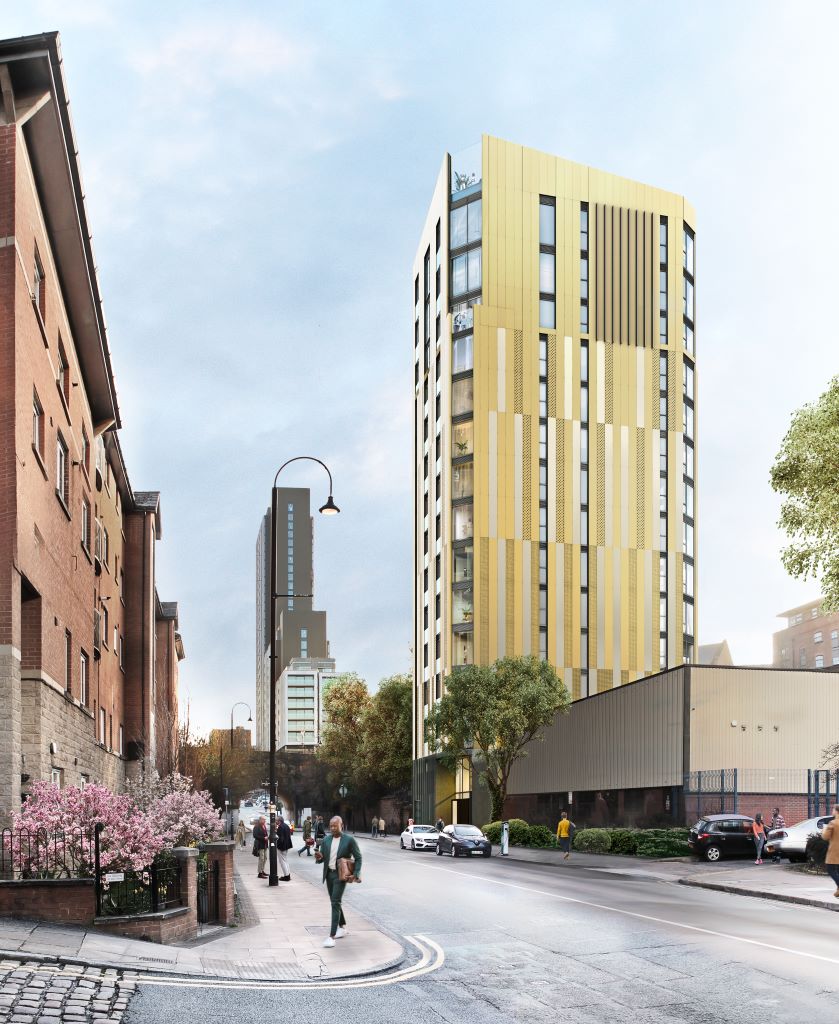
Credit: North Made Studio
Developer: M1 Piccadilly, part of LW Group
Architect: 5plus Architects
Planner: Zerum
The 15-storey scheme will provide 54 apartments on a site close to Property Alliance Group’s Oxygen on Store Street.
M1 Piccadilly’s project, which has a striking gold façade, features a cinema room, gaming room, covered terraces, residents’ lounge areas, and private office space.
A previous planning consent on the site secured by Westward Estates Developments lapsed in 2020. Westward’s proposal was a 13-storey block with 34 apartments designed by BDP.
LW bought the site following the expiry of Westward’s permission.
The project has a gross development value of £14.6m and will not provide any on-site affordable housing.
The developer has offered a £125,000 contribution towards off-site affordable housing.
Gamecock redevelopment

Manchester Central MP Lucy Powell has opposed the development. Credit: via Cratus
Developer: Curlew Opportunities
Architect: SimpsonHaugh Architects
Planner: Turley
The London real estate group’s development arm lodged plans for a 261-bedroom student accommodation block 12 months ago.
Under the plans, Curlew Opportunities wants to demolish the vacant Gamecock pub on Boundary Lane, south of Manchester city centre.
In its place, a 13-storey scheme designed by SimpsonHaugh would be built.
The development is to feature a community hub that could be used by residents of the wider Hulme community, according to the developer.
The Gamecock Community Hub would front Booth Street West and Boundary Lane and feature a gym as well as space for meetings, exercise classes, and community activities.
The prospect of Curlew’s development has angered some residents in neighbouring residential blocks Cooper House and Hopton Court.
A campaign to stop the project has been launched amid claims from residents that Manchester does not need more student accommodation and that the development would block sunlight to their gardens.
Lucy Powell, the MP for Manchester Central has also objected to the project.
However, a report by Manchester City Council’s planning officers said the project is “wholly consistent with planning policies for the site and would help realise regeneration benefits and meet demand for student accommodation in a sustainable location”.