




Commentary
Water: Liverpool City Region’s next development challenge
Within the last decade, flood risk assessments and drainage strategies have often been viewed as little more than planning requirements, something to tick off once a site layout has already been established writes Jake Busby of Curtins
While recent changes to legislation and planning policy are beginning to shift that mindset, there are still occasions where water management is treated as a problem to be dealt with later rather than a fundamental consideration from the outset.
That approach is becoming increasingly difficult to justify. Planning authorities, regulators, and other stakeholders are becoming wise to schemes where flood risk and drainage have been considered too late in the design process. In many cases, the result is avoidable redesign, delayed applications, or missed opportunities to create more resilient and attractive places.
We’ve Run Out of Easy Answers
The recent changes to the National Planning Policy Framework (NPPF) haven’t created these challenges, they’ve simply shone a brighter light on them. For developers looking to bring forward sites in the Liverpool City Region, water has always been a key consideration. It is now becoming much harder to leave those conversations until the final stages of design.
Demand for development across the city region shows little sign of slowing down, but the easy sites have largely gone. Former industrial land, waterfront locations, constrained urban sites and large strategic allocations each present their own flood risk and drainage challenges. Add to that the low-lying nature of areas such as Sefton and the proximity of Liverpool city centre and the northern and eastern coast of the Wirral to both the Mersey Estuary and the Irish Sea, and it is easy to see why water remains one of the defining considerations in how the region grows.
For many years, discussions around flood risk focused heavily on river flooding and Environment Agency flood zones. Whilst these remain important, some of the most challenging issues on development sites today come from surface water. The city region isn’t blessed with simple topography. From low-lying coastal areas to steeply sloping urban catchments and heavily constrained brownfield sites, every location brings its own challenges when balancing flood risk, drainage and the need for continued growth.
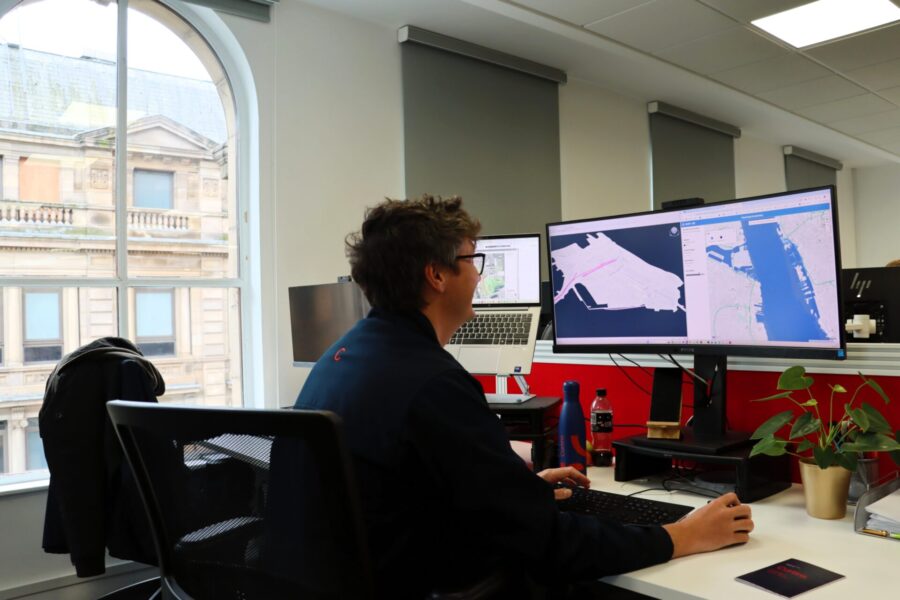
Jake Busby at work in Curtins’ Liverpool office.
A different way of thinking
Water still tends to be viewed as a constraint. That’s understandable, but it’s probably the wrong way of looking at it. Some of the best schemes Curtins has worked on used drainage and flood risk to influence the layout from day one, rather than treating them as problems to solve at the end.
All you need to do is look at the ongoing works at Liverpool Waters, or the proposals at Borough Road Yard in Birkenhead, to see that there is a way forward. Both sit alongside the Mersey and take different approaches to managing water as part of the development rather than treating it as an afterthought. New housing developments in Widnes and the continuing transformation of Festival Gardens provide further evidence of a region increasingly willing to work with flood risk and drainage, rather than simply work around it.
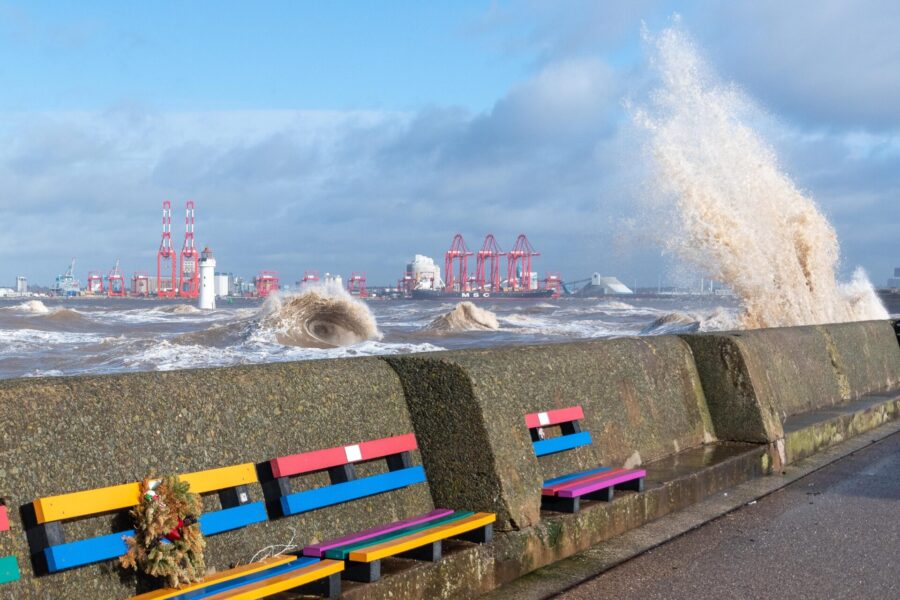
Liverpool’s waterfront highlights the importance of designing with water, rather than against it. Credit: Adobe Stock
Is resilience the answer?
The question is no longer simply whether a site floods. That’s the easy part.
The real questions are why it floods, how often it floods, what happens when it does, who is affected, where the water comes from, and how quickly the development can recover afterwards.
In many cases, a degree of flooding during extreme events may be unavoidable. The difference is whether a site has been designed with that reality in mind. Resilience is increasingly becoming just as important as prevention.
Some of the most successful regeneration projects in the region will embrace water as part of the design rather than treating it as something to hide underground.
Why wouldn’t they?
A region grown and shaped by water
The Liverpool City Region was built on its relationship with its river, yet for years the property industry’s response has largely been to move it underground as quickly as possible. As rainfall becomes more intense and pressure on drainage infrastructure increases, that approach feels increasingly outdated.
Designing with water rather than against it is not a new concept. It’s common sense.
Perhaps the strongest argument for designing with water comes from the fact we’re already spending time and money retrofitting sustainable drainage into existing developments and public spaces.
Across the Liverpool City Region, there is growing recognition that surface water flooding cannot always be solved by simply enlarging pipes and storage tanks. Instead, councils and infrastructure providers are increasingly looking at how water can be managed above ground through sustainable drainage features integrated into streets, public realm and operational sites.
If that’s where we’re heading for existing places, it seems logical that new developments should be getting ahead of the curve rather than following behind it.
This is particularly relevant in a city region that has set ambitious targets around growth, placemaking and environmental improvement. If managed effectively, sustainable drainage can contribute to all three objectives. Climate resilience is no longer a nice-to-have. Whether you’re a developer, local authority or future occupier, the question is increasingly the same: how will this place perform when the weather becomes less predictable?
The Liverpool City Region has always adapted to its relationship with water. From the docks that drove its growth to the regeneration projects that continue to reshape its waterfront and urban centres, water has influenced how the region develops.
As planning policy evolves and climate pressures increase, that relationship is becoming more important than ever.
- Jake Busby is associate civil engineer at Curtins

Related Articles

Analysis - Commentary
Cumbria’s next chapter: who gets to shape it?
As someone who has only worked within the English planning system for little over a year, I frequently find myself searching for the overarching ‘so what’ among a revolving door of speeches, proposals, draft programmes, and policy changes, writes Jasmine Whims of LUC.